Showing posts with label fitness tracker. Show all posts

Wednesday, 4 May 2016

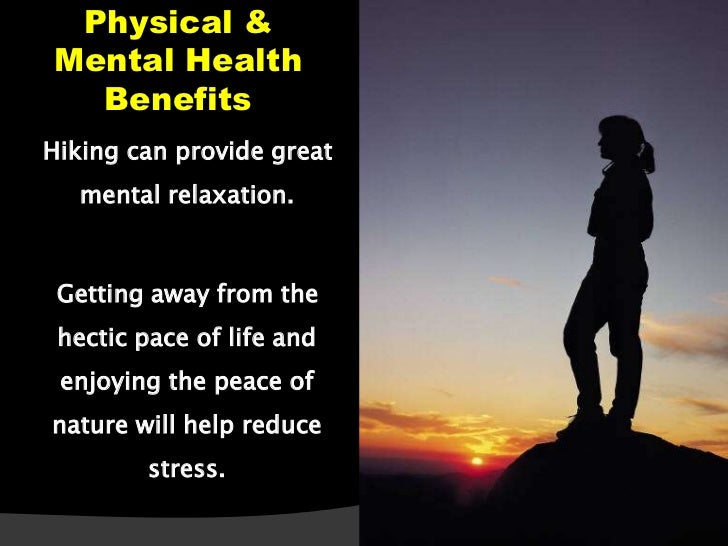
Hiking Truly Is Healthy

Hiking Truly Is Healthy
A fit body is a happy body, and one of the best ways to stay healthy is to get plenty of exercise. Hiking is an efficient way to increase your action level, while offering an excess of health benefits. Start gradually, especially if you are a bit out of shape. Invest in a sturdy pair of hiking boots and do your research first. Many hiking trails are evaluated by intensity, so get a hiking guide and start out at the level that is correct for you. Get your doctor's advice before hiking if you are pregnant or have any health issues, such as heart illness or even if you are diabetic.

Improves Your Overall Health
Hiking is an exceptional way to get outdoors and get some exercise. Hiking offers prosperity in overall health benefits and may help extend your life. Moderate-intensity aerobic exercise, including hiking at your own level, is safe for most people, according to the Centres for Illness Control and Prevention.

Lowers Your Risk of Cardiovascular Disease
Take a hike to help keep your cardiac system top shape. Regular exercise, such as hiking, helps raise your high-density lipoprotein levels and lower your triglyceride levels. This diminishes your risk of heart disease, high blood pressure and of having a stroke.

Helps Prevent and Control Diabetes
Consistent hiking helps you to control, and or even prevent diabetes by depressing your blood sugar levels. Hiking gives your muscles a workout, which transfers glucose from your bloodstream for energy. Talk to your doctor first as you may need your diabetes medications attuned when hiking frequently.

Increases Your Energy Level
Aerobic undertakings such as hiking bring in extra oxygen and fuel your muscles, organs and even body tissues. This additional oxygen provides an enhancement fuelled by a process called Glycolysis whereby energy is created when glucose is broken down and this strengthens your muscles and lungs, while increasing your stamina, attentiveness and energy level.

Lowers Your Cancer Risk
Hiking helps decline your odds of developing cancer cells. There is a lesser risk of breast cancer and colon cancer linked with regular physical exercise, and it may also drop your chances of acquiring lung cancer and endometrial cancer.

Source

Monday, 14 September 2015

Lower Body Workout Routine Options, Machines, Dumbbells or Body Weight?

Many women and men think taking up a lower body workout means heading off to the gym and chewing up hours each day. 

This doesn’t have to be the case. 
You can train effectively using the hints below at home, while travelling or even at work.

Developing a lower body workout routine that actually works for your body can be challenging. 

You may identify with some of the most common obstacles that ordinary people come across when they decide to start working this area of the body:
Limited access to weight machines and other equipment.
Lack of knowledge about what exercises are effective and which ones are a waste of time.
Limited information about different movements and modifications of harder movements.
Inaccurate beliefs.

Lack of motivation
Inaccurate beliefs and the lack of knowledge about what exercises to perform are big problems for many people who want to start a good lower body workout routine. One of the most common inaccurate beliefs is that you have to use weight machines or other fitness equipment to work the lower body effectively.

It's true that the machines you see at gyms can be great tools for working the lower body muscles. But that doesn't mean that they’re vital for getting in a great workout. Far from it. You can use the weight from your own body to strengthen, tone and challenge the muscles in your lower body.
Here is just a small sampling of classic exercises that can be incorporated into a lower body workout routine with great results:

Squats. 
Stand with your legs about shoulder width apart. Have your hands either out in front or folded in front of your chest. Have your toes pointed slightly outwards. Keep your chest out, your midsection firm and head facing frontwards. Now squat as if you were going to sit down, leaning into your heels, until your backside is inline or parallel to the floor. Then using your thighs and butt push yourself back up again. Do not lock your knees out when returning to standing position. Keep your knees soft and the movement flowing. Continue with the second squat, then third etc until you have completed the set.

Lunges. 
Stand with your feet together. Keep your chest out and midsection firm, do not arch your back. With your hands on your hips or by your sides, step forward with a large stride. Bend both your knees. Your front leg should be at a 90 degree angle (your knee and shin should be in a straight line with your ankle). Your back leg should be extended behind you and your knee should be nearly touching the floor. Now with your front foot push up carefully to starting position. Keep yourself steady throughout the exercise. After you have performed the required amount of reps on that leg, swap to the other leg.

Step-Ups, along with various floor and mat exercises.
With just these exercises alone you can create a lower body workout routine that is very effective for sculpting and shaping your legs, hips, butt and thighs. And of course there are modifications you can also implement for each of these movements.
For instance, you can do a variety of different types of squats to target different lower body muscles in different ways:

Sumo squats with your legs very wide apart, squats with legs placed together, single-legged squats that exhaust the muscles one side at a time. 

Including a wide variety of floor exercises that mimic the work done on larger weight machines can really work wonders for your thighs and butt. You may need to do more reps than you would do of a movement with weight machinesFree Reprint Articles, but a lower body workout routine using only body weight can be highly effective.

Those who don't want to add bulk to the thighs and butt are often better off working with very light weight or no weight at all with this area of the body.

Damian@FitnHealthy


Friday, 17 July 2015

GPS Watches Help Monitor Five Areas While Training

GPS watches help individuals monitor several things at the push of a button. GPS watches can help an individuals monitor speed, distance, pace and calories burned while training.

Just a decade ago runners and walkers would time workouts and them have to figure out how far they ran/walked. If you didn't know the distance of workout you may have to get in your car, drive the loop and hope your car measured the distance accurately. 

Many don't realize that often cars are not calibrated accurately. This could mean the workout is actually longer or shorter than expected sometimes by a tenth or more per mile. This could significantly affect the result of the workout. 

The individual then would have to calculate their pace per mile by dividing the total time run/walked by the distance covered. If you wanted to see how many calories you burned during the workout once again you have to spend time calculating your weight, distance, speed into calories burned. The individual then had to keep track of all the data somehow. 

With a GPS running watch the individual simply turns the watch on and is off to start the workout. The GPS watch times your run while calculating your pace, distance covered and your calories burned all while you are running. This information is helpful in keeping the individual running at the pace they should be training at. The individual knows instantly if they are running too fast, how far they have run to the tenth of a mile and total calories burned. 

GPS watches are especially useful when you run in an area you are not familiar with. The GPS tracks your every turn in the city or woods during your workout. If you become confused just follow the plotted map back the way you came. 
GPS watches also store the data for future viewing. One can look back to see how far they ran on a certain day, week or month. The Garmin Forerunner Personal Trainer let you download recorded courses and compete against previous workouts. The GPS watches need to be recharged. The battery life of a GPS watches is usually between 10-13 hours. With a battery life this long it means you get several workouts in before you have to recharge the watch. The data stored in the GPS watch is not lost even if you let the battery die.

GPS watches help the individual monitor speed, distance, pace and calories burned during a workout so you can train smarter, more effectively and enjoy the feedback of the latest technology!

Damian@FitnHealthy

Monday, 13 July 2015

5 Helpful Things to Do to Start Your Personal Fitness Program

The most common challenge that people I talk to face is how to incorporate fitness into their lives. They know they have to do something to get in shape but they really don’t know how. It can be discouraging because of the abundance of information out there......

The most common challenge that people I talk to face is how to incorporate fitness into their lives. They know they have to do something to get in shape but they really don’t know how. It can be discouraging because of the abundance of information out there. 

So much that you may not know where to begin.

Our society has so many food choices that it is easy to pack on the extra pounds. Also our day to day jobs are less physical as they where 100 years ago so we have more sedentary life styles. We know there are benefits involved when we exercise and cleaning up or diet. However, most of us know don’t know how or where to start. 

So where do we begin? Or is the question: How do we begin?

try these 5 things to help you get started:

Make the Choice to Start Exercising and Eating Right

Making the decision to do something provides a form of commitment you made to your self. Deciding that you need to change behavior creates new possibilities. 

When you say to your self “I need to get in shape”, it means something. 
You should be answering these questions in your mind: 

When can I work out? 
What exercises do I need to do? 
What foods should I be eating? 

Make your self think about the commitment you just made. Only then you can let go of the past and take steps to move forward. 

Write Down What You Do

You need a reference that is realistic towards your weekly activity. Write down everything you do during the week. This should include work hours, commuting hours, nights spent with your spouse, your child’s activities and anything else you can think of that you do. You should also include what you do on weekends. You should make a list for each day of the week. Here’s why….. 

Some people set lofty goals like working out for 2 hours a day. This can be due to an old saying, “More is Better”. However, this is not the case. 

Knowing your schedule will help you set realistic goals and help you find a few hours a week to start exercising. You’ll have a visual perspective on what you can and can’t do with your routine. 

Research and Get Information

Most people do not have enough information before they start a work out program. So how do we get the information we need? The good news is we live in the information age. Take advantage of your favorite search engine and learn a little bit about fitness and nutrition. However, do not go overboard and lose focus. Find a source of information you like and take notes. Find the simplest and easiest workouts and nutrition tips. Don’t over load yourself with information, take a look at our Home Workouts and look at circut training 

If you have the money, hire a personal trainer for a few sessions to help you get started. Hiring a personal trainer is a great way to get started because you have made a commitment to meet someone to workout. Your goal is to have the trainer show you the basics on exercise and eating healthier. It may also be safer to learn how to perform the exercises (especially if you have not exercised for a while).

Create a Simple Plan and Set Realistic Goals

Keep it Simple! Following a simple plan while on a hectic schedule is much easier than following an elaborate plan. You should have a plan of which days you want to work out and one goal to change your eating habits for the next few weeks. For example, “I will work out for a half an hour for 3 days this week. I will eat a little less each meal.” Simple is success. 

Execute Your Plan

Now that you have a plan, all you need to do is follow it. This is another big step. You should look at your plan every day upon waking. You need be mentally prepared for the great day ahead of you. Having your daily schedule in hand will help you achieve your goals for the day. When you complete your workout for the day, highlight it or cross it off your list. It will show you that you accomplished something for yourself. No matter what you must execute. This will be the hardest (and most rewarding) step. 

I hope these things help you get started on a new life of physical fitness. Life is filled with making decisions, knowing your commitments, getting information, planning and execution. 

Try these approaches for yourself and you will see that having your own workout and nutrition program is not as far fetched or complicated as you think .. If you need help reach out to us HERE 

Damian@FitnHealthy 


Saturday, 4 July 2015

Does Your Heart Rate Really Matter?


How would you feel if I told you that I would give you $100, give or take $200?
For years, this is not unlike what we’ve done with heart-rate training. Measuring exercise intensity using heart rate has suffered from two major problems:
  1. Using relatively inaccurate formulas to make specific exercise-intensity recommendations
  2. Attaching discrete, seemingly all-or-nothing objectives to various heart-rate ranges
The overreaction to these problems has taken the form of proposing that heart-rate training doesn’t matter when it comes to measuring exercise intensity, especially with the rise in popularity of high-intensity interval training, where the directive is a straightforward “go as hard as you can.”
Not everyone needs to use heart rate to measure intensity, as their goals may not be that specific or their starting health status may not be questionable enough to warrant needing a definitive intensity range to ensure safety when starting an exercise program. However, most people will benefit from having some accurate gauge of exercise intensity to help direct exercise efforts.

Age Ain’t Nothing But a Number…Until It Becomes a Bad Number

Using any formula that starts with age is problematic and introduces huge error ranges that are potentially as large as the training zones we are using. Any formula including any version of 220 – Age for maximum heart rate calculation is going to be a mess for the same reason that selling a single shoe size to everyone is going to be a problem. Not every 50-year-old has the same fitness level, and maximum heart rate is determined by more than just the number of years you have been alive.
Today, instead of having to rely on formulas, we have field tests that measure specific points where the physiological response to exercise intensity shifts. A recent study illustrates the unacceptable level of error when using a formula now that we have the field tests. The formulas get it right for some people, but get it wrong for enough people that if a better option is available, it should be the preferred choice.

Out With the Inaccurate, In With the…More Accurate

The field tests directly measure two critical heart-rate points for each individual. The first ventilatory threshold (VT1) occurs when intensity reaches the point where the fuel for activity is coming in equal parts from carbohydrate and fat. The second ventilatory threshold (VT2) occurs when the rate of accumulation of lactate in the muscles begins to exceed the ability of the circulatory system to recycle it.
Any time an individual works above resting heart rate, he or she is improving fitness (if deconditioned), and at least maintaining fitness (if already well-conditioned.) Beyond that, the two intensity shifts at VT1 and VT2 can help define more personalized training progressions because they are based on field tests of the individual’s response and not formulas. (Details of the field tests and expanded details surrounding VT1 and VT2 can be found in the ACE Personal Trainer Manual, 5th edition.)

Are You In the Zone?

Now for the second problem: Using heart ranges to define narrow training objectives like the “fat-burning zone,” or the “cardio training zone,” as if in one zone all you are doing is using fat exclusively and the other zone is the only place you find cardiovascular improvements.
Working above resting levels but below VT1 will improve fitness in deconditioned individuals and maintain it in those with an average baseline level of fitness. Working between VT1 and VT2 will maximize both caloric quality and caloric efficiency (explained in the next paragraph) in the interest of prioritizing a metabolic response during the exercise session. Working above VT2 will maximize increases in the ability to perform at a high level and prioritizes a metabolic response after the exercise session.
As many people now realize, the big problem with the fat-burning zone idea is that it emphasizes lower intensities because a higher proportion of the calories burned come from fat. But high-er doesn’t necessarily equal high. A large portion of a small number is still a small number. Working between VT1 and VT2 (which will be higher than the old fat-burning zones) maximizes caloric efficiency through intensity that is high enough to burn a relatively high number of calories, yet low enough to allow caloric quality, meaning a significant portion of calories come from fat. (Note: At VT1, the carb-fat mix for the fuel of activity is equal.) What does this mean? A significant amount of fat is burned during the exercise session and significant improvements in cardiovascular fitness are achieved.
Working above VT2 will generally result in shorter-duration workouts for those pursuing general fitness goals, as well as a higher portion of carbohydrates burned as the fuel source for exercise. However, at this intensity, the “after burn” effects begin to manifest and metabolism gets a slight boost while at rest, which is when the body shifts to using a higher portion of fat. Note that training above VT2 also requires a high degree of psychological commitment as well.

Surrounded by Fat-Burning Zones

As a result, both of these zones are really “fat-burning zones.” Between VT1 and VT2, you burn more fat during the exercise session. Above VT2, you burn more fat after the exercise session. Shortly after I first learned of these methods from an ACE exercise physiologist several years ago, I began using them with my clients and it enhanced my clients’ results by delivering more precise training-intensity recommendations, which yielded better results without an excessive investment of time for the clients.
Gone are the days where you need to know someone’s age to recommend heart-rate training intensities. This evolution of cardiovascular training intensity is a natural phenomenon in any field, as methods are altered as understanding grows.
 
Source Jonathan Ross | ACE 

Wednesday, 24 June 2015

The Exercise Afterburn Effect

The Afterburn Effect; Burn Calories While Doing Nothing!

What Is The Afterburn Effect?
- Exercise after-burn, also know as excess post-exercise oxygen consumption (EPOC), is when the body continues to burn calories after the exercise session is over. For example, let's say you go for early morning jog for 30 minutes. After you have finished the 30 minute jog, your body will continue to burn calories for the next 15 minutes to 48 hours! EPOC represents the amount of oxygen consumption needed to bring the body back to a pre-exercise state. The amount of calories burned from EPOC is directly related to exercise intensity and duration. The harder and longer you exercise, the more calories your burn via the exercise after-burn!

Exercise Intensity!
- Exercise intensity, according to all the studies conducted to date, is the most important determinant of the effect of EPOC. The harder and more intense you exercise, the greater the effect of EPOC is.
In a study published in the European Journal of Applied Physiology and Occupational Physiology, the effect of exercise intensity on EPOC was studied in 8 trained men and 8 trained women. The subjects were examined after completing 3 separate exercise bouts of different intensities. The intensities were 40%, 50%, and 70% of their VO2 maxes. Your VO2 max is the greatest amount of oxygen your body can take in and use for exercise. Your VO2 max is a good measure of your fitness level. The more oxygen you are able to use, the more energy you will be able to create, so the higher your VO2 max, the higher your fitness level is. 
 
So let us get back to the study. The study showed that the intensity levels had a great effect on the duration of EPOC. In both men and women, the effect of EPOC was greater as intensity increased. 

The study also showed that even low levels of exercise intensity still have a positive effect on EPOC. The results of the study were as follows:

- For the men
40% VO2 max - EPOC was 31.2 min;
50% VO2 max - EPOC was 42.1 min;
70% VO2 max - EPOC was 47.6 min

- For the Women
40% VO2 max - EPOC was 26.9 min;
50% VO2 max - EPOC was 35.6 min
70% VO2 max - EPOC was 39.1 min
In another study published in the Journal Of The American College Of Nutrition, the effects of low and high intensity exercise on calories burned during exercise and after exercise were studied in 8 active women, ages 22 to 31. Although both groups burned 500 calories, the effect of the exercise after-burn was much greater for the high intensity group (45 extra calories) versus the low intensity group (24 extra calories).

Effect Of Duration On EPOC!
Duration also has been shown to play a big role in the energy after-burn effect. In one study conducted in 1988 published in the Canadian Journal of Sports Science, subjects were divided into 3 groups.

Although all three groups exercised at 70% of their VO2 max, the duration was different for each group. One group exercised for 3o minutes, another group for 45 minutes, and the final group exercised for an hour. The results of the EPOC values of the studies were 33 calories lasting 128 minutes, 74.5 calories lasting 204 minutes, and 165 calories over 455 minutes for the durations of 30, 45 and 60 minutes, respectively. This study showed that increasing exercise duration has a great effect on EPOC.

 
In another similar study (1), 6 healthy male subjects exercises at 70% of their VO2 max for 80 minutes, 40 minutes, and 20 minutes. The results of EPOC were 55.5 calories, 73.5 calories, and 159.5 calories for 20 minutes, 40 minutes, and 80 minutes respectively.

There have also been studies that have combined high intensity exercise with longer durations.

There are more studies such as these that show similar effects of duration's effects on EPOC. In a study published in the European Journal of Applied Physiology and Occupational Physiology, 8 trained males performed 164 minutes of treadmill running at 70% of their VO2 max. The average EPOC effect was 162 calories, which is a significant contributor to overall energy expenditure.

So it's pretty simple then, right? Just exercise harder and longer and you'll burn more calories from the exercise after-burn! Unfortunately, that may not be entirely correct. There have been studies that show different exercise after-burn effects from exercise. Some studies showed a low EPOC effect after exercise of long and short duration even with high intensities. From all the research done, the effect of EPOC varies from person and person. It seems that many factors such as gender, age, fitness level, etc. may be playing a role in the effect of EPOC.

Interval Training!
If you really want to maximize your calories burned from the exercise after-burn, the I would highly recommend performing intermittent training, which is a form of interval training. Intermittent training consists of shorts bouts of all out exercise followed by a rest period. You would repeat this over and over throughout the course of the workout. The Fields Sprints workout video is an example of an interval training workout.

A study published in the Journal of Applied Psychology consisted of 8 males performing 20 1-minute intervals at 105% VO2 max with corresponding 2 minute rest periods between intervals. The same 8 males also performed 30 minutes of continuous exercise at 70% VO2 max to allow for comparisons. The results showed a significant increase in the EPOC effect for the interval training (75 calories) versus the continuous running (34.5 calories).

Resistance Training!
So we have pretty much covered everything about the exercise after-burn effect on cardiovascular exercise, but what about strength training?!

Although it is difficult to compare cardio to resistance training because of just the sheer difference of the type of workout and exercise intensity, there have been studies trying to compare them.
In a study published in the Journal of Applied Sport Science Research, the subjects were broken down into 3 groups. One group performed 40 minutes of cycling at 80% of their maximal heart rate. Another group performed 40 minutes of circuit training (50 percent of individuals' maximum lift [1 RM] x 15 repetitions x 4 sets) and the final group performed 40 minutes of heavy resistance lifting (80 to 90 percent of 1 RM x 3-8 repetitions x 3 sets). Heavy resistance training produced the greatest EPOC ( 53 calories) compared with circuit training (51 calories) and cycling (33.5 calories).
So what did we learn from all this? 

To exercise! More important than any of the details of the exercise afterburn is the exercise! Find something you enjoy doing and do it! Above all else, just make sure to exercise and be active. If you really want to maximize your training program and burn the most calories from the exercise after-burn response then I would recommend doing the following:
Tempo Training:Continuous aerobic exercise at a high intensity for half an hour to an hour.
Long, Slow Distance Training:Continuous aerobic exercise at a moderate intensity for an hour.
Split Training:2-4 high-intensity exercise bouts for a period of 15-25 minutes with a 5 minute rest in-between.

Continuous Interval Training:Alternating 3-minute bouts of low-intensity and high-intensity exercise for a period of 30-60 minutes. An example of this would be to walk for 3 minutes, then jog for 3 minutes, then walk for 3 minutes, etc. Or if you are in very good shape, you would jog for 3 minutes, sprint for 3 minutes, jog for 3 minutes, etc.

Supramaximal Interval Training:15-20 of really high intensity exercise (the hardest you can exercise) for a period of 1 minute, with 2- to 5-minute rest periods in-between.
Heavy Resistance Training:2-4 sets, 8-10 exercises, 3-8 reps of 80%-90% of your 1-rep max with 2- to 3-minute rest periods

 Source : Danny Maman

Monday, 22 June 2015

Getting Motivated With Physical Fitness

Most people would spend money to enroll in gym memberships or buy those fitness equipments only to quit as soon as they start. Either they are too busy that they couldn't find time to keep it going or they quickly lose their interest due to lack of motivation. It's easy to start a lifestyle of fitness.  What's difficult is how to be consistent with it.

Studies reveal that most Americans engage in physical fitness only once in a while.  Others don't even exercise at all. And yet, about a quarter are able to find time to go the gym and sweat it out to their heart's delight.  

How could they?
It's easy to start a lifestyle of fitness.  What's difficult is how to be consistent with it.  Most people would spend money to enroll in gym memberships or buy those fitness equipment only to quit as soon as they start. Either they are too busy that they could no longer find time to keep it going or they quickly lose their interest due to lack of motivation.

In order to stay motivated, try to set some fitness goals and write them on paper. Putting them down on paper gives them more weight than just saying things to yourself.  be specific and realistic with your goals.  Instead of telling yourself that “I will start working out in a gym next week and build some muscles,” try writing it down in paper as “I will start working out in a gym next week, 3 times a week, Monday...Wednesday...and Friday, after work.” Setting unrealistic goals may lead to disappointment and frustration.  Exercise can give you a healthier body and add a certain glow, but it won't catch you a lover or turn you into a celebrity or supermodel.

 Setting aside a specific regular time for your fitness regimen is important to keep your enthusiasm going. The number one reason why most people, especially women, don't exercise is because they're too busy doing things for other people: their spouse, their kids, their boss. 

Make a plan or schedule for all the little stumbling blocks that usually get in the way and incorporate your time for exercise into your daily routine. Be sure to follow it and stick to it. Biking to work or taking a walk to do errands make a great deal in adding physical activity to your lifestyle.


Treat exercise as a social event by joining a group or being with a workout buddy.  Camaraderie helps in keeping the spirits up. Make family time a lot of fun by playing catch or kick with your kids, or swimming together in a lake or pool. Routine variations help, such as working on several activities during the week will help develop different sets of muscles and skills. 

While athletes do this for cross-training, one doesn't have to be in training to enjoy the benefits of mixing different sports, such as running, biking, and swimming.

 When fatigue interferes with your desire to workout, something may be wrong with your eating habits. Eating small meals frequently throughout the day is much better than skipping a meal, say lunch, and  then eat a big dinner.  Starving yourself affects your brain and leads to fatigue.  

However, eating too much at once slows your metabolism and makes you feel sloppy. On the other hand, eating frequently keeps your blood sugar level constant and maintains your energy level up. High-protein and high-fiber foods such as nuts and fruit are a good snack to give yourself a boost.

Treat yourself with rewards whenever you complete a cycle of your schedule, say every month, buy yourself something to encourage you for your effort. Some experts suggest putting a small amount of money in a jar every time you work out. At the end of the year, use your collected cash to buy something just for you.

Being consistent helps you become motivated. And the more you exercise, the easier it gets. Building more strength helps muscles develop more mitochondria, the cell parts that turn sugar into energy. The more mitochondria you have, the harder you can exert yourself. You also increase the number of capillaries which helps the oxygen flow to your muscles to provide more energy.

As you continue being faithful with your schedule and goals, the changes may not be visible at once.  Most of these bodily changes are invisible but they are happening and are important in laying the groundwork for a strong, healthy physique. As the cliche goes, “no pain, no gain.” Stick to it and you will soon realize that everything will fall into its proper places.

Damian@ufitnhealthy

Saturday, 16 May 2015

Does the Fitbit Work ?

Does the Fitbit Work and Why to Buy One!

There are loads of reviews out there that you can Google but does the Fitbit work? Well that really depends 100% on you. Sometimes you have to make an investment in order to get the benefit, and this is the case with the Fitbit. Surprising gadgets that can help improve our lifestyle arrive every day due to the constant advances in technology...and so along the way some of these can help our frugal ideals.
 

So what is the Fitbit? The device was first launched in 2008 and then later there was an improved version in 2011. In short it is a wireless device that tracks your activity metrics and sleep patterns. How exactly does the Fitbit work, well it contains a 3D motion sensor similar to a Wii remote. A wireless USB docking station automatically uploads your data to the Fitbit website. Daily progress can be checked at any time either via the display on the device or by logging onto the website. In addition there are also apps for the iPAD and Smart Phones so you have no excuse for not having the latest data at your fingertips. The Fitbit is small and discrete and you just clip it onto your belt or shirt. At night it slips into a soft wrist band. Start using it and you will be amazed at what it can show you about your lifestyle and activity levels.

 Does the Fitbit work, well the device only provides you with data in a consistent way each day. However, even if the data is not 100% accurate you can measure your progress since it is always measured in the same way. After that it is really up to you to unlock the potential....no device can actually magically make you fit without any effort!

Get More Sleep:
Without doubt most of us really have no idea just how much sleep we are getting or how well we really slept during the night. Does the Fitbit work to help you get more sleep? It can't make you sleep but it does act as an eyeopener to see the graph of how many times you woke up during the night. For example the second time I used it it showed that I had woken 11 times when I thought that I had only woken up once! By tracking the actual hours you sleep you can then make sure that you get to bed on time, have a nap during the day or use the weekend to catch up on your sleep deficit.

5 Good Reasons to Buy a Fitbit:
Lets look at how the Fitbit can potentially improve your lifestyle and perhaps save you money at the same time:

* Better Sleep: It tracks your sleep and makes you aware of your sleep patterns. You can learn from this and make sure you get enough sleep. The immediate impact is that you will have more energy and be more efficient€¦longer term your health should improve since many conditions are related to sleep deficit.

* Higher Activity Level: The more active you are the more calories you burn, the fitter you get and you are more likely to be able to keep your weight under control and within healthy limits. The more energy you have the more things you can fit into the day!

* Improved Fitness: The Fitbit makes you aware of your activity level so you automatically start moving around more€¦and this will improve you general level of fitness. And with improved fitness there is normally an improvement in overall health€¦providing you are also eating and sleeping correctly. So really you can see why this is a lifestyle choice.

* Awareness: By being aware of your activity level you can make the choice do something about it. You can sit at your desk all day at work or you can make sure that you get up and walk around. Stand up when you are on the phone€¦.go and see that person in accounts and talk face to face€¦start using the toilet on the next floor so that you can walk further!

* Save Money: And the bottom line is that if you are fitter you will tend to adopt a more healthy lifestyle which will save money on food. Can you ditch the gym membership as well? That depends on your level of motivation€¦it is really difficult to keep up a regular exercise routine on your own without going to a gym€¦and this is where the Fitbit could just tip the balance.

Does the Fitbit work and can it help you achieve your objectives? It does what it says on the box and the rest is up to you!

Source Richard Shield |Go

Sunday, 3 May 2015

Motivating Yourself To Exercise..

Tips That Will Make the Difference!

We are told that exercise is good for us. But motivating yourself to exercise is more difficult. Many times we have the best intentions, but something else always seems to get in the way.
And we may not feel that getting physically fit is really all that much fun. Do you know why that is?  It actually is very simple, we tend to do things we don't do normally. So here are some tips that can really change things for you.

 Before we get started we need to understand what motivates us. Do you want to look better? Feel better? Or is someone or something else encouraging you to go to the gym. Is it your health? Regardless of the reason, enjoying something about exercising will help increase motivation.
 
If you are competitive, you might like to set goals between yourself and others. However, it is important to set goals that are not unrealistic. We are more motivated when we can feel competent. Doing something that is challenging but attainable is important.

If you are social, you might like to take a class with other people. When we see that we are not alone or that others are doing something difficult, we are more likely to feel that we can also do it.  Also, sometimes if you don't like to run on track for example, and enjoy outdoors more, why not run somewhere in nearby park.

We also must be careful not to undermine our motivation. How many people do you know who accomplished an exercise goal and then "rewarded" themselves with a less-than-healthy food item? Often when people do this, they end up feeling guilty. This can quash their desire to exercise again. If you wish to give yourself a reward, it is important to choose one that will support your goal and your desire to keep exercising.

Remember to set yourself up for success. If you are not a morning person, don't attempt to exercise in the morning. You will essentially be trying to motivate yourself to not only get up to exercise but also to get up when your body does not want to.
 
Motivating yourself to exercise, is a lot easier if you decide to do what you like to do, instead of doing what you hate to do.  It is as simple as that. Also, some people don't understand that you can workout even when it does not feel like working out, but you can easily burn 500 calories.  For example, if you rake leaves in your backyard, you are doing something around the house and you can easily burn 400-700 calories.

However, eating fat burning foods makes all the difference between staying overweight or losing those extra pounds. If you eat four meals every day, but each day you eat different food and you get exercise plan which anyone can do, you can look the way you really want to. The best part, your metabolism does not even know you are on diet, and you still lose weight. People, who are skeptic, can even get a free metabolism booster guide and see how it works for them.

Written By Ivonna Boss Combo's Lim 
   

Friday, 1 May 2015

Keep Your Brain Buff

Exercise and the BrainMost people know that exercise is good for the brain, but to know why that's important you need answers to two critical questions: 
  • What makes the brain succumb to diseases like Alzheimer’s and Parkinson’s?
  • What is the best type of exercise to maximize the brain benefits?
Major degenerative diseases in the brain are all caused by one thing – mitochondrial decay in the brain.  Scientists classify degenerative brain diseases differently based on their symptoms and which region of the brain region they affect, but they all have the same cause.  Why is this a good thing?  Because it means that what‘s good for preventing one disease is also good for preventing others.  And because the primary factors for determining your susceptibility to brain disease is not genetics.
Mitochondrial decay causes brain disease, and which one you get depends on where you experience decay.  If it dominates in the hippocampus, you get Alzheimer’s.  If it dominates in the substantia nigra, you get Parkinson’s. 
And surprisingly, genetics is not your biggest determining factor.  Even if you have a defective gene, something in the environment has to activate it.  Michael J. Fox’s Parkinson’s was considered genetic until three other people who worked at the same Canadian TV studio in the 1970s also developed it. 
Brain Damage
Your brain uses 20% of the calories you consume.  As a result, it has a large number of mitochondria and experiences a by-product of energy production called free-radical production.  Free-radical injury to the mitochondria progressively reduces its ability make ATP.
The worst damage to proteins occurs at the inner membrane of the mitochondrion.  In harnessing the light (all food is essentially light turned into edible form) to give us energy, the mitochondria inevitability suffer damage by free radicals.
These are the four main processes of mitochondrial decay:
  • Decline in energy supply, mostly from free-radical damage to the mitochondrial membrane
  • Cumulative free-radical damage to lipids and proteins inside the cell, which turns them rancid
  • Chronic inflammation in the brain, caused by free-radical driven overexpression of the inflammatory cascade
  • Free-radical damage to mitochondrial DNA, which destroys bits of genetic code
What Can You Do About It?
Protecting your mitochondria is your best chance at preventing brain decay. Here are three main methods you can use:
  • Take mitochondrial antioxidants
  • Eat aromatic spices
  • Manage chronic inflammation
To prevent oxidative stress to mitochondria, which has been associated with Alzheimer’s and several other diseases, look into mitochondrial antioxidants. Lipoic acid, glutathione, acetyl-carnitine, CDP choline, green tea and Vitamins A, C and E can protect your brain. The list of all mitochondrial antioxidants is too extensive to list completely.
Aromatic spices such as turmeric, cinnamon, ginger, cloves and red pepper (cayenne) are all strong anti-inflammatories.  And of course, managing stress plays a large role in managing inflammation.  Most modern stressors don’t require a physical response.  Instead of fight-or-flight, it’s stew-and-chew.  We stress over our retirement, our kids’ schooling, our careers, traffic – none of which requires a physical response.  But the brain doesn’t know this – it interprets stress as a fight-or-flight event, so we often end up eating more when stressed. The downside of that is stress hormones that get pumped out never get used up by physical activity – that’s where exercise comes in!
Keeping your brain buff doesn’t just mean exercising; it means participating in the right type of exercise, which means more than just walking.  Physical activity boosts a protein (BDNF or brain-derived neurotrophic factor) that protects neurons from damage.  If we have enough BDNF flowing around our brains, we can handle any amount of stress.
Greenough worked on an experiment in which running rats were compared to others that were taught complex motor skills, such as walking across balance beams, unstable objects, and elastic rope ladders.  After two weeks of training, the acrobatic rats had a 35% increase of BDNF in the cerebellum, whereas running rats had none. 
The point is that your workout regimen has to include skill acquisition and aerobic exercise.
Essentially, exercise has to stimulate the senses, engage you and perhaps be a little bit “scary.”  Use simple math problems during exercises (even goes left, odd goes right, etc.), bounce a tennis ball around or kick a pebble back and forth while going for a walk, use random patterns with medicine ball tosses – the ideas are limitless.  Insert some skill acquisition and cognitive processing into exercise and you’ll greatly enhance the brain benefits, and get the brain one step closer to buff!

Source Johnathan Ross /Ace
 

Friday, 17 April 2015

Developing A Workout Routine

If you are focusing on improving your health by losing weight and getting fit, one healthy habit you should not overlook (aside from improving your nutrition) is developing a workout routine.
Naturally this can be a bit awkward especially when starting out for the first couple months. It takes a considerable amount of effort to remove yourself from the couch or bed and get that body moving again. For many, it will be a slow process as your legs, arms, and body get used to exercising.
However once you make it past that initial stage and are able to exercise for 30 minutes to an hour, you've crossed the first and most difficult hurdle. Now the fun can really begin!
The Importance of Developing A Workout Routine

 
  The next item of business is figuring out exactly which activities you want to continue doing on a weekly basis which is why developing a workout routine can really help.
One important point to remember in regards to exercise is that you don't want feelings of boredom to creep in. These thoughts can fester leading you to slowly give up this healthy habit and that's the last thing you want to happen.

This can be compared to the types of foods you eat. It would become extremely boring to eat the same meal each and every day. Who would want to eat in this manner unless you absolutely had no other option?
You should consider exercise in the same way. Doing the same workout day after day may be fine for a couple of months but eventually you may get bored with this routine. Granted this is not true for everyone, and if you are able to run the same course 4-5 times per week month after month, then by all means stick with that.

However for those of you who like change and want to have a diversified portfolio of workouts, then creating a workout routine can really help keep you motivated and focused.
Naturally before you can create a workout routine, you need to not only have some options, but also the abilities to do the activities safely and properly. That's not to say you can't try out something new like a sport or activity you've always wanted to learn. If that's the case just be sure you get someone who is qualified to teach you how to do the activity properly.

Personally, my workout routine has grown immensely over the past two years. When I first started exercising, the only activity I did was walking - four times a week for about an hour at a time.
Sure that doesn't sound all too exciting, but my 300 pound self at the time could only handle that amount of activity safely.

After a couple of months, walking turned into hiking, then a couple of months later into jogging. Once I was able to run for an hour without feeling completely drained afterwards, I knew I had developed a newfound endurance and energy level I had not enjoyed in over a decade.
Over the past year I have experimented with a number of different activities. I started playing tennis again, attending a local Bootcamp class, biking with my dog, snowboarding regularly during the winter, a gym membership to my local LA Fitness, and even did the Insanity at-home workout program to see what that was like.
 
  These days I have a consistent workout routine that I usually stick with week after week. Monday and Wednesday is Bootcamp class, Tuesday and Thursday is tennis, and I usually either run or bike my dog on Friday and on one of the weekend days.

Maintaining this diverse workout routine keeps me motivated to stick with my plan every week. Best yet, I never go more than two days in a row without some type of exercise.
If you have had issues sticking with a consistent fitness routine, developing a workout routine so you can regularly exercise which will not only get you into better shape but you'll lose weight too! The best of both worlds.

Source Gregory L. Gomez

Wednesday, 7 January 2015

Will The Popular Running Apps Get You Ready to Run?

With the new partnership between ACE and the Women’s Running Series, it is a good time to review and comment on some of the more popular and well-known running apps. It seems that I get an email every month from a fitness technology company touting a new running app. So, what do I look for in a running app? Are they really all that different? Most share the standard features and have millions of dedicated users. Check out my thoughts below, then tweet me your favorite running app and why.

RunKeeper – Free (with paid upgrade available)

RunKeeper is a popular Boston-based running app available in eight different languages. One of the first running apps, RunKeeper has a dedicated following of more than 20 million users. The app has an easy user interface that tracks stats like pace, distance and time. Add a sensor and monitor heart rate as well. It also comes with a goal-setting option and, if you need that extra motivation, a coach in your headphone with built-in audio cues. One of the features of the paid app provides live tracking, but use with caution. While your friends can track and see where you are on a map, so can others.

MapMyRun – Free (with paid upgrade available)

With the tag line “You pound the pavement, we provide the motivation. Plan each stride and learn from every route,” how can you not want to at least try MapMyRun. By using the built-in GPS on your mobile phone, MapMyRun will track your duration, distance, space, speed, elevation, route and calories burned (if you preset your body weight) on an interactive online map. On a business trip in Cleveland and looking for a place to run? Check out the thousands of training maps created by users just like you. (By the way, Cleveland has 5,382 routes and 350 courses.) You can even find a local running group with which to tag along. The paid MVP in app purchase is even smart enough to plan your route; you just tell the app how far you want to run and it finds the route for you.

Nike+ - Free

You don’t need to run in a pair of Nikes to use their app (but I am sure they’d like you to). Gone are the days of the sensor in your shoe—now all you need is your mobile phone and the Nike+ app. In addition to the standard tracking features of time, distance and pace, the app converts your runs into a Nike Fuel score, so you can challenge your non-running training partners to keep up with your pace. One of my favorite features of Nike+ is the live cheering option. Have you ever been on a 10K and needed just a little extra push? Use this app, share your run to Facebook or Path and when anyone likes your mile postings, you will hear a cheer in your headphones. My brother ran the DC marathon a few years ago, and I tracked his progress and cheered along the way, even though I was 5,000 miles away. Same caution of live sharing as mentioned in RunKeeper.

Zombie Run - $1.99 and up

What if you could make a game out of your runs? Now you can with Zombie Run.
Thousands of runners experience an “epic adventure” during their run that motivates them to run faster and farther than ever before. I know I’d run faster to avoid being eaten by a zombie. New to running and want to train for that upcoming 5K in a few months? They have a sister app with an eight-week training program. Zombie Run takes your own music and combines it with an action-packed game while you burn those calories. (And there is no truth to the rumor that Zombies don’t like McDonalds and that if you stop for a snack, they will track you down.)

Strava – Free (with paid upgrade available)

Designed originally for athletes, Strava takes social fitness to a new level. What if your training partner can’t sneak away from the office at lunch for your team run? Or perhaps you’ve moved to a new city? Use Strava and get back that sense of camaraderie and friendly competition that drove you to achieve your best when training with others. The free version allows for unlimited activities per month with detailed maps and activity analysis. You can challenge friends through virtual challenges and watch their progress. The premium version for $59 a year includes progress and performance goals, leaderboards and additional analysis features.
People use running apps for all sorts of reasons. Some use the app to track milestones, others to brag to their friends about their personal best. No matter the reason, if you get that extra motivation to exercise from technology, it gets two thumbs up in my book. So the next time you run around the block, consider trying one of the many running apps. Like I say “… an app a day keeps the doctor away.”

Note: Extended use of GPS available in many running apps will drain your battery.

Source : Ted Vickey, M.S., is the Senior Consultant - Fitness Technology for ACE