Showing posts with label Personal Training. Show all posts

Friday, 19 February 2016

Fitness Programs for Women: Four Essential Tips

Fitness programs for women are often wrought with bad advice and pseudoscience. It's no wonder that so many fitness programs for women utterly fail! There's plenty of great information out there, but it can be impossible to find amidst the gimmicks, fad diets, and ineffective workout routines. If you're looking for fitness programs for women that really work, try using the four following tips.

1. Lift Heavy Weights
Plenty of women make their way into the weight room now and again, but most are afraid that they'll get "bulky" if they lift too heavy. That's nonsense! It takes male bodybuilders years of dedicated effort to pack on muscle mass, and they've got testosterone and tons of food on their side. Not only will you not get "too big" by lifting challenging weights - you'll actually look better.
Lifts like squats, bench presses, deadlifts, and other heavy movements are great for stimulating your metabolism and packing on a little bit of lean mass. Whether or not you realize it, that's really what you want! The right amount of muscle gives you a lean, fit look that you simply can't achieve with cardio alone. Challenging yourself in the gym will also cause you to burn more calories, which means you get to eat more and still lose weight.
2. Low Fat is NOT Healthy!
Some nutritionists are still stuck in the 1980s' low-fat craze, but avoiding dietary fat is NOT going to get you the results you want. In fact, most "low-fat" products like crackers, pretzels, and other grain-based products will make it nearly impossible to get lean! They make your blood sugar levels skyrocket, which in turn causes your body to secrete tons of insulin - a hormone which actually makes your body store even more fat. If you're trying to get lean, ditch most of your carbs and eat plenty of olive oil, avocados, nuts, and even some red meat.
3. Ease Up on the Cardio
If you're going to start lifting heavy weights (which you should!), then you're also going to need to ease up on all of that cardio you're probably doing. Slaving away on a treadmill or elliptical is simply not necessary, and it eats up way too much of your time. It's great to do a few short sessions per week for your cardiovascular health, but hours upon hours of monotonous movement aren't going to help you lose fat.
However, there is a much better type of cardio for optimal fat loss: interval training! On a track, treadmill, elliptical, or exercise bike, simply alternate short bursts of all-out sprinting with longer bouts of active rest. For example, you might do eight rounds of fifteen-second sprints and forty-five second "jogs" on an elliptical machine. The whole thing will be over in under ten minutes, but the intensity of the workout will cause your body to burn more fat all day long.
4. Don't Under-eat
One of the worst things you can do in fitness programs for women is to eat too little. Your body is an adaptive machine, and it will respond to severe calorie restriction by slowing its metabolism way down. Have you ever noticed how lethargic, tired, and cold you get when you don't eat enough? Those are sure signs that your body is burning less fuel!
That's not to say that you shouldn't cut calories at all - your body does need a reason to use its fat stores for energy instead of your food. The key is to eat just little enough that you can burn fat while avoiding hunger. Focus first on the right food choices, and then start counting calories if you truly need to. Overall, it's best to take it slow and steady with your fitness programs for women and focus on losing no more than a pound per week.

Wednesday, 17 February 2016

Make Your Gym Sessions More Productive And Comfortable In The Right Gym Shoes

Getting a gym membership can be exciting whether you are looking forward to losing weight and shaping up, building muscles or simply getting fit. Whatever your reasons for going for some gym activities, you ought to remember that the shoes you select can have effects on how comfortable and productive you remain. A good gym shoe is one that does not keep reminding you that you are wearing it probably because it is too hot, too tight too heavy or because it pinches. You need to choose the right shoe to make sure that you give maximum concentration on  the gym workout.

Grip – This is very important especially when you are looking for weight lifting shoes. Shoes that offer a flat firm grip on the floor or ground gives you proper form and they keep you safe from skidding when lifting heavy weights. It is important to avoid thick soled high tech shoes when in the weight room for safety and effectiveness in the activity. Always look at the sole of your shoes and the anti-skid features it has to ensure that you select a pair that is bound to offer firm grip regardless of the gym floor that you get exposed to.

Support – This is another very important aspect of gym shoes especially for strength training and cardio sessions. Remember these are activities that consist of side to side shuffling and jumping and you therefore should look for a shoe that has ample support. Wide toe box high top sneakers can be great choices when you are looking for optimal movement. Look for shoes that offer ankle support and arch support as well to keep the aerobic movements swift and safe for you. Shoes that are able to keep your feet from inward rolling are best for treadmill time  so make sure you pay attention to this supportive feature as well.
Comfort – It is definitely something you must pay attention to. Choose high top sneakers that have ample cushioning to keep your feet comfortable whether you are strength training or lifting weight. A comfortable gym shoe should not only be cushioned but also light enough and breathable for your feet so that they don't end up feeling overheated and heavy as this can slow you down. Comfort also relies on the shoe size that you select. Make sure your workout shoes fit comfortably. Avoid choosing very tight shoes or very large ones because either way you will have a hard time keeping up with the gym demands.

Style – You might be going to the gym but you definitely do want to look stylish. There are so many stylish sneakers you can choose for your gym workouts so you do not have to compromise your sense of style just because you are hitting the gym, go for workout high tops! When you take time to weigh your options, you will find a gym shoe you love and one that matches your personality. Love the shoe to enjoy wearing it to the gym.
Bodybuilding sneakers are very important for any gym workout. Ensure you remain safe, productive and comfortable by selecting excellent gym shoes that have all important features included and get the right fit for your feet.

Source

Thursday, 21 January 2016

Living a Healthy Life

We’re so busy racing through our day to day lives that we don’t take the time to look after ourselves. It’s really no wonder that so many of us are tired and run down. What are some simple things that we can do to improve our quality of life?

 
In the fast paced world that we live in it can be easy to neglect our health and wellness. We’re so busy racing through our day to day lives – family, friends, work, social engagements – that we don’t take the time to look after ourselves. It’s really no wonder that so many of us are tired and run down. What are some simple things that we can do to improve our quality of life?

Drink Drink Drink…

You’ve heard it a million times and you’ll probably hear it a million more – drink more water!

Think about it: The human body is 72% water. A 5% drop in fluids creates a 25-30% loss in energy. A 15% drop in fluids causes death! At this point in time 66% of us aren’t drinking enough water, so over half the population isn’t running on all six cylinders to begin with – before things like bad air, bad food and stress take their toll.

It’s not really a difficult thing to remedy. Just drink one glass of water every half hour or so – or 10-12 glasses of water per day – and you’ll notice a huge jump in your energy levels.

Living Food – Loving Life!

A little known fact is that heating food above 116°F destroys much of the nutrient content. Considering that we already aren’t eating enough veggies, that’s a fairly substantial problem. Nutritionists recommend five serves of fresh vegetables per day. How many of us are actually taking that advice?

A great way to get the nutrients found in fresh veggies without spending all day at stove or eating raw celery sticks is to juice your veggies. Make sure that you own a good juicer (some juicers expose vegetables to heat created by friction during juicing, which breaks down important enzymes), grab some fresh vegetables and drink your way to good health. It takes a fraction of the time (there’s no cooking involved, for one thing) and it’s convenient. You can take your juice to work and even give some to the littlies for school lunches!

Wheatgrass in particular is an excellent source of nutrition. It’s high in chlorophyll (sometimes described as ‘plant blood’ because it closely resembles human red blood cell molecules) and has over 100 elements that the body needs. Fresh grains are another excellent source for vitamins and minerals.


Energy In – Energy Out

Exercise is another dirty word for most of us. The thing is, exercise doesn’t have to be horribly time consuming or mind-numbingly boring. There are plenty of options.

Years ago gyms usually offered weight rooms, aerobics classes and maybe a tydro-circuit. Now you can add water aerobics, yoga, pilates, dance-ercise, step classes and a whole range of new workout options.

If you don’t really have the time or money for the gym, or prefer to spend your mornings/nights at home, then try an exercise bike or walker. I’d be lost without my exercise bike – I set it up in front of the television and peddle away merrily during my favourite shows.

If, like me, you suffer from illness or injury or your level of fitness is quite low, you might like to consider some invaluable advice that I got from my doctor:

Once you’re physically unfit, and particularly if you’re also unwell, it can be a mammoth battle to just do the most minimal amount of exercise in a day. The danger is that inactivity leads to further loss of energy, which becomes a self-perpetuating cycle until you can barely get off the couch.

An excellent way to get back into a physical routine is to start slowly. Ridiculously slowly, it may seem. For the first couple of weeks, walk/ride for 5 minutes per day – exactly 5 minutes, no more, even if you think you could continue. When the 2 weeks are up, increase to 7 minutes, then 10 minutes, 12 minutes… continue to gradually increase your activity until you’re at a level that you’re comfortable with.

It may sound a little silly, but it works. In effect, you trick your body into producing more energy. You’re building your exercise time up so slowly that your body doesn’t really realise what’s happening. Follow this method and, before you know it, you’ll be comfortably exercising within your limits every day.

So, folks, that’s the basics. If you can rearrange your life a little to allow for better eating habits and a little exercise, and if you remember to just drink a glass of water every half hour or so, you’ll be well on the way to living a healthy life. On a final note, don’t forget to take some quiet time for yourself. Meditating is an excellent way to minimise stress. You don’t have to sit around for hours, just give yourself 5 minutes of quiet time every day – even in the shower, if that’s the only place where you can get time out – and have a little catch up with yourself.

And, last but by no means least, laugh! In fact, laugh like a loon – the louder the better! You’ll be amazed at how much such a simple thing can lift your spirits!

Damian@FitnHealthy


Monday, 19 October 2015

Cardio-Boxing for Super Fitness

Sports scientists agree that cardio-boxing is one of the best forms of exercise, because it conditions the total body and provides a complete workout for your cardiovascular and endurance systems.

The major benefits of cardio-boxing include:

 Increased Stamina
 Increased Strength
 Increased Speed
Increased Coordination

Cardio-boxing also promotes a person’s well being by strengthening their self-discipline and combined with strength training it’s well and truly the total package for self-defence and fitness and usually consists of:

 Adjusted heart rate work 
Actual boxing techniques 

 The usual workout consists of the age-adjusted heart rate work starting with 10 minutes for beginners and leading up to 20 minutes for the more advanced.  For the second part of the workout, you’ll need to perform and practice 20 minutes of actual boxing techniques.

 Cardio

The best way to measure the effects of an exercise program on your body is to check your pulse.

The easiest way to check the pulse is to place your index and middle fingers on your carotid artery or the wrist. Immediately after the exercise, count your pulse for 15 seconds and multiply by 4.

You can also check your pulse during the exercise but with safety as a first priority. To get a more precise reading of your pulse rate, purchase an electronic device from any sports store.

Now you have your exercising pulse rate or heartbeats per minute.  We’ll be concentrating at the upper end of your pulse region: the 50% - 70% ranges. 

To figure this out, deduct your age from 220. Suppose your age is 40, deduct this from 220 and you get 180. 

50% of 180 is 90 beats a minute,
60% of 180 is 108 beats a minute,
70% of 180 is 126 beats a minute and so on.

Don’t jump into 70% work straight away. Start with 50% and slowly work your way up to the 70% upper limit.

Start with no more than 10 minutes, and work up to 20 minutes. Once you’re comfortable with working out for 20 minutes at 70% then try to increase the heart rate up to 80%.

Mix up your cardiovascular activities in the gym. Use the treadmill, skipping, rower, climber, and bike and other equipment that might be available to you.


Boxing

The boxing stance is the posture a boxer takes before and after every action depending on whether you are left or right handed. We’ll be dealing with the most common; right-handed. For left-handed people, just reverse the instructions.

Stand with your feet shoulder width apart, with your left foot in front of your right foot. Your right heel should be slightly raised with your left foot flat on the floor and toes pointing ahead.

Bend your knees a little and balance your weight comfortably and evenly.
Place your elbows close to your body with your left fist held at head height and in a position that corresponds to your left foot.

The right fist should be at head height also and guarding the chin, with both elbows protecting your body and both fists protecting your chin.

This is your defensive and offensive position after throwing punches, so please practice this before going any further.  When moving forward in this boxing stance the left foot moves forward first and then the right follows.

When moving back, the right moves back and then the left follows.  When moving sideward to the right, the right foot moves first followed by the left.  When moving sideward to the left, the left foot moves first followed by the right.

Practice this moving forward, back and sideward in the boxer’s stance until it is done smoothly and quickly. Remember to keep your guard up and elbows tucked in to your sides.

Keep your head at eye level with your upper body leaning forward slightly.   In boxing it is important that punches are thrown quickly and then bought back quickly to assume a defensive posture.
             
Punching

A left jab has many uses, it can be used for both offensive and
Defensive actions. From the set stance the left arm is pushed quickly and forcefully forward, the weight is shifted to the front foot. The fist moves in a straight line and straight back again for defence.

At the moment of impact the back of the hand and the lower arm are in a straight line. Keep the right fist in the defensive position and elbow tucked into the body during the movement.

The straight right is also known as the punching hand and can be thrown with considerable force. The arm moves straightforward from the chin, the body weight is shifted to the front foot with the ball of the foot of the back leg pushing into the floor for more power.

The back of the hand is straight and pointing up at the moment of impact. The arm is then immediately pulled back for protection after the hit.

The left hook to the head and body is an effective punch for closer range work. From the set stance turn your left shoulder quickly and move your elbow up to shoulder height. The fist moves in a circular motion to the target, with the elbow bent.

Rotate your hip and body whilst pressing your front left down keeping the back of your fist pointing up and in a straight line with the lower arm. The left hook to the body is similar to the above but increases the rotation of the body

The right uppercut is also carried out at close range. Drop the lower part of your punching arm until the lower and upper arm is at right angles to each other. The back of your hand should be pointing away from you, now thrust your arm forward and upward to your target.

Shift your body weight to your front leg and rotate your hip and shoulder on the same side. Remember to keep your left fist guarding your chin during the entire movement. Now practice all your punches until they are done quickly and smoothly.

To develop speed and endurance, try punching straight left and right combinations into the heavy bag. The duration of the exercise period is the same as the rest period i.e. 10 seconds exercise, 10 seconds rest, 20 seconds exercise, 20 seconds rest, and so on. Move up higher as your condition improves.

Damian@FitnHealthy


Thursday, 17 September 2015

Balance Training and Co-ordination


The definition of Athletic Intelligence is - the organized thought process of an athlete to increase athletic qualities which can include: speed, agility, endurance, balance, rotation, and determination. Athletic Intelligence is not limited to those who are currently participating in Sporting events. Average Joes and Pro Athletes alike can strengthen their athletic intelligence to increase multiple athletic qualities. When someone mentions functional training, you start to think about lifting heavy, jumping high, and moving fast, but what about the mental aspect?

Here are 5 ways to Improve Athletic Intelligence from body to thought:

Promote Balance Training & Coordination – Balance and Coordination are the building blocks of Athletic Intelligence because of their ability to increase performance of multiple athletic qualities. There are simple, yet effective exercises that can be worked into any current workout programming to promote these foundational skills. To take it one mental step forward, think about how you are balance your outside the gym obligations with your working out schedule and your free time.

Building Better Body Awareness –Within each exercise or drill you perform, break down the movement into slow motion and observe your position and how your body is aligned. Ask yourself questions: Does this look/feel uncomfortable? Am I turning too much? Can I perform this move more effectively? This will help you begin to understand how your body functions. Taking things slower, not only can improve your posture and position but also give you a greater appreciation for lifting when you are able to move with greater ease and fluidity.


Non-Dominant Side Training – After observing your body, you may notice that you have a Dominant and a Non-Dominant Side. Elevating the less coordinated side of your body through Non-Dominant Side Training will not only strengthen the skills of that side, but will encourage symmetry within the body. Symmetry within the body will help overall communication and coordination with your thought and functions in the gym.

Strengthen Core Muscles – Powerful and explosive movements start with strong core muscles. Incorporating workout and training styles that focus on pelvic, hip, and abdominal muscles like the WeckMethod RMT Club will give you an added oomph in each speed and agility stride.

Think Like An Athlete – The moment you decide to improve physical abilities is when you should start thinking like an athlete. Getting your mindset into the idea that you can continue to increase skills is the first step to improving Athletic Intelligence. Just having the desire and drive and want to do better can create a power mental and physical reaction.


 Source


Monday, 14 September 2015

Lower Body Workout Routine Options, Machines, Dumbbells or Body Weight?

Many women and men think taking up a lower body workout means heading off to the gym and chewing up hours each day. 

This doesn’t have to be the case. 
You can train effectively using the hints below at home, while travelling or even at work.

Developing a lower body workout routine that actually works for your body can be challenging. 

You may identify with some of the most common obstacles that ordinary people come across when they decide to start working this area of the body:
Limited access to weight machines and other equipment.
Lack of knowledge about what exercises are effective and which ones are a waste of time.
Limited information about different movements and modifications of harder movements.
Inaccurate beliefs.

Lack of motivation
Inaccurate beliefs and the lack of knowledge about what exercises to perform are big problems for many people who want to start a good lower body workout routine. One of the most common inaccurate beliefs is that you have to use weight machines or other fitness equipment to work the lower body effectively.

It's true that the machines you see at gyms can be great tools for working the lower body muscles. But that doesn't mean that they’re vital for getting in a great workout. Far from it. You can use the weight from your own body to strengthen, tone and challenge the muscles in your lower body.
Here is just a small sampling of classic exercises that can be incorporated into a lower body workout routine with great results:

Squats. 
Stand with your legs about shoulder width apart. Have your hands either out in front or folded in front of your chest. Have your toes pointed slightly outwards. Keep your chest out, your midsection firm and head facing frontwards. Now squat as if you were going to sit down, leaning into your heels, until your backside is inline or parallel to the floor. Then using your thighs and butt push yourself back up again. Do not lock your knees out when returning to standing position. Keep your knees soft and the movement flowing. Continue with the second squat, then third etc until you have completed the set.

Lunges. 
Stand with your feet together. Keep your chest out and midsection firm, do not arch your back. With your hands on your hips or by your sides, step forward with a large stride. Bend both your knees. Your front leg should be at a 90 degree angle (your knee and shin should be in a straight line with your ankle). Your back leg should be extended behind you and your knee should be nearly touching the floor. Now with your front foot push up carefully to starting position. Keep yourself steady throughout the exercise. After you have performed the required amount of reps on that leg, swap to the other leg.

Step-Ups, along with various floor and mat exercises.
With just these exercises alone you can create a lower body workout routine that is very effective for sculpting and shaping your legs, hips, butt and thighs. And of course there are modifications you can also implement for each of these movements.
For instance, you can do a variety of different types of squats to target different lower body muscles in different ways:

Sumo squats with your legs very wide apart, squats with legs placed together, single-legged squats that exhaust the muscles one side at a time. 

Including a wide variety of floor exercises that mimic the work done on larger weight machines can really work wonders for your thighs and butt. You may need to do more reps than you would do of a movement with weight machinesFree Reprint Articles, but a lower body workout routine using only body weight can be highly effective.

Those who don't want to add bulk to the thighs and butt are often better off working with very light weight or no weight at all with this area of the body.

Damian@FitnHealthy


Thursday, 6 August 2015

Used Fitness Equipment: To Get Fit

Today, more and more people are getting more and more concerned about how their body looks. You can never deny the fact that having a great looking and muscular body is very attractive. With those well-defined muscles, you can be sure that you will have more FitnHealthy appeal than your average person with that extra "love handles" or "beer belly".
You also need to consider the health reasons behind the great looking and muscular body. Having a great looking and muscular body means that you will also have a healthy heart. First of all, you need to consider that muscles burn fat inside your body. By doing this, you will be able to prevent heart related diseases where fat clogs up your arteries and make you suffer from heart attacks and strokes.

You have to realize the fact that there is a significant increase of heart related diseases and diabetes cases in the World. Thanks to fast food and automation, people are getting more obese each day .

Because of this, more and more are turning their TV off, and are now starting to exercise in the gym. Exercising is the best and the normal way to develop your muscles and keep your heart healthy. It is very important to remember that by exercising, you will be able to have that muscular body you have always wanted. However, what if you don’t even have time to go to the gym and you prefer staying at home?

You can consider answering this question by purchasing your own home fitness equipment. However, you also need to realize that home fitness machines are quite expensive. If you are a type of person who is in a low income level and you still want to exercise, you can still do so by jogging around your local park. However, the main disadvantage of this is your local weather. If it rains or snows, you can never go out and do your daily run.

So, the best way to exercise without going to the gym is by purchasing used fitness equipment. These are second hand fitness equipment that the previous owner doesn't want anymore because of various reasons. Some sells their fitness equipment because they plan on replacing their fitness equipment with newer models, while other says that they sell their fitness equipment because no one actually uses it.

However, before you purchase used fitness equipment, you have to consider the fact that this equipment are already used and may have maintenance problems. If it is possible, you have to try it out first for a few times. By doing this, you will determine if the used fitness equipment being offered is still in good working condition. Never buy used fitness equipment that emits strange and unnecessary noise when being operated.

If it is possible, you can bring your personal trainer along when shopping for used fitness equipment. They will be able to determine if the used fitness equipment being offered is in top working condition or not. They will also be able to recommend some fitness equipment's that you need.

These are some of the things you should remember when purchasing used fitness equipment.

Damian@FitnHealthy

Monday, 13 July 2015

5 Helpful Things to Do to Start Your Personal Fitness Program

The most common challenge that people I talk to face is how to incorporate fitness into their lives. They know they have to do something to get in shape but they really don’t know how. It can be discouraging because of the abundance of information out there......

The most common challenge that people I talk to face is how to incorporate fitness into their lives. They know they have to do something to get in shape but they really don’t know how. It can be discouraging because of the abundance of information out there. 

So much that you may not know where to begin.

Our society has so many food choices that it is easy to pack on the extra pounds. Also our day to day jobs are less physical as they where 100 years ago so we have more sedentary life styles. We know there are benefits involved when we exercise and cleaning up or diet. However, most of us know don’t know how or where to start. 

So where do we begin? Or is the question: How do we begin?

try these 5 things to help you get started:

Make the Choice to Start Exercising and Eating Right

Making the decision to do something provides a form of commitment you made to your self. Deciding that you need to change behavior creates new possibilities. 

When you say to your self “I need to get in shape”, it means something. 
You should be answering these questions in your mind: 

When can I work out? 
What exercises do I need to do? 
What foods should I be eating? 

Make your self think about the commitment you just made. Only then you can let go of the past and take steps to move forward. 

Write Down What You Do

You need a reference that is realistic towards your weekly activity. Write down everything you do during the week. This should include work hours, commuting hours, nights spent with your spouse, your child’s activities and anything else you can think of that you do. You should also include what you do on weekends. You should make a list for each day of the week. Here’s why….. 

Some people set lofty goals like working out for 2 hours a day. This can be due to an old saying, “More is Better”. However, this is not the case. 

Knowing your schedule will help you set realistic goals and help you find a few hours a week to start exercising. You’ll have a visual perspective on what you can and can’t do with your routine. 

Research and Get Information

Most people do not have enough information before they start a work out program. So how do we get the information we need? The good news is we live in the information age. Take advantage of your favorite search engine and learn a little bit about fitness and nutrition. However, do not go overboard and lose focus. Find a source of information you like and take notes. Find the simplest and easiest workouts and nutrition tips. Don’t over load yourself with information, take a look at our Home Workouts and look at circut training 

If you have the money, hire a personal trainer for a few sessions to help you get started. Hiring a personal trainer is a great way to get started because you have made a commitment to meet someone to workout. Your goal is to have the trainer show you the basics on exercise and eating healthier. It may also be safer to learn how to perform the exercises (especially if you have not exercised for a while).

Create a Simple Plan and Set Realistic Goals

Keep it Simple! Following a simple plan while on a hectic schedule is much easier than following an elaborate plan. You should have a plan of which days you want to work out and one goal to change your eating habits for the next few weeks. For example, “I will work out for a half an hour for 3 days this week. I will eat a little less each meal.” Simple is success. 

Execute Your Plan

Now that you have a plan, all you need to do is follow it. This is another big step. You should look at your plan every day upon waking. You need be mentally prepared for the great day ahead of you. Having your daily schedule in hand will help you achieve your goals for the day. When you complete your workout for the day, highlight it or cross it off your list. It will show you that you accomplished something for yourself. No matter what you must execute. This will be the hardest (and most rewarding) step. 

I hope these things help you get started on a new life of physical fitness. Life is filled with making decisions, knowing your commitments, getting information, planning and execution. 

Try these approaches for yourself and you will see that having your own workout and nutrition program is not as far fetched or complicated as you think .. If you need help reach out to us HERE 

Damian@FitnHealthy 


Sunday, 21 June 2015

Fitness Boot Camp - A Great Help...

Fitness Boot Camp - A Great Help

The fitness industry is getting popular these days due to the increase in demand of health fitness. This is because people are becoming conscious about their body shapes. Now, there is an increase amount of boot camps, gyms, personal trainers and fitness centers in the market. Most people work according to the instructions of their trainers to get best results. 


Excellent results cannot be attained only by joining the gym, it requires better programs and techniques. Fitness camps are the best option to get the best value for money and best professional results.
Personal trainers:
Personal trainers cost 5 times more than these fitness camps. In this fitness area you cannot get attention like personal trainers, but motivation will be a lot more than trainers. Boot camps will motivate you more to work hard. It will provide you with more encouraging and inspiring environment. So that you can work out more, boost your metabolism and burn your fat and get better fitness shape.
All the fitness programs are not same, you need to select the best one for you. In that case you must keep following points in your mind:

Type of camp:
Different fitness areas are designed especially on the basis of gender. Women prefer to join women based fitness program and men prefer to join men based fitness program. At present, boot camps are described as group training centers. You will find a professional coaching in these centers. Do get the necessary information about the type of training provided in the boot camp.

Skills of the trainers:
Be sure that your trainers are highly skilled. They must be certified by the related authorities. There are national standards for the creation of fitness programs and appointment of the coaches.

Cost:
Another important thing to notice is the cost. Sometimes you find the camps costing less and providing best of opportunities to achieve full fitness for your body.

Nutritional advice:
This is an important area that is ignored by many fitness programs. Without a balanced diet plan you can never achieve the best results. Only training and work out is not enough. If you come across such a boot center that emphasis on the eating habits along with the other training programs then you must go for it.

In a nutshell, fitness boot camp is the most effective way of getting your body in shape. You can see the results easily after a few days. So, better choose this fitness center for your fitness.

Article Source: Yasir_M_Chohan


Wednesday, 13 May 2015

Virtual Fitness Training - The New Trend in Fitness

We all know the deal - watch what you eat, follow a fitness routine, and, if it is within your budget, join a gym or hire a personal trainer and you will lose weight, look good, and feel great. Often this will work, at first. The problem is, most of us have a hard time sticking to this ideal. Busy lifestyles, lack of sleep or energy, or loss of motivation usually kick in at some point to throw us off our accomplished health routines. What does it take, most of us wonder, to achieve results that can last, and not break our budget?
Welcome to the world of virtual training. With today's ease of technology and mass of social networking sites, in addition to the need for budget-friendly options, the next step in fitness is virtual training. What is virtual training? Virtual training is doing a fitness routine with your fitness coach from the comfort of your own home, or anywhere you have a computer, without the burden of paying high fees for your trainer to come to you. 

One of the top fitness trends is cost-conscious workouts using limited equipment. 
How is that accomplished? 
 

Directly through your computer and Internet service! Simply set up convenient times to meet with your fitness coach, set up the free computer program Skype™, make sure you have a video camera and microphone with your computer (most new computers come already equipped with these features), grab your workout sneakers and you are ready to go! A full workout routine can be accomplished in a small space using your own body weight, or a set of dumbbells, for equipment.

Virtual training has all the benefits of in-person fitness training without the drawbacks of having to physically leave your home or office. Accountability is the most critical factor for maintaining an exercise routine and continually making progress towards your goals. 


Regular virtual appointments with your fitness coach keep you on track, pushing you with ongoing support and encouragement to achieve desired results, without ever having to leave your home! 

Safety is another key factor in exercise, and your credentialed fitness coach will ensure that you make safe exercise progressions based on your health and level of ability and that you use good form for each exercise. 

Motivation is yet another essential element to fitness success. A fitness coach trained in behavior change techniques will ensure you overcome your personal hurdles and set-backs along the way with strategies that work specifically for you.

Hiring a high quality fitness coach is essential.
Before making a commitment to working with a particular fitness coach, review his/her credentials.

Look for a fitness certification from a respectable organization in the fitness industry that has received accreditation from the National Commission for Certifying Agencies (NCCA). The American College of Sports Medicine (ACSM), the National Strength and Conditioning Association (NSCA), and the American Council on Exercise (ACE) are a few that are accredited by the NCCA. Also look for a college degree in an exercise or health related field and for experience. Many experienced fitness coaches will provide references or testimonials. And, finally, many fitness coaches go through additional training in behavior change principles, which helps clients like you to move past personal barriers that may have been delaying progress. Wellcoaches® is a corporation, endorsed by the American College of Sports Medicine, that trains health and fitness professionals in coaching competencies.

Ask your Trainer / PT/ Coach what training he/she has had in behavior change or coaching.

As you work on your goals, remember to use all available resources to help you achieve desired results. Virtual fitness training is one convenient and affordable resource that can bring you to real success.

Source : Sonja Boggs| Ezine

Saturday, 9 May 2015

7 Ideas to Take Your Fitness Training Outside

Are you getting bored with your current training routine? 
Are you sick of driving to the gym to work out when the weather is so nice? 
Are you stuck in a fitness rut and looking for some new ideas to renew progress? 


Let's face it. Driving 30 minutes to the gym to walk on the treadmill and lift weights does not make much sense when the weather is nice. Not to mention you have been cooped-up all winter long, you are bored out of your mind with your fitness routine, and you have not seen any progress in months.
Sit back and get comfortable. I am going to share with you some ideas that will get you outside, get you interested in training again, and will help you experience a level of progress that you have not seen in years. Interested? I hope that you said YES!

In my 10 years in the fitness game I have found that it keeps coming back to a couple key points. One: You need to try to strive to do more from training session to training session. Two: We all need regular variety in their training (for psychological and physiological reasons). Today I am going to talk about the second point and teach you how getting a little variety in your training can help get you back on track. Check out these outdoor training ideas to add a little variety to your routine:
1. Take your weight training outside to mix it up: During the summer months I really enjoy taking my strength training outside. I love taking my weights out into my backyard or to the local park. Training with a loved one or a group of dedicated friends is a great way to do it. Some of the training tools that work well for outdoor training are kettlebells (shown in the picture below -- looks like a big bowling ball with a handle), clubbells (a weighted bat), medicine balls (fun to throw around), sled dragging (great for athletes), weighted vest workouts, sandbag training (nothing fancy here, just sand in a bag), and good old dumbbells.

2. Try Some Interval Training to increase fat loss: Look, the "fat-burning" zone is a myth. Sure your body does use fat as an energy source after 30 minutes of continuous exercise at a certain intensity but the sports scientists have shown us that shorter efforts of higher intensity exercise can be even more effective at decreasing your body fat percentage (did you ever wonder why sprinters are so lean without having to run for 30 minutes straight???). A great way to incorporate interval training into your summer training can be as simple as warming up for 5-10 minutes and then alternating 30 seconds of more intense effort with 30 seconds of a more moderate effort. You could do this on your mountain bike, road bike, doing hill sprints, kayak sprints, jump roping, sprints on the track, or even doing a bodyweight callisthenic such as jumping jacks. Enjoy!

3. Perform mini-workouts throughout the day: A simple way to fit in some outdoor training is to pick any exercise and take short exercise breaks outside. You could walk out of your office and perform a set of squats, walking lunges, elevated push-ups, stair climbs where you skip steps, or even calf raises. Remember: It's your total energy expenditure at the end of the day that is important -- not doing it all at once.

4. Do some yard work: The yard is a mess so you might as well get a workout and be productive at the same time. Try stacking wood, raking leaves, building a rock wall, digging a hole (you decide what for), walk with a loaded wheelbarrow, carry things across the yard over your head, spread some mulch around your new plants that you just put in the hole you dug earlier.

5. Take in some scenery: Make the world your gym. Commercial health clubs have nothing on Mother Nature. Get yourself outside and go for a walk in the local park, go hiking, kayaking, mountain biking, and go to the beach to run in the sand or jump in the waves. Getting outdoors can be a great way to adopt a fitness lifestyle and add some variety to your current training program.

6. Go for obstacle walks: A cool way to add some variety to your routine is to mix in some bodyweight calisthenics such as squats, push-ups, and jumping jacks into your summer walks to increase calorie expenditure and challenge your body. Walking on a treadmill is boring and predictable. Going for an obstacle walk through your local park can be a lot more enjoyable and the "chaos" of walking outside could be the right kind of variety you have been looking for.

7. Participate in a summer sports league: Playing sports is a great way to add some variety to your routine and have a blast doing it. There are hiking clubs, mountain biking clubs, road bike clubs, triathlon training clubs, softball leagues, martial arts tournaments, basketball leagues, and more. In fact, I am participating in a summer basketball league for the first time in years and I can't wait to start. It's a great chance to get outside, make new friends, and perform a fitness activity that enhances your life.

There you have it -- 7 ideas to take your fitness training outside and incorporate some variety into your program. One thing to consider is to hit the gym a couple days a week and perform your other workouts outside. Mother Nature has provided us with some great options so get outside this summer and take advantage and I am sure that you will see renewed progress (and you'll have a blast doing it!).

Train with purpose.


Wednesday, 8 April 2015

Learn how you can Jump Higher

Learning how to jump higher will help you in more than one way. There are lots of exercises that will help you increase your vertical leap, all you need to do it find a workout that suits your needs. You should realize that no two people are build the same way, find something that works for you.

If you are a person who is into sports, jumping higher is a huge asset and knowing how to increase your jump can be a valuable tool to you. It doesn't matter if you are a basketball, baseball, or football player, increasing your vertical leap will help you improve your game by leaps and bounds. If you take the time to learn how to jump higher, you will not only increase your vertical jump, but it will help you improve your overall agility. This will make a huge difference in your performance as an athlete.

One of the ways to help you start to jump higher is by including power training and strength training as well. Strength training will build the muscles in your legs and calves to increase your vertical jump. Power training will teach your body how to be explosive which can be used in every sport. 
   If you have a jump rope, good. If you don't, go out and get one today because jump roping about twenty to thirty minutes per day is a great way to increase your vertical jump. You can also increase your leg strength by running and jumping up stairs or bleachers. When jumping, slowly increase the number of steps you are jumping so you are constantly increasing your jump. You could also buy jump boxes from a sports store and jump on and off of them. When you are able increase the height of the boxes, you will know that you are making great improvement on your journey to jump higher.
In just a few weeks, these exercises will help you improve your fitness, agility, flexibility, and stamina. Finding ways to jump higher is essential for most athletes. Basketball players, volleyball players, high jumpers, and long jumpers can all benefit from jumping higher. If you can increase your vertical jump, you will excel in these types of sports.

To be completely honest, you don't need to be a sports person to learn to jump higher. If you are just an average person, you can include exercises in your daily workout to increase your vertical leap. If you have always wanted to be fit and more agile, you will find that jumping higher will get you there in no time at all. Power training activities like jump roping, box jumping, and running stairs will help you lean to jump higher. 


Knowing how to jump higher is a skill that will help you in many ways throughout your life, in sports, and outside of sports. It will help boost your confidence and is a great boost in morale. Take the steps that you need to in order to start jumping higher. You will not regret it.

Source :Peter Velaskes / Go

Monday, 1 December 2014

How to perform Pistols, Single Leg Squats for CrossFit

Hip strength is Probably the most important factor for almost any sport. It's almost a given these days, that's why we squat, deadlift, clean and/or snatch heavy at least once a week at an absolute minimum.

Bilateral movements (2 legs at a time) are great for developing raw strength but you don't want neglect split stance (lunge variations) or especially movements where you are in a single leg unsupported stance like pistols. One foot on the ground, either balance or hop around pogo stick style until you can get stable again.

If you're already pretty strong at the big lifts then it's time to master the pistol.

Here's how to do it:

Try to treat it just like a 2 legged squat as much as possible
Hips back (at first)
Knees out
Go as low as you can with your heel down
Sit your butt right down to your heel
Stand up!
Hold a plate in front of you if you need a counter balance
Mobility check:

Put your feet together and try to squat all the way down with your knees out, if fall over backward you likely have some type of ankle mobility issues to work on.
Try wearing your weightlifting shoes at first, it'll be a little bit easier having a small heel lift.
Scaling:

Rings: Combo ring row and pistols
Bands: Pulls you out of the bottom of the movement
Boxs: Partial reps, helps to start sitting then stand
Eccentrics: Lower yourself down under control, sit on the floor then stand back up with two legs
We just started a new site that TechniqueWOD will eventually be hosted on called Fitr.tv. We have a weekly video podcast called Barbell Shrugged where we interview experts in fitness and nutrition!

Monday, 24 November 2014

25 Must-Try Medicine Ball Exercises


Time to get schweddy with some balls! Medicine balls, that is. Available in varying sizes and weights (some up to 150 pounds!), these weighted spheres can help improve muscular power and sports performance . The balls can be thrown and caught (don’t try that with a dumbbell!) making for explosive medicine ball movements that can improve overall athletic ability .
Plus, they’re super old school. Hippocrates used sand-filled animal skin pouches to help patients recover from injuries almost 2,000 years ago (clearly he was on to something). When choosing a weight, pick a ball that’s heavy enough to slow the motion (slower than if you weren’t using any weight at all), but not so heavy that control, accuracy, or range of motion take a hit (or the poor guy next to you).
Reps and sets will depend on intensity and fitness levels, so for most of these moves, we recommend aiming for three sets of 10-20 reps with good form. For those more focused on power and speed performance, switch it up with 3-5 sets of 3-5 reps (applying max force and max speed into every repetition ). Of utmost importance: Be aware of your surroundings. These balls can be a weapon of sorts, so pay close attention to the people (and pricey equipment) around you. Alright then, let’s go balls to the wall.

Full Body

  1. Rock and Roll Up: This one is a toughie at first to coordinate, but hits all the major muscle groups in one powerful move (byahh!). Lie down, back to the mat, with knees bent. Hold a medicine ball on the ground with arms fully extended overhead. Pull the knees into the chest, preparing to use the weight of the ball (and the strength of your core!) to help catapult you to a controlled squat position, then standing. Next, slowly lower back into a squat, and ease back to the floor, butt first before lying back down. Don’t get too comfy though: The goal is to rock and roll for 10-12 reps.

2. Lunge With Twist: Come on baby, let’s do the twist! Engage that core, standing hip width apart with shoulders relaxed. Holding a medicine ball a few inches in front of the chest, step forward into a lunge with the right leg. (Safety first! Keep the knee from sliding forward past the toes.) Get deep into that lunge, making sure the front thigh is parallel with the floor, then with extended arms, reach the medicine ball to the right, rotating the torso at the same time. Maintain the lunge and return to center. Come to standing, then lunge with the other leg (and rotate to the left this time). These can be done in place, or moving forward as walking lunges. Do the twist for 10-12 reps per side.

3. Lunge With Overhead Press: Stand with the feet together, holding a lightweight medicine ball in front of the chest in both hands. Lift the right foot off the floor, bending the knee, and hold this position for one count before stepping forward into a lunge. With the bodyweight shifting to the right leg, reach the medicine ball straight overhead (try to avoid pulling a matrix move). While still in the lunge, pull the ball back to the chest, and bring the front leg back to the starting position. Lunge for 10 reps per leg.

4. Squat Press and Throw: Heels grounded, come to a squat position (as if sitting in an invisible chair). Drive through the heels to jump, and throw the ball straight up as high as possible — then get the hell out of the way! (a quick step back should do the trick). Let the ball drop to the ground. Press it out for 10-15 reps.

5. Reverse Swing: This move could be as disastrous as throwing a bowling ball the wrong way, so read carefully. Stand with the feet hip-width apart. Hold a medicine ball directly in front of the chest, with the elbows pointing down toward the floor. Lower into a squat, keeping the back flat, and head facing forward. Reach the medicine ball back between the legs. Ready for the fun part? Explosively swing the ball up overhead to the point that it reaches behind the head and neck (just don’t throw it backward!). Keep the abs contracted as the ankles, knees, and hips extend. Bonus: Throw the ball to the ground (and watch out for your face!). Ball so hard for 10-12 reps.
 

Legs & Glutes

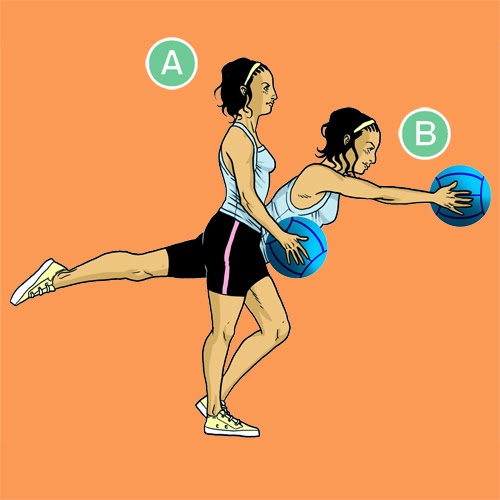
 6. Reaching Romanian Deadlift: This one takes balance, and a little breathing room to fully extend. Stand on the right leg, with a medicine ball in both hands. Bend the right knee slightly, and hinge forward at the hips, extending the left leg straight back (and for an extra challenge, extending the arms overhead). Feel like a ninja? Check! The body should now form a straight line that’s perpendicular with the standing leg. Return the extended leg to the floor, and repeat for 10-12 reps, then switch legs.

7. Step Jump: Hold a medicine ball to the heart, and never let go (Jack), while straddling the middle of a low bench or step (make sure it’s sturdy!). Drop into a squat until the tush makes contact with the bench. Stand about six inches from a low bench or platform, and jump up onto it so the feet land in a natural, wide stance.. Carefully jump back down to the start position. Jump up for 10-12 reps.

8. Circle Squat: Stand holding a medicine ball at the right hip. Circle the ball overhead toward the left, while stepping out the left leg to into a squat (just like a sumo wrestler). Circle the ball all the way to the right side of the body, while still in the squat, then step the feet back together, and circle the ball back to the right. Repeat 8-10 times through, then switch directions.

9. Single-Leg Squat: Stand with feet hip-width apart, knees slightly bent. Lift the right foot off the ground and extend it forward. Hold a medicine ball in front of the bellybutton. Lower the body into a squat position, sitting back into an imaginary chair with the knees safely positioned over the feet. Return to start position, and switch legs. That’s one rep. Get your squat on for 10-12 more.

10. Single-Leg Butt Lift: We’re warning you, this one really puts on a show. Lie on your back and place the sole of the right foot onto the medicine ball. Thrust the hips to the sky (very Jane Fonda-esque) with the left leg straight in the air, with all your weight supported by the right foot and the shoulders. Hold for one count, then slowly return to the start position with the butt on the matt, and repeat for 10-12 reps on each side.
 

Chest and Back


11. Medicine Ball Push-Up: Drop down and get ballsy. Starting in a traditional push-up position, toes tucked under, place your palms on the medicine ball, and shift your bodyweight forward until in plank position. Keeping the core tight, and the head aligned with the spine, slowly lower the chest toward the ball (woof!) until it nearly touches, keeping the elbows pinned tightly at your sides. Finish the move by pressing upward through the arms until they’re fully extended. Need an adjustment? Pop the knees on the mat and push it real good for 10-12 reps.

12. Weighted Superman: Lie face down on the mat with arms stretched out in front, holding onto a lightweight medicine ball (try starting with 4-6 lbs). Slowly raise the arms and legs up as high as possible, engaging the back muscles. Hold the position at the top for a few counts, all the while pretending you have a cape around your neck. Lower the body back down to the mat and repeat for 12-15 reps.

13. Lying Chest Toss: Since two balls are better than one, this move enlists a pair. Lie face up on a stability ball with the head and shoulder blades resting on the ball’s center, and knees bent at a 90-degree angle (the torso should be parallel to the floor). Keeping the neck in a neutral position (not straining forward or hanging back), hold a medicine ball with both hands just above the chest, with the elbows bent and pointed out to the sides. Push the ball out, in line with the chest, (like a classic chest pass) and toss it straight up toward the ceiling. Be extra careful not to toss the ball too hard. (Just remember: What goes up must come down.) Repeat for 12-15 reps.

14. Rolling Push-Up: If 9th Grade phys ed is in the past, then you know what push-ups are all about. Adding in a medicine ball quickly morphs the upper body-blaster into an even more challenging move. Get into high-plank with a medicine ball under one hand, and lower the chest toward the floor to perform a push-up. Return to high-plank and roll the ball to the other hand. Roll out 8-10 reps, or as many as possible maintaining good form.

15. Wall Pass: Find the nearest med ball-safe wall (when in doubt, always ask the gym’s staff which areas are fair game). Stand about 3-4 feet in front of it, holding a lightweight medicine ball with both hands. Get into an athletic stance, with a slight bend in the knees, and the core engaged. Bring the ball to the chest, and firmly throw it at the wall (get that aggression out!), and catch the ball on its return. Your mission: Balls to the wall for 12-15 reps — without taking off another gym goer’s head.


Shoulders and Arms


16. Ball Fly: This can get a little tricky as far as balancing goes, but we promise you’ll look like a total champ once you’ve got it down. Lie face up on a stability ball with the neck and shoulder blades resting on the ball’s center, and knees bent at a 90-degree angle (torso parallel to the floor). Now it’s time to really put on a show: With the abs engaged and hips raised, extend the arms, holding a lightweight medicine ball to the ceiling. Shift the ball to the left hand, and slowly lower the ball until the left arm is parallel with the floor (maintain a slight bend in the elbow). Bring the ball back to the center and shift the ball to the right hand (do the same thing on this side) to complete one rep. Repeat for 8-10 reps to really feel the burn. 17. Shoulder Press: This move is one of the easiest for beginners, but can be amped up with a heavier ball. Hold a medicine ball at the chest (about an inch away, right in front of the sternum). Extend the arms to the ceiling, reaching the ball overhead, and slowly lower the ball back to the start position. Easy peasy, right? Press it out for 12-15 reps.
18. Figure 8: This is totally like ribbon dancing, just probably not as graceful. Stand with feet about shoulder-width apart. Hold onto a medicine ball with both hands to one side of the head, with arms fully extended. Slowly move the medicine ball in a fluid, controlled motion, forming the figure 8. Repeat 8-10 reps through clockwise, then switch directions. This one can be deceivingly tiring, so try it with a lighter ball first.
19. Triceps Extension: Stand in a comfortable stance, or sit tall in a chair, with the core engaged. Hold a medicine ball in both hands with the arms extended overhead, inner arms grazing the ears (resist the urge to lurch the arms forward and make an elephant noise). Next, bend the elbows, lowering the ball behind the head until the arms form a 45-degree angle (or as far as feels comfortable). Squeeze the triceps to straighten the arms, bringing the ball back to the starting position. Pump out 12-15 reps.
20. Bicep Curl: Stand with feet shoulder-width apart, holding the med ball in both hands at the chest. Keeping the elbows close to the body, lower the ball toward the ground until the arms are fully extended. Then curl the ball back up to the chest. Lower the arms back to the starting position. Curl for 12-15 reps — just never at the squat rack.

Core

21. V-Up: How To: Lie flat on your back, legs extended (but try not to snooze on the mat). Reach the arms overhead—à la first thing in the morning stretch—with a medicine ball in both hands. Engage the core to lift the hands and feet simultaneously so the body forms a  “V” position. At the top of the “V,” pass the ball from the hands to the feet. Squeeze the ball between your sneaks, and slowly lower the arms and legs back down to the floor. Return to the “V,” and pass the ball back to the hands. That’s one rep. Wipe the sweat from your brow. Repeat for 8-10 more.
22. Overhead Slam: Stand with your feet shoulder-width apart, and knees slightly bent. Hold a medicine ball in both hands, and lift it overhead. Then bend at the hips (slightly hinging forward), careful not to arch the back, and slam the ball on the ground directly in front. Ask fellow gym-goers nicely if it’s OK to slam on. And don’t slam toooo hard (control is key). Retrieve the ball and keep at it for 10-12 reps.
23. Straight-Leg Sit-Ups: Ready to take the standard sit-ups up a notch? Lie flat, back to the mat, with a medicine ball in both hands. Extend the arms straight so the ball is directly above the hips. While keeping the legs together, raise them directly over the hips to the ceiling (so the body forms a giant “L”).  With control, return to the start position and bust out 12-15 reps.
24. Hay Bailer: Kneel on the right knee, (with the left foot back, toes curled under) to form a 90-degree angle. Hold a medicine ball in both hands close to the body while keeping the torso tight, and perpendicular to the floor. Bring the medicine ball toward the right hip, while keeping the rest of the body forward, then transfer it diagonally up and across the body (Think: John Travolta in Saturday Night Fever). Hold this position for one count before returning to the start position. Repeat the movement in the opposite direction with the right foot forward. (Pro tip: The more the arms are extended, the harder the move is). Bail that hay for 12-15 reps.
25. Toe Touch: Touching your toes just got even trickier. Lie on the floor, holding a medicine ball in both hands. Extend the arms overhead, with shoulders back and down to the mat. While keeping the legs together, raise them directly over the hips to the ceiling (so the body forms a giant “L”). Next, bring the ball overhead (keep the neck in a neutral position throughout), and reach it as close to the toes as possible. Crunch the upper body to the toes for 12-15 reps.

Source http://greatist.com/fitness/25-must-try-medicine-ball-exercises