Showing posts with label Kipping Pullups. Show all posts

Tuesday, 1 September 2015

Body Weight Workouts for a Strong Body

Bodyweight workouts are very misunderstood and under-estimated ways of enhancing muscle tone and strength. Many trainers and fitness seekers can't see past traditional bodyweight workouts consisting of push-ups, pull-ups and dips.
 
 Both men and women can follow body weight workouts and get great results that are in line with fitness goals ranging from slimming, shaping and toning to strengthening and lean muscle building.
A big hurdle for most people to get over when considering body weight workouts for fitness is the question of, "How can a body weight workout routine replace one that uses weight training and machines?"

It is easy to see how psychology can be an obstacle in trying to help people understand that properly structured bodyweight workouts can be better than traditional weight-lifting and exercise machine workouts. Traditional workouts offer many variations, almost endless actually. Where as bodyweight workouts rely on creativity mixed with a good understanding of how the body functions and what exercises stimulate healthy and safe fitness progress.
 

Many fitness pros believe that body-weight workouts offer just a limited amount of exercise options and are very general at best, meaning that there is no ability to target and isolate specific muscle groups during a bodyweight workout. This is a big mis-perception that prevents many fitness success stories from ever becoming a reality.

Here's the reason why. When people get into the 'health club mentality' of only being able to workout with equipment, weights and machines, they set themselves up for many episodes of 'falling off the program' and failing. Bodyweight workouts eliminate this excuse.


Here's an example where bodyweight workouts are a million times more effective than regular old gym workouts. You go on vacation or you go out of town on business, or maybe to visit family for several days. So many times these events become excuses for people not sticking to their fitness plan because they 'couldn't go to a gym'. With a well-rounded, bodyweight workout program this excuse is not valid.

The right body weight workouts can be done anywhere and anytime. They can be done at home, the office, a fiend's house or even on a play-ground. And in terms of effectiveness - I can only say through personal experience with my own bodyweight workouts and those of the people who I have trained that when planned properly and followed consistently, bodyweight workouts can be even more effective than most weight lifting or machine based workout programs.

Body weight workouts offer 'fitness veterans' - a refreshing, eye-opening alternative to the those repetitive weight and machine training programs. Even more importantly, bodyweight workouts offer sedentary fitness beginners a safe, non-intimidating and effective method for starting a home based fitness program with a high probability for success.

Whether you are just beginning or you've been 'pumping the weights' for some time now, give some consideration to the benefits and advantages of properly structured body weight workouts and how they can help you move forward in your fitness and conditioning goals. Open up your mind to the possibility of a bodyweight workout being a part of your overall fitness plan and see what happens. You'll be very pleased and maybe a bit surprised with the results you experience.

 Damian@FitnHealthy

Sunday, 23 August 2015

Weight Lifting | CrossFit Straps

To begin, let's all agree that buying weight lifting straps is not brain surgery. But, there are a few things that are totally helpful to remember when trying to find the best straps for you that will meet your needs.

1. Define your own goals.
Do you want to be the next Arnold? Or just lean down and try to look better in that bathing suit that you've been afraid to put on for the past year? Being honest about what your goals are when working out in the gym is very important. The muscle-heads will need the heavy-duty, serious weight lifting straps that will enable them to throw a ton of weight around while the beach beauties will simply need another gym fashion accessory so that they can look great.

2. What exercises will you be using your weight lifting straps for?
Some people find that they use their straps for almost every exercise they perform in the gym. Others, like me, simply use them for the heavier weight exercises that put the most stress on my grip since I try to push more weight than I would normally handle. It's important to think about which exercises you'll be using your straps for so that you can make your selection based on need. Pushing or pulling or both?

3. Think about what kind of material you'd like in your straps.
OK. Some people are more into leather than they'd like you to know! But woven cotton and even neoprene weight lifting straps offer their own benefits. Consider which type of material is going to make your workouts better. And, if you're a sweaty muscle-monkey, then you may want to consider whether you can wash your straps too! They tend to get really dirty and quite stinky too.

4. Are the straps you like simple to use or do they take half your workout just to wrap around the bar and your wrist?
One thing that most people don't think about is what the straps will be like once they're in the gym using them. If they are the long strap with the loop at one end version, then you're probably the type who is planning on Hulking up huge. If you're really looking for hand protection as opposed to uber heavy lifting ability, then you may be more interested in a simpler hand grip product. Wrapping the extended material around the bar to grip more weight can be cumbersome to certain people. A simple on and off quickly type product, such as a hand grip, may be what the trainer ordered instead!
 
  
5. Think about the look you're going for at the gym too.
Yeah, I know... you're just going to work out. You don't care what you look like. Bull. Anyone who is in the gym in the first place, is thinking more about the image that they are projecting than not. And, it's really OK too. So, remember that when you're selecting the right weight lifting straps for yourself, think not only about functionality, but about aesthetics too. What do you really hope that your new found straps or grips will say about you? Egotistical callused muscle maniac or considerate baby smooth handed boyfriend with the sensitive touch? Whichever it is, make sure it works for you!

The grips that work absolutely best for my needs are a crossover pair between lifting straps and grips. They are called Gorilla-Grips. They are made of 100% leather with elastic finger loops which hold them in place on my hands. They are totally stoked for lifting super heavy weights or just for use as a protective layer between me and the germ-ridden handlebars in my spin class.
 
Source Hamilton B | Ez

Friday, 14 August 2015

Know All About Crossfit Gloves worth it or not ?

With the intention of achieving superior results, weightlifters need to have the correct equipment, especially the most excellent weight lifting gloves. Although this piece of gear might appear to be very minor, but it can have an enormous impact on your performance. If you are a serious weightlifter, it is time to start researching the best products that are available in the market. 

Crossfit Gloves can provide extra protection between your hands and metal grips that the weights feature. This protection helps to reduce both soreness and calluses. The right materials help to prevent slipping which is a huge concern at the time of weight lifting. These are also great for those people who are new to lifting weights.

Another indispensable advantage is having proper wrist support. There is a fabric extension on these gloves that help to stabilize the wrist and keep it correctly positioned. Users with this extra support can avoid sprains and other injuries. These gloves also offer a fingerless design which can be more comfortable and allow for the evaporation of sweat. This enables the wearer to stay cooler longer. There are lots of workout gloves available in the market. These gloves come in different designs, shapes, sizes and fabric.

Many manufacturers have their own dedicated features that make their gloves different from others. Some of the most popular and renowned Crossfit Glove manufacturers include the Armor Nitro, Gripad, Reebok and Nike. The type of gloves will exclusively depend on the kind of workout activity you do in the gym. It is therefore pretty significant to know what kind of characteristics you ought to be looking for in your preference of gloves.

Some of the most popular and renowned Crossfit Glove manufacturers include the Armor Nitro, Gripad, Reebok and Nike. The type of gloves will exclusively depend on the kind of workout activity you do in the gym. It is therefore pretty significant to know what kind of characteristics you ought to be looking for in your preference of gloves.
If you find it difficult to select which gloves are perfect for you, then there are a number of websites such as GloveReview.com that give you information about different kinds of Crossfit gloves. So you can easily select the one that goes well with all your requirements and budget. At the website, you can get the information about different brands of gloves and know about all types of gloves on a single platform. 

Damian@FitnHealthy

Wednesday, 12 August 2015

How To Select Your Dream Crossfit Shoes?

May possibly not be considered a bad idea to choose a pair of crossfit shoes for you, however it would definitely not best if you get this choice irrationally. Before going for this kind of choice, you've got to ensure that you are making certain that the company you might be selecting is satisfying some basic options that come with the best crossfit shoes. Many of these features are already discussed the following:
1.Versatility
The one thing you shouldn't compromise may be the versatility of the brand you will choose. This means that your brand should not be limiting you to only some products. There should be a wide range of products open to ensure that you can pick the pair of shoe that truly suits your personality and overall looks.
2.Affordable Price Range
Rationally speaking, what can function as the use of this type of brand which can be offering a good quality from the product but in a type of price range that merely falls out of one's cost range? Certainly, choosing this kind of brand would simply to place an extra stress on your pocket. Therefore, it is always very crucial that the brand you will choose should be very reasonable too.
3.Longer Life from the Products
Remember, these crossfit shoes for women are high price products. You got to make certain that your brand should offer a good quality for these products which do offer a lengthier lifetime of the shoes.

The bottom line is, the best possible things to be considered while deciding on the best crossfit shoe are excellence of the shoe, cost range with the shoe, color combination or perhaps the versatility with the shoe brand and the reliability of the merchandise. Wherever you are going to locate an amalgam of these items together, you've got to ensure that this is actually the right time to strike the chord and select the shoe for adding feathers to your persona. Plus a closer take a look at all international brands currently operating on the market, probably no brand offers a better amalgam of those things than Reebok. This brand has earned significant amounts of name on the time frame and it has won the trust of the customers around the world. From quality to price range and from versatility for the life of the product, this brand is merely outstanding and having a presence of its own. What exactly are you waiting for? Have the opportunity to hold the luxury of using these inordinate couple of shoes and let your personality flair better yet, even higher and even better!

Damian@FitnHealthy

Tuesday, 14 July 2015

7 BENEFITS OF HEAVY RESISTANCE TRAINING

For years only a finite number of dedicated fitness enthusiasts practiced a sure-fire method of achieving results from exercise: weightlifting with the heaviest loads possible. 

Most common gym routines are derived from the bodybuilding world and focus on moderate-to-high repetition ranges, usually eight to 15 reps, to increase the size of a muscle. 
Serious strength-training enthusiasts know that lifting heavy for five repetitions or less, while extremely challenging, is the quickest way to increase muscle strength.

There is a distinctive difference between training for muscle size—technically called hypertrophy—and training for strength and increasing a muscle’s ability to generate force. While lifting heavy can improve the force output of a muscle without significantly increasing its size, training for size can increase muscle volume without necessarily improving strength. 

Lifting with high repetitions can increase the sarcoplasmic hypertrophy of a muscle by increasing the amount of fluid in the sarcoplasm of muscle cells. However, using a heavy weight for fewer repetitions results in myofibrillar hypertrophy by increasing the thickness of individual muscle fibers. 

Sarcoplasmic hypertrophy increases the size of a muscle, while myofibrillar hypertrophy results in thicker muscle fibers capable of generating higher levels of force.

If you are looking for a way to supercharge your clients’ workouts or help move past them past a plateau, consider using a weight heavy enough to limit them to five repetitions or less.* Here are seven benefits of how using heavy resistance can maximize the results from your fitness program.

Training for muscle strength is different than training for muscle size. A six- to 10-week strength-focused mesocycle of heavy resistance and low reps followed by a six- to 10-week hypertrophy (bodybuilder) mesocycle of moderate weight for higher rep ranges can produce significant gains in both size and strength.

Using heavy weights increases intramuscular coordination, the number of type II motor units and the amount of muscle fibers engaged within a specific muscle. Have you ever felt your muscles shaking while lifting heavy weights? This is because you are recruiting and activating the larger type II muscle fibers, which are only stimulated to work when a muscle is challenged with heavy resistance or working to fatigue.

Using maximal loads for compound (multi-joint) movements like the deadlift, squat-to-shoulder press, bent-over row or chest press can improve intermuscular coordination, which is the ability of many muscles to work together to generate and control high levels of force through multiple joints.

Lifting heavy weights elevates levels of anabolic hormones—specifically testosterone, growth hormone and insulin-like growth factor (IGF-1)—which are used to repair muscle fibers damaged during exercise. This helps the muscle fibers to become thicker and capable of generating higher levels of force.
Lifting heavy weights increases production of the hormone IGF-1. This hormone is related to the production of brain-derived neurotrophic factor (BDNF), which is a neurotransmitter responsible for stimulating the growth of new neural pathways in the brain along with enhancing communication between existing pathways. In short, lifting heavy could make you smarter by enhancing cognitive function.

Training with heavy weights helps you to improve your self-confidence. Knowing that you can lift heavy stuff gives you the confidence that you can handle common challenges, such as a putting a bag in the overhead bin on an airplane or carrying a heavy piece of furniture while reorganizing a room or helping a friend move.

Strength training with heavy weights improves muscle definition. Muscle definition occurs as the result of muscles remaining in a state of semi-contraction and heavy strength training recruits the larger type II muscle fibers responsible for a muscle’s appearance.

Source - C/O Ace 

Friday, 3 July 2015

Pull up workouts - The benefits of Pullup Exercises

Pullups and Chin ups are an extremely effective way of building both strength and endurance. They are very good for full body conditioning, particularly if you are an athlete or martial artist.

Pullups are one of the most beneficial overall muscle and strength developers. This exercise (also called a chin up) is a simple body weight exercise for building upper body, back and core strength. Unfortunately this exercise is often overlooked/neglected in favour of pumping iron or machine weights at the gym.

Why do PullUps?
 A pull-up is a compound, pull-type exercise which works a large number of muscles in your back, shoulders, and arms (biceps) at the same time. An added benefit is that it works the abs as well as burning fat. Bonus!

Standard exercise for special forces and elite organization fitness testing
Improves grip strength significantly
Develop a V-shaped back
If you are new to this exercise or are out of practice a weight assisted pull up machine at the gym will help your muscles adapt to this challenging exercise. Lat pull downs machines should also help prepare you for a non assisted pull up workout. Once you have mastered the basics there are various different types of pull up you can do including wide and close grip: 

As a much prefer time efficient home workouts (especially as i am a new father with a busy work schedule). Other pull up bar include door frame pull up bars, and pull up stations, however, i have not used these.

Pull up workouts can be made varied and challenging by integrating them into explosive cardio circuits. There is also scope to attach weights to yourself or use a weighted vest if you become very advanced at pull up workouts. I am currently working on the twenty pull up challenge, and have improved consistently since i first started. Following a structured training program, I have achieved positive results with good gains in my biceps, chest. triceps and shoulder muscles. Just need to work on my diet a bit more to get those abs. Good luck with your workouts.

Thank you for reading this article.

Damian@FitnHealthy
Tuesday, 21 April 2015

Andrea Ager- CrossFit Tabata


 CrossFit Athlete Andrea Ager performs an insane Tabata workout consisting of an array of staple CrossFit movements, and also takes a minute to chat about Tabata and CrossFit in general.

Saturday, 18 April 2015

Is the Kipping Pull Up Cheating?

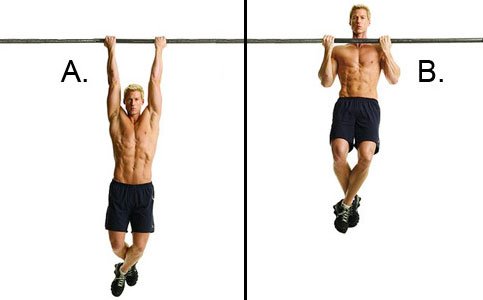
On the pull-up bar, the kipping is oftentimes referred to as the "cheating" pull up, however, this exercise, like the dead hang, can give you outstanding complete body benefits. The reality is, it requires some ability to master.

What is the Kipping?    It is a cutting edge pull up technique that not only targets muscle tissues, from top to bottom, but also may get your heart racing! 

While the kipping doesn't seem like a total pull-up, it is the precise movement adopted from gymnastics.You will know if you have done this properly of you were able raise yourself up by using your hips to thrust you upwards! It really is smooth and ultra powerful and is also the whole body exercise. 
 
  There is not any room for muscle isolation in kipping routine. The kip allows you to lead with your shoulders as much as your hips, while you throw your feet behind you.Differences between the Dead Hang and the Kipping The rigorous, dead hang is the usual traditional exercise that comes to mind when you think of pull ups. This is a muscle-building procedure that increases and contracts the muscles of your upper back and arms, generally the lats, biceps, and forearms. 

The other parts of the person's body is designed to remain in sufficient tension to hold a rigid structure. You begin by hanging on the bar with your arms completely extended. 
The elbows and shoulders are the only parts of the body that are expected to move. All your other joints need to stay on practically still, as they shouldn't help with the force production needed to perform the routine.On the other hand, the kipping begins with the pop from the hips that powers the body up and over the bar. Once it is completed, you continue in a quick, rhythmic fashion.
By way of effectively lifting the body with the very least amount of upper body pulling, this is a far more efficient method for raising the face on the bar. Athletes who practice kips can achieve much higher numbers with a kip as opposed to the strict dead hang.In doing the kipping pull-up your hips are forward, your feet should be in the opposite direction. 
In the same manner, when the feet are frontward, the hips should be backwards. This means that the feet is always in reverse position of the hips and shoulders. 

Your body need to either be in the front similar to a half moon shape along with your hands and feet at the back, or the body must be in a half moon shape the reverse way with your shoulder and hips at the back and feet and hands forwards.From this two pull up styles which do you think is the best?
It actually depends on the person. Sure, the dead hang pullups is the classic variation. Nonetheless, the kipping pull up is capable to become a lot more efficient. 
Either physical exercise will provide a huge benefit, the kipping requires much more coordination and use of hips, as the dead hang generally requires a lot more energy.

Source Sam Stevens

Saturday, 4 April 2015

Complex Training: Strength and Conditioning Workout for Athletes


Up until about 40 years ago, most athletes were told to avoid resistance training because the misperception was that strength training would actually reduce their athletic performance. Of course, we now know that a proper strength and conditioning program is essential for athletes who want to reduce their risk of injury and enhance their performance. 
Athletic performance is based on a number of skills that can be developed through a sports conditioning program. This particular program focuses on improving both muscular strength and power using a technique called post-activation potentiation (PAP), also commonly referred to as complex training. 
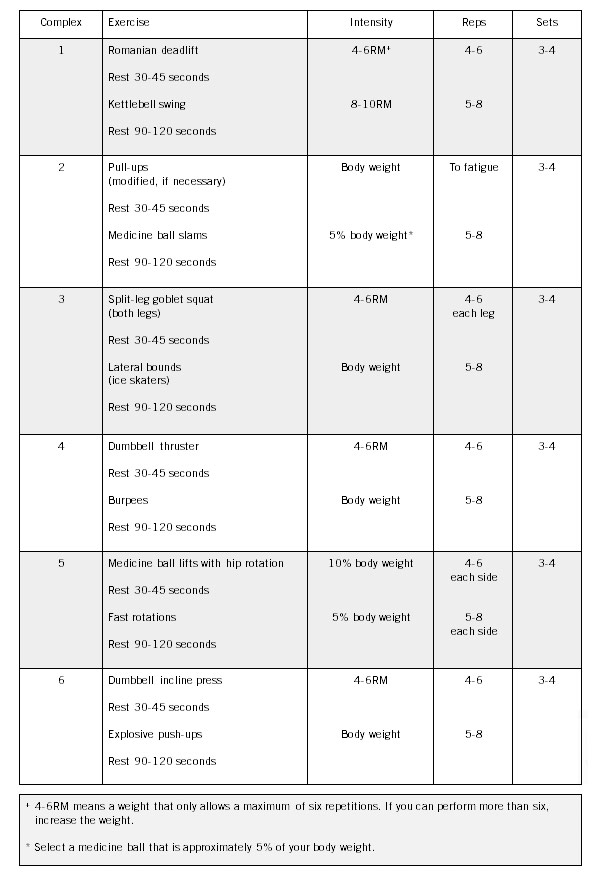
Complex training combines strength exercises from the load phase of the ACE Integrated Fitness Training® (ACE IFT®) Model and power exercises from the performance phase to improve both muscle force production (strength) and the rate of force production (power). A complex training set involves performing two exercises back to back, with a brief rest period in between. The first exercise is a strength exercise using a heavy weight for four to six repetitions (ideally fatiguing by the final rep). The second exercise is a power exercise focusing on explosive movement for five to eight repetitions. There should be a 30- to 45-second rest interval between the strength and power exercises and a 90- to 120-second minute rest interval after both exercises. 
It is important to perform a number of mobility exercises for a proper dynamic warm-up before attempting a high-intensity training program. There are two ways to do a complex workout: Complete all complex sets of one exercise before moving on to the next, or combine the exercises into a circuit. Circuit training allows you to reduce the rest time between complex sets, which increases the challenge of the workout.
 Complex Training Program 

Exercises:
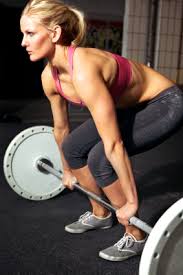
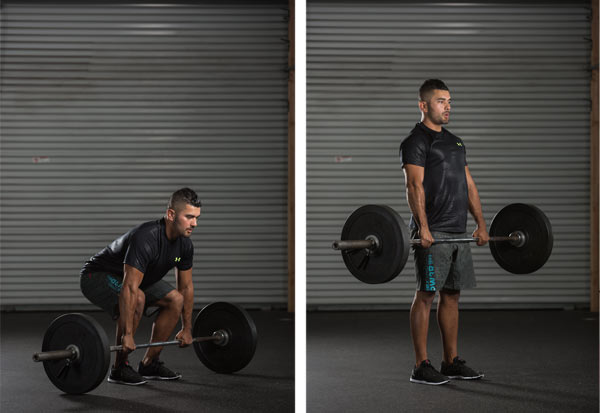
Deadlifts
 
Deadlift


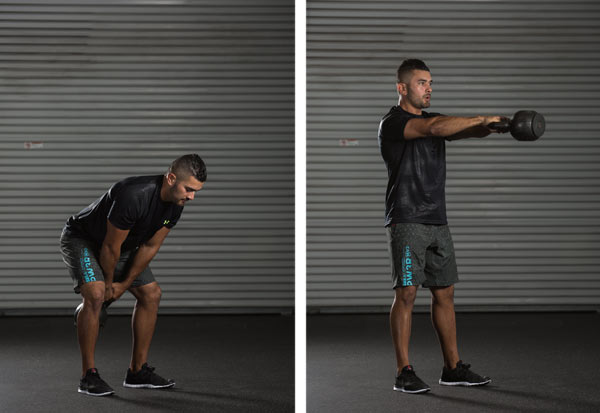
 Kettlebell Swings

kettlebell swings


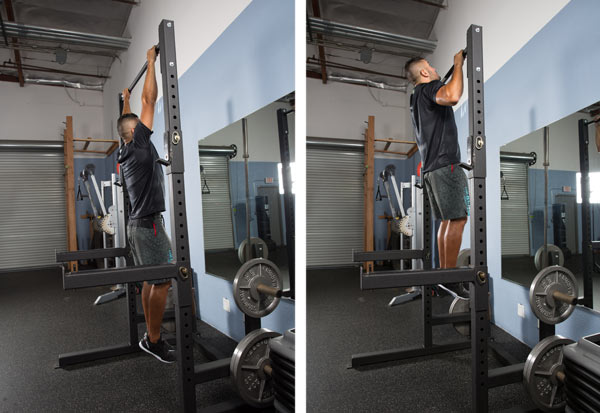
 Pull Ups

 pull up

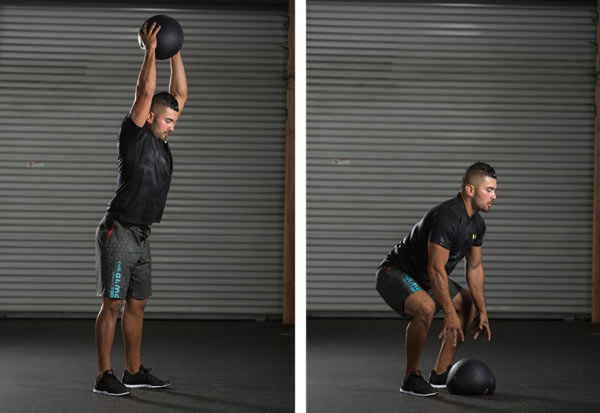
 Medicine Ball Slams

 medicine ball slam

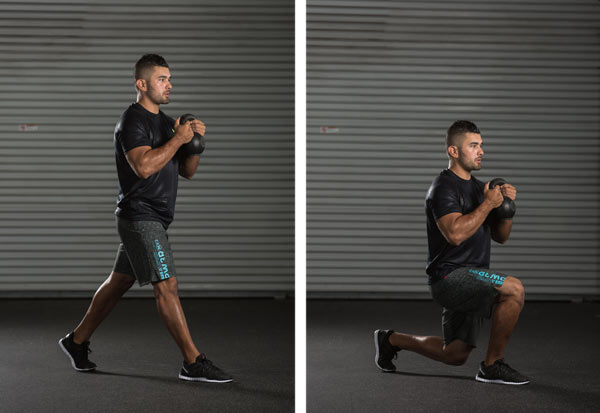
 Split-Leg Goblet Squats

 split-leg goblet squat

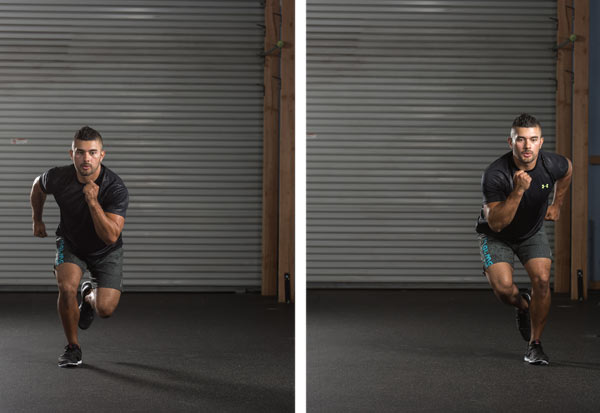
 Lateral Bounds (Ice Skaters)

 lateral bounds

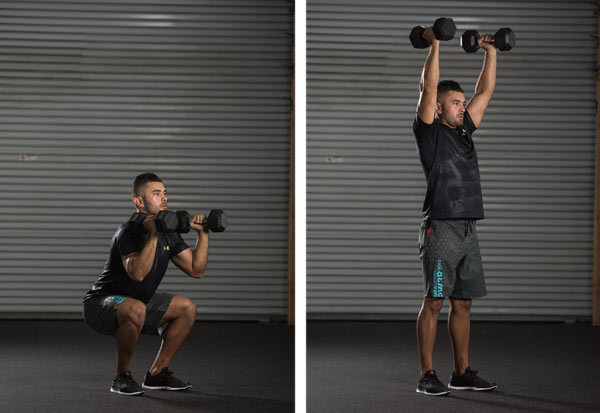
 Dumbbell Thrusters

  dumbbell thrusters

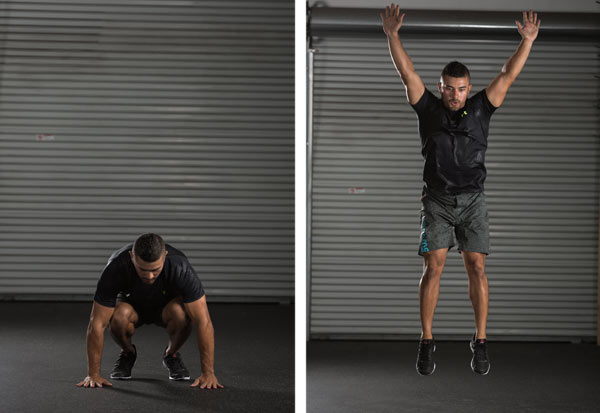
 Burpees

 burpees
 
 burpee

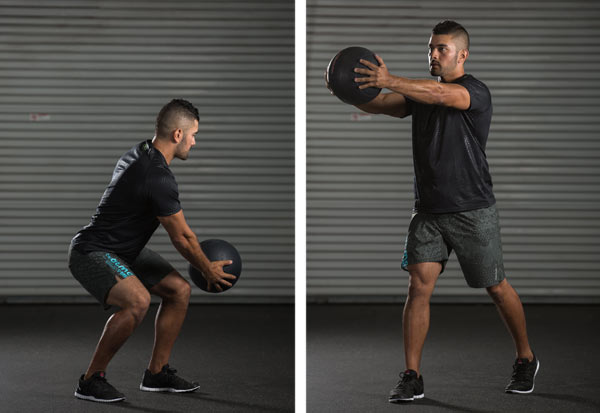
 Medicine Ball Lift with Hip Rotation
  
Medicine ball lift

 Fast Rotations

 medicine ball rotations

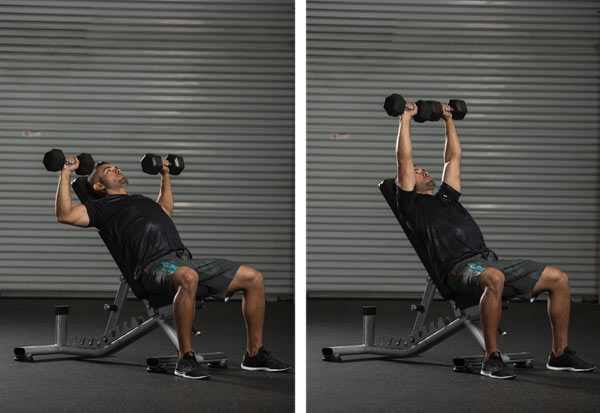
 Dumbbell Incline Press

 dumbbell incline press

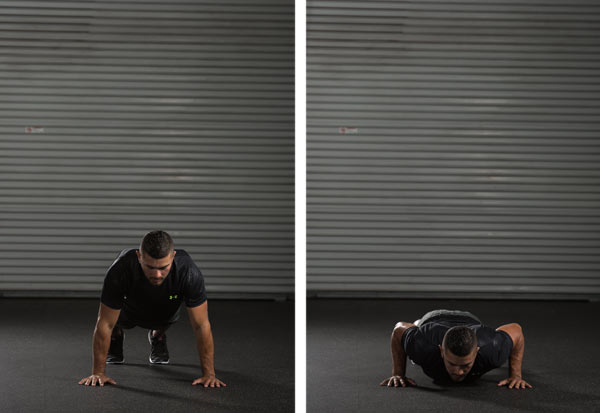
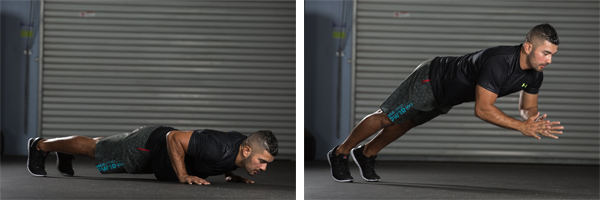
 Explosive Push Ups

 Explosive push-ups

 Source : By Pete McCall, MS/ ACE

Friday, 27 February 2015

2014 Games Highlights | Mini Doc and review


From the Open to the regionals to the Games, the 2014 Reebok CrossFit Games season made history.
 In this in-depth look at the top level of CrossFit competition, we catch up with 2014’s top-seeded competitors Camille Leblanc-Bazinet, Rich Froning, Jason Khalipa, Josh Bridges, Sam Briggs, Lindsey Valenzuela and more.
Watch as we get inside the minds of the athletes who achieve their dreams of making it to the Games and find out what makes them tick. What are they thinking before 3-2-1 … go? Who are they watching? What are their expectations?
At the end of the weekend, three women and three men occupy the coveted Games podium and while some are already thinking about 2015, others are taking in every second of what may be their last time on the floor of the CrossFit Games.
Video by Ian Wittenber.

Saturday, 21 February 2015

Mastering the Muscle Up for CrossFit

Many athletes struggle greater to do the muscle up, than they do just about any other technique in CrossFit. While technique is the most valuable tool an athlete has at his disposal, the development of the muscles used in this workout will assist the athlete in exploding above the rings, and having the kinesthetic muscle awareness to maintain proper technique.

 Many workout regimens I have seen are ineffective while others are dangerous. Today we are going to break down some vital workouts that, when used effectively, can help you achieve a perfect muscle up.

#1: Strict Pull ups
In CrossFit, I feel we focus a little too much on our kipping pull-ups and butterfly pull-up and forget the pull-up we all did in P.E. in elementary school. The strict pull-up is foundational for the bar muscle up. This movement develops your latissimus dorsi, traps, supraspinatus, infraspinatus, teres minor and subscapularis which is vital for your strength and support for your rotator cuff. If you are unable to do a strict pull up, there are a number of exercises you can play with to develop this critical movement.
  • Negative pull-ups (start at the top and lower yourself slowly)
  • Ring Rows
  • Pendlay Rows
  • Isometric Pull up hold
  • Gymnastic Rings Archers
# 2: Develop your Core Strength
In addition to isometric lifts and explosive power, a strong core is vital to this. Abdominal isometric holds, like L-holds and hollow holds accompanied with explosive core work like pike-ups and GHD situps will strengthen the explosive muscles needed in the abdomen that you will need to get the pop your hips need for a muscle up.
#3: Chest to Bar
The next drill you should perfect in your quest to mastering the muscle up, is developing a strong chest-to-bar. For this drill I want you to focus less on stringing chest-to-bar pull-ups together, while instead trying to bring your hips and legs parallel to the floor and pulling the bar to your rectus abdominus. This will involve a dramatic back swing followed by an explosive kip.
If you can master this skill and can learn to pull that bar to your abs, you are just one step away from flicking your elbows to the air, and finishing your muscle-up.
You will also need to develop a strong hollow and a strong arch on the ground which will develop kinesthetic muscle memory.
#4: Learning the transition from False Grip to Ring Dip Position.
As stated earlier, technique drills are vital to this workout. While this articles scope is more focused on the muscle development needed to do a muscle up, there is one particular technique that simply must be practiced before one should try a ring dip from below.
For a proper technique video on the drill I'm discussing, check out Jason Khalipa's technique video


Practicing this transition will prepare you for the "flick" of the elbows to the sky you will need to master before attempting your muscle ups.
Philip Gephardt is a professional fighter and owner/founder of Factum CrossFit and MMA in Utah. Phil was a nationally ranked wrestler before switching sports and focusing on a professional mixed martial arts career turned gym owner
 
Souce  : Philip Gephardt / Ezine 

Wednesday, 11 February 2015

Natural Movement Workouts: Hang Time

The Journal of Clinical Psychology reported jungle gym pastimes are a thing of the past, and gone are the days when swinging from the monkey bars is a safe activity on the playground. But is the related danger really something adults and children should be overly concerned about? Exercise today neglects to include many functional movement patterns, like hanging or brachiating (swinging from rung to rung on an overhead ladder or bar). “Hanging and the much more challenging action of swinging from object to object, uses upper body strength in a general sense. Swinging requires the full participation of every bit of tissue from the fingers to the lower body,” said Katy Bowman, a biomechanics specialist on natural movement and development.
Although our physical exercise capabilities have not changed from our Paleolithic ancestors, we have mechanically engineered the functional movements of climbing and carrying very heavy loads out of our modern life. Our bodies are paying the price. Increased rates of osteoporosis, osteopenia, and sarcopenia, in addition to common shoulder and back problems can be attributed to muscle and joint weakness or imbalance. In 2006, approximately 7.5 million people were treated for shoulder injuries, and the National Institute of Arthritis and Musculoskeletal and Skin Diseases estimates 8 out of 10 people will experience back pain in their lives. So, how might we incorporate hanging and brachiating into their exercise regime?
Our bodies were genetically designed for these kinds of movements. Paleoanthropologists suspect bipedalism in humans was directly correlated to swinging and suspensory climbing, rather than for walking. Just look at all babies today. The palmer grasp reflex that enables them to grab a finger is the very same mechanism our hunter-gatherer ancestors used to grab a branch. In fact, babies are even strong enough during their first six months of life to be able to suspend their entire body when gripping a bar. The grasping reflex begins to disappear at 6 months of age, however research suggests it is only the lack of cultivation of the capability that reduces its appearance. For this reason alone, we should encourage our children to hang on their arms, and join in on the fun.

Where to get started?

Begin to add isometric hangs and brachiation movements to your fitness routine a few times a week, working up to daily sessions of up to 7 minutes. You can install a pull-up bar in your home for convenience or visit your local playground.


However, if you are a beginner or rehabilitating a shoulder injury take some of the weight off of your arms by placing your feet on the ground, either by using a low bar at playground or placing your feet up on a bench. In the supported position, your hands, wrists, elbows, shoulders and hips will be in alignment, and your knees and feet will form a 90° angle.


Active hang

From the passive position above, retract your shoulder blades back and down towards to the ground. Return to the passive position and repeat for your desired amount of time.


Active Hang

Brachiation Basics

Once you have built enough endurance to successfully perform passive and active hangs, experiment with brachiation. Test your strength to see if you can perform passive or active hangs on one arm at a time before adding in the momentum. Try swinging from side-to-side, using each arm as you move across an overhead ladder, like monkey bars at a playground. As you become more skilled, the options for where you can go with your arms are unlimited. 


Source : Stephanie Vuolo

Sunday, 21 December 2014

Do Your First Muscle Up

The Six Step How To Guide

Imagine yourself pulling yourself over the bar

Feeling like the silverback king of the jungle. I know what it feels like. And soon you will too!

This is the exercise every Bar Brother wants to learn. But guess what, it’s not easy to learn.
It’s pretty damn hard (Even for a gorilla). But I have some good news.
In this blog I will give you a step by step explanation of how you can learn the muscle up.
Does that sound like a plan or not?

I’m not hearing you…So I guess that’s a yes.No actually I assume that’s a yes, because everyone wants to do the muscle up!

Want to know why?

Well…Because it is probably the best upperbody compound exercise (meaning you train muscle groups) that is known to men. The pure power, coordination and technique it requires, make it a must have in your BEAST MODE arsenal.
But what does it look like?


Looks cool, doesn’t it.

Most beginners want to do a muscle up immediately, but fail to realize that doing a muscle up is not something which is ‘just done’, you have to train for it.

Step 1: Start Doing Pull-Ups
Far before you are able to do a muscle up, you have to master your pull ups and feel comfortable with doing them.
Do as many reps as you can do and controlled as you can do.
There is no precise number, make sure you max out.
What really helps is having a number in your mind and to keep going until you reached that number.
Do not think you can do a muscle up before you can do a pull up.
It is like trying to do a marathon before you can walk. Learn to walk first.

bars bar brother pullup

Step 2: Make explosive moves
Because a muscle up has an exaggerated range of motion, this is what you should exactly practice.
Don’t stop when the bar is below your chin, push through and make sure it goes all the way towards your chest.
Make this movement as explosive as possible. Pull yourself up as fast as possible and then go down slowly.
Focus on an object in the distance, explode, hold it and then let go.
Explode and let go, repeat this until you master it.


Step 3: Jump yourself into the movement
Modifying your muscle up a little can help a lot in training the motion.
Remember that a muscle up is just as much technique as it is strength.
One easy way to do this is by jumping yourself into your muscle up.
– Hold the bar with both hands
– Pull yourself up
– Jump while you are pulling yourself up
– While you are pulling yourself up transition into a muscle up
As you keep practicing this movement, decrease your jumping power until you are able to do it without jumping.

Step 4: Use your motion
Especially when you do your first muscle up, using your legs an hips to generate an extra swing can be really useful.
Make sure you time your movement.
– Swing forward
– Swing backwards
– When you are in the backwards motion halfway, do a pull up full force to transition yourself into a muscle up
The more comfortable you get the less you can move your leg motion and master a straight muscle up.

Step 5: Do negatives
Negatives are really useful in learning pull-ups and muscle ups. They require less strength and are easy to apply.
Combine them with the above mentioned exercises.

Step 6: Be patient
No body was built in one day, it will take more than a day to learn a clean muscle up.
Make sure you focus on the technique instead of forcing your body above the bar.
This will only cause injuries and as a result will take you longer to master your muscle up.


 This six step how to guide, if followed in a disciplined manner will surely help you get your first muscle up. There are a lot of online tutorials, make sure you watch them, keep practicing your skill to unleash the Bar Brother Beast.

Source http://www.barbrothersgroningen.com/
Rich Andoh


Saturday, 20 December 2014

CrossFit World Champion Rich Froning is “The Fittest Man on Earth

What does it take to be the best?

Strength. Endurance. Skill. Discipline. Those are the qualities that made Rich Froning a two-time CrossFit Games champion and earned him the title of “The Fittest Man on Earth.” But it takes more than sheer physical strength to compete and win at an elite level. It takes incredible mental and spiritual toughness as well. And it is the precise balance of all three that makes Rich Froning a champion.

In First, readers come alongside Rich as he competes in back-to-back-to-back CrossFit Games and get an inside look into the CrossFit phenomenon that is sweeping the world as well as a personal glimpse into the life of the down-to-earth champion. From the infamous rope climb that cost him the title in 2010 through his subsequent wins in 2011 and 2012, Rich shares invaluable lessons, priorities, and insights that have transformed his life and career and ultimately underscore what CrossFit is all about.

Most important, Rich shares the secret to his own success both in and out of the gym: when God comes first, everything else falls into place.

Check Out Richards New book a great read for the holidays...


Saturday, 6 December 2014

What's the WOD ?

WOD is "Workout of the Day." The great folks at CrossFit post a workout for each day. The common splits are a) as posted, which is 3 days on/1 off, and b) 5 days on, two off.
If you need explanation on doing the WODs, check here or in the discussion board. Likely your question has been asked before.

Some insight and thoughts on sets and reps:

The WOD descriptions are very literal; don't read into them. If it says "squats" it means bodyweight (aka "air squats") - no added weight, unless it says back squats or front squats.
A "rep" or repetition is one iteration of a movement. One bench press, one squat. A "set" is a group of reps: 10 reps =10 bench presses, 10 squats. 3 sets is do a group of repetitions, rest, repeat, rest, repeat. So, 3 sets of 10 (reps) is 10/rest/10/rest/10. The rest interval is up to your recovery time, and the goal of the WOD. Obviously, if it's a timed WOD, you want to rest less.
Also, rest and reps are frequently inverse. Sometimes a WOD says deadlift 3-2-2-1-1-1. This means a set of 3 reps, a set of 2 reps, another set of 2, a "set of one" aka a "single." This few reps indicates maximal load, and indicates longer rest times.
Back to literal: if the WOD says 21-15-9 reps of bench and pullups in "rounds" (or any two or three exercises as given) you do 21 reps of exercise 1, followed by 21 reps of exercise 2, and 21 reps of exercise 3 if there is a third one. Now do 15 of the first, 15 of the second...9 of the first, 9 of the second.
Most likely you will be breaking the 21's and 15's (and maybe the 9's) into subsets, aka "breakdowns." This is based on your strength and conditioning. Remember if you need to adjust the weight downward, do so, since these are timed WODs.

Here's some insight from Coach on the intent of CrossFit:

"CrossFit is in large part derived from several simple observations garnered through hanging out with athletes for thirty years and willingness, if not eagerness, to experiment coupled with a total disregard for conventional wisdom. Let me share some of the more formative of these observations:
1. Gymnasts learn new sports faster than other athletes.
2. Olympic lifters can apply more useful power to more activities than other athletes.
3. Powerlifters are stronger than other athletes.
4. Sprinters can match the cardiovascular performance of endurance athletes - even at extended efforts.
5. Endurance athletes are woefully lacking in total physical capacity.
6. With high carb diets you either get fat or weak.
7. Bodybuilders can't punch, jump, run, or throw like athletes can.
8. Segmenting training efforts delivers a segmented capacity.
9. Optimizing physical capacity requires training at unsustainable intensities.
10. The world's most successful athletes and coaches rely on exercise science the way deer hunters rely on the accordion."

Source : http://www.crossfit.com/cf-info/faq.html

Wednesday, 3 December 2014

CrossFit Hand Care

CrossFitters often revel in the fact that our workouts have bloodied our hands. "We're such badasses! We're SO hardcore!" But let’s call a spade a spade: IT IS NOT “COOL” TO HAVE CHUNKS OF OUR SKIN RIPPED FROM OUR HANDS.


Flayed skin is not a badge of bad-assery. It does not mean that you are tougher or better at working out. And it most definitely does not mean that CrossFit, lifting and/or gymnastics should be avoided because of the possibility that the skin on your hands might get torn.

All it means is that:

You’re a soft-handed newbie who hasn’t yet had the chance to build up thicker skin on your fingers and palms to protect them from tearing, or

You’re not giving your hands the T.L.C. they need to keep from getting shredded.

Torn skin is painful and annoying, and may put you out of commission for a spell. And THAT is unequivocally un-hardcore.

My first encounter with shredded hands occurred shortly after starting CrossFit, back when the roughest activity my hands saw was an occasional difficult-to-open jar of spaghetti sauce. After neglecting proper hand care for weeks. Over the past year, I’ve experienced minor tears and major ones. In this post, I’m going to discuss what I could (and should) have done to prevent bloody hand, and what treatment options are available to those of us unfortunate enough to gash open our hands doing high-rep pull-ups, kettlebell snatches and the like.


Hand Grooming 

Those who are new to gymnastics, weightlifting or CrossFit in general often start with soft, callus-free hands. Ideally, to reduce the likelihood of hand tears, beginners should try to gradually build up calluses (through -- what else? -- handling bars) to the point where the skin on their palms and fingers are tough and thick -- but smooth. Once some skin-thickening is achieved, the goal is to keep any calluses filed down. The goal is have a consistent, smooth palm surface, without noticeable ridges or fluctuating thicknesses of skin. A raised, rough callus will eventually blister and tear away from the surrounding skin, ripping open your hands and making a bloody mess. A general rule of thumb: If you can pinch a raised edge of the callus, it needs to be filed down. Constant vigilance and regular hand care is key to preventing tears.

You can use a number of different tools to keep your calluses in check, including:
  • A nail file; 
  • A callus/corn shaver;
  • Cuticle scissors; 
  • A pumice stone; 
  • A dull razor blade; 
  • Sandpaper; 
  • A butter knife; or
  • A Dremel tool!
Obviously, don’t be an idiot. Use these tools with care.

As one CrossFit Journal article put it:

Ideally, your entire palm surface should be one thick callus with no bumps or ridges in any one particular area. In order to do this, groom your hands always after a hot shower or bath (this allows the calluses to swell up). While the calluses are still “swollen,” I take a double-edged razor and very carefully shave the dead callus bumps down a little at a time until the bumps are about even with the thickness of the rest of the hand. With my younger students, I simply ask them to get a callus stone (you can buy one at any drug store), and gently sand the callus down even with the rest of the skin. Remember, whenever you groom or shave your calluses, don’t overdo it, since you don’t want to go too deep into your skin. Always leave enough thick skin so to facilitate your workout the following day. The goal is to maintain an even and consistent thickness of hard skin throughout the entire palm.

Also: Lube up your hands. Chalk and frequent washing will suck the moisture right out your skin, and dry, cracked hands do not feel awesome. So listen to the Silence of the Lambs guy: Lotion is important for skin care. (And remember to put the lotion in the basket.) Use Balm or whatever suits your fancy.

This, by the way, is what a well-groomed pair of CrossFitting hands is supposed to look like:


My hands don't look like this. Being the idiot that I am, I’ve never been very consistent about filing down my calluses, and lately, I developed a few big ones with rough edges. I didn’t do anything about ‘em, and as a result, I tore ‘em wide open yesterday. Not fun.

Grip & Technique A lot of CrossFitters rip open their hands doing high-rep bar movements: kipping pull-ups, clean-and-jerks, snatches. But there are ways to tweak your technique to reduce the chances of a nasty tear.

First, use the right grip.When working with a barbell, some folks are inclined to grip the bar across the middle of their palms. This, unfortunately, squishes the fleshy pad below the base of your fingers against the bar, causing discomfort, added friction, blisters, and worse. A better way to go is to grip the barbell across the base of your fingers -- where the metacarpals meet the proximal phalanges. Check out Mark Rippetoe’s explanation of how to grip a bar properly:

5 Steps for a Successful CrossFit Experience

1. Take the introductory course offered by your CrossFit affiliate.

If you are new to CrossFit, taking the orientation course at your CrossFit box (gym) that teaches you proper exercise technique is a must. These introductory classes are vital to your success as a “CrossFitter,” especially if you have never regularly performed the foundational movements of CrossFit. These movements include, but are not limited to, various types of squats, overhead presses, dead lifts, and Olympic lifts. Even if you are an experienced CrossFitter, it’s a good idea to periodically revisit an introductory course to review the basics of proper movement technique.

Bottom line: Make sure you are ready for all of the CrossFit movements by attending your box’s introductory course.

2. Know how to modify every movement, every time.

Practicing excellent form during every repetition of every exercise is one of the most effective injury-prevention strategies. Make sure you know your options for the successful completion of every single repetition. In CrossFit, the workout of the day (or WOD) is posted along with recommendations (or Rx) for load and/or movement skill. For example, the load recommendations for the wall ball movement, which involves quickly moving from a deep squat to standing while tossing a large medicine ball several feet overhead, typically include a 20-lb ball for men and a 14-lb ball for women. However, some individuals cannot safely perform wall balls with that amount of weight. In fact, some people cannot safely perform wall balls at all, and they must modify the exercise to one that is suitable to their capabilities. Whether it’s selecting a lighter weight than the Rx recommendation, or altering the movement (e.g., modifying to a half-squat rather than a deep squat in the wall ball example), knowing how to scale the different variables of an exercise to meet your specific goals or limitations will help you safely and effectively complete a WOD. Knowing the right modifications for your individual needs is best learned during the introductory CrossFit course (see Step #1), and through having a frank discussion with your CrossFit coach (See Step #3). Lastly, understand that your physical capacity changes from day-to-day and, depending on your fatigue level and frequency of training, you might need to modify a movement one day, but several days later perform that same movement at the Rx recommendation.

Bottom line: Be sure you approach each WOD with the knowledge of how to modify a movement, if necessary.

3. Regularly communicate with your CrossFit coach.

Although this is Step 3 on the list, it fits in with the previous points and cannot be emphasized enough. First, let the coach of the class you are attending know about any limitations or past injuries that might make the performance of a particular WOD unsuitable for you. Then discuss with your coach possible modifications in movement and/or weight load that will make the exercises work for you. Be sure to arrive a few minutes early and talk with your coach BEFORE class so that when the timer is winding down to begin the WOD, you are not left wondering what to do. As a coach myself, I ALWAYS appreciate it when participants approach me before class to inform me of any current limitations. In addition, I always announce modifications that can be performed instead of the Rx recommendations before each workout.

Bottom line: If you are unsure about how to perform an exercise so that it works for your individual needs, ask your coach before the WOD begins!

4. Respect your limits.

We all have limitations and strengths. Because the programming is so varied in CrossFit, you will probably find that some movements come more naturally to you than others. For example, people with endurance-training backgrounds who have low body fat and lighter body weights often find the gymnastics-style movements, such as pull-ups and burpees, easier to tackle. However, those same body types often find strength-based exercises such as squats and deadlifts more challenging. The point is to recognize that everyone (including you) will experience exercises that are more or less difficult to master than others. You must respect your limitations and not let the highly competitive atmosphere of performing a CrossFit WOD with your peers cloud your judgment. Only perform movements that you can safely execute with good form. This might mean that you need to unload your barbell during a WOD if fatigue sets in and your form starts to decline.

Bottom line: Be honest about your limitations and avoid letting competition prevail over proper form.

5. Avoid overtraining.

This step might seem obvious, but it can be overlooked by new and veteran CrossFitters alike who are eager to compete and improve. To be successful in CrossFit, participants must train smartly by progressing training volume gradually. The high-intensity nature of CrossFit WODs requires adequate rest and recovery between sessions to decrease the likelihood of injury. Initially, a frequency of two CrossFit workouts per week is a good starting point. Over time, adding in more days, while still paying attention to rest and recovery, can be accomplished. The number of days per week that an individual can tolerate performing WODs depends on numerous factors (e.g., current state of fitness, goals, and desire). Be sure to discuss your goals with your CrossFit coach so that he or she can provide you with safe and effective programming guidelines to help you achieve them.

Bottom line: Have a plan for proper progression to decrease the risk of overtraining.

Source: Sabrena Merrill, M.S., is an exercise physiologist and ACE Education Content Development


Saturday, 29 November 2014

Joe Manganiello's Fitness Tips

In addition to winning both popular and critical praise as the star of True Blood and Magic Mike, Joe Manganiello has become known around the world for his incredible physique. Now, from the man that director Steven Soderbergh called “walking CGI,” comes the cutting-edge guide to achieving the perfect body and raising your overall quality of life. Check Out Joe's Fitness Tips


Tuesday, 25 November 2014

The Seven Habits of Highly Effective Crossfitters

The Seven Habits of Highly Effective Crossfitters

1. Be Proactive – Take responsibility for your life
Some things are not within your control but take control of those that are.  Doing Crossfit on a regular basis requires guts, determination and a commitment. It is also an investment in your well-being, which transfers outside of the gym. Turn up, push yourself and be positive.
2. Begin with the end in Mind – Define your mission and goals
Everyone who does Crossfit has strength and weaknesses, some more so than others. Whilst it is great to nurture your strengths, the greatest gains often come from addressing your weaknesses. This is one of the major benefits of Crossfit over a traditional gym. The WoDs are prescribed and scalable, so unless you ‘WoD pick’, you get an all round experience. Set yourself a challenge and work for it.
3. Put First things First – Prioritise and do the most important things first
Get the balance right. It is easy to become obsessed with Crossfit but it needs a balance against other activities – particularly if you have a family. Don’t be in a rush to attend every session and do listen to your body. A good diet, adequate rest and sleep are crucial to continuing to make gains.
4. Think Win-Win – Have an everyone can win attitude
Perhaps the greatest shock to someone who attends Crossfit is that it is often the person who finishes last who gets the most cheers. The people you train with quickly become friends. Egos are rare and the encouragement you give to others is readily reciprocated.  The only time you have to beat is your last time.
5. Seek first to understand, then to be understood
The coaching staff have a complex role to undertake – to teach, to encourage, to push and to support. The coaching aspect at Crossfit is one of its greatest attributes. The ‘syllabus’ is extensive so it helps to listen, to trust and to persevere. It takes years of practise to achieve competency, so don’t try and coach but give advice when needed – such as when someone is doing something which may be harmful.
6. Synergise – Work together to achieve more
Partner workouts are an opportunity to work together and plays to each other’s strengths. Team WoDs and competitions take this further. Take opportunities to socialise and do some extra events – like workshops. These are often the most fun.
7. Sharpen the Saw – Renew yourself regularly
There are always improvements to be made, so it is important to review your techniques and movements on a regular basis. The ‘tekkers’ sessions assist this, drilling good form and allowing the more experienced Crossfitter the opportunity to fine tune their techniques. There are always more efficient ways to do things and the opportunities to learn are always there.
NB – I don’t profess to being an effective Crossfitter but I thought it would be useful to articulate the Seven Habits as suggested by Sean Covey (and his late father, Stephen Covey) with a Crossfit bias, as a reminder of what I feel I should be doing.
Their books expand on the Seven Habits and I would recommend them, especially the Teenager book by Sean Covey.

Source http://kfullwood.wordpress.com

Monday, 24 November 2014

Kipping Pull-Up

Banded Pull-ups: To Band or Not To Band?


Over the last two years, I’ve had the pleasure of visiting many different CrossFit boxes throughout the United States. Plus, I’ve been a solid member of three different CrossFit boxes. As a result, I’ve been able to experience many different coaching and programming styles in which each gym brought their own specialty to the table. However, I found something universal among most gyms: the banded kipping pull-up.
Kipping pull-ups are a high-skill exercise that requires coordination and strength to keep the shoulder supported under a dynamic load. This seems to be a major struggle for most novice and some intermediate CrossFitters. I know it was for me, especially coming from a bodybuilding background where strict isolated movements were most common. Whether it’s because of a lack of knowledge on how to properly teach the movement or the patience to do so, I’ve noticed that members get thrown on the bands almost immediately.
Being educated in human anatomy (I have a CPTS from Fitness Institute International and am ACSM certified) with a special interest/knowledge about the shoulder, I questioned this coaching style and whether banded pull-ups were actually affective and safe.
Recently, my fiance and I relocated a bit north of Fort Lauderdale to the Delray Beach area in Florida, and we became members of CrossFit Delray Beach. While finishing up a workout session one day, I started a conversation with Laura Canteri, one of Delray’s head coaches.  Laura is a former collegiate athlete who is passionate about human performance and program design. Once she had completed her Master of Science in exercise physiology, she enrolled in James FitzGerald’s OPT (Optimum Performance Training) assessment and program design courses. After learning about her background in exercise science, assessment, program design and coaching, I was anxious to hear her opinion on the banded kipping pull-up.
“I can’t speak for every coach, but I believe bands do more harm than good in terms of an athlete’s development,” Laura said. It was a breath of fresh air to hear my concerns validated.
Laura and I discussed how the most challenging part of a pull-up is the initial pull, which requires scapula retraction and depression. Band tension is highest at the bottom of the movement, so the initial snap of the band causes you to bypass the most important part of the pull-up. Athletes who continue to use the band will never learn how to fully activate the muscles needed for a strict pull-up and, in turn, will never build true strength. Laura and I then went on to discuss the importance of strength and skill in the movement.
“Its important to improve strength and skill simultaneously in all movements,” Laura said. “However, I stress the importance of strength before skill for kipping pull-ups due to the nature of the shoulder joint. If someone is unable to perform a strict pull-up, they will not possess the strength to support their shoulder in a dynamic load such as the kipping pull-up.”
Because the shoulder is a shallow socket joint and the most mobile joint in the human body, it’s highly susceptible to chronic shoulder problems and/or injuries. I’m not suggesting the removal of bands from your gym altogether, but I challenge you, whether you’re a coach at a box or a member of one, to hold yourself to a higher standard. Teach your members the importance of building strength and activating muscles that support the joints before you put them under the stress of a ballistic movement such as the kip. Program exercises that teach scapula retraction and depression such as ring rows and, of course, strict pull-ups.
If you’re a member of a box that allows you to use bands, start practicing without them. Add in strict pull-ups on your own, and if you can’t do a strict pull-up, then do jumping pull-ups and try to hold yourself up to the bar as long as you can. I guarantee you will get stronger and be able to do a bodyweight pull-up on your own.
Being fit and healthy is what we all want to achieve. On that journey, we hope to stay injury-free.
Stay enlightened, my friends!

 Source MHP-sponsored athlete Sarah Grace