Showing posts with label balance. Show all posts

Friday, 18 December 2015

Perfect Your Form

Do a better squat, perform a better lunge, and fix your flawed technique

Lunges

What You Do Wrong:
You lean forward, causing your front heel to rise.

1/ "Narrow your starting stance," says Gray Cook, author of Athletic Body in Balance. The closer your feet are, the harder your core has to work to stabilize your body.

2/ "As you do the lunge, focus on moving your torso only up and down, not pushing it forward," says Craig Rasmussen, a fitness coach at Results Fitness in Santa Clarita, California. This keeps your weight balanced evenly through your front foot, allowing you to press into the floor with your heel, which tones more lower-body muscle.
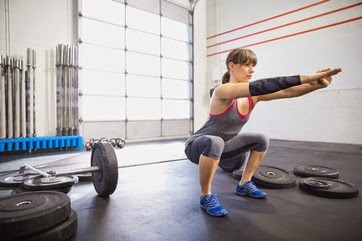
Squats

What You Do Wrong:
You start the movement by bending your knees.

1/ As you squat, imagine you're sitting down into a chair, rather than forward on top of your knees. Push your hips back first instead of beginning by bending your knees, which puts more stress on your joints, says Dan John, a strength coach in Burlingame, California.

2/ Women tend to lean forward on their toes, but they should sit back into their heels. Try this fix: Pretend that you're standing on a paper towel, says Charlie Weingroff, lead physical therapist for the U.S. Marine Corps Special Operations Command at Camp Lejeune, North Carolina. "Then imagine trying to rip the towel apart by pressing your feet onto the floor and outward." This activates your glutes, which helps you use heavier weights and break through plateaus.

Straight-Leg Deadlifts

What You Do Wrong:
You round your lower back as you bend over.

1/ "When bending down, act as if you are holding a tray of drinks and need to close the door behind you with your backside," says Alwyn Cosgrove, co-owner of Results Fitness. This helps you push your hips back instead of rounding your lower back—a form blunder that puts you at risk for back problems.

2/ It's easy to put too much space between the weight and your body as you move up and down. Pretend you're shaving your legs with the bar or dumbbells, suggests Kaitlyn Weiss, a certified strength and conditioning specialist in Southern California. The farther the weights are from your body, the more strain on your back, which limits the work of your hamstrings and glutes.

Rows and Pullups

What You Do Wrong:
You ignore the muscles that draw back your shoulder blades.

1/ "Before you start the exercise, create as much space as you can between your ears and shoulders," says Rasmussen. Pull your shoulder blades down and back, which will ensure you work the intended middle- and upper-back muscles.

2/ "As you row the weights, stick out your chest," says Mike Boyle, owner of Mike Boyle Strength and Conditioning in Woburn, Massachusetts. This allows you to better retract your shoulder blades, which will lead to better results.

3/ "Imagine an orange between your shoulder blades," says Nick Grantham, owner of Smart Fitness in the U.K. "As you pull the weights or your body up, 'squeeze the juice out of it' by bringing your shoulder blades together."

Source

Sunday, 7 June 2015

Great Abs With Balance Ball!

Doing yoga on the ball can benefit anyone, including:

1. Yoga beginners. Moving into poses with the ball's support builds confidence and can help your muscles gradually stretch and strengthen as you improve your yoga routine.

2. People recovering from injuries. Some injuries create muscular weaknesses that make it difficult or painful to do yoga postures such as backbends or Warrior poses. A ball can ease you into a pose comfortably and with less risk for re-injury.
Doing yoga on the ball can benefit anyone, including:

1. Yoga beginners. Moving into poses with the ball's support builds confidence and can help your muscles gradually stretch and strengthen as you improve your yoga routine.

2. People recovering from injuries. Some injuries create muscular weaknesses that make it difficult or painful to do yoga postures such as backbends or Warrior poses. A ball can ease you into a pose comfortably and with less risk for re-injury.

Work Those Abs

Abdominal work is only part of the story. You may be surprised to learn that even more essential to your core stability than a set of six-pack abs are tiny muscles that run along the spine and support the body's joints. Normally we associate a strong body with the large muscle groups.

But, what really improves overall body fitness is the strength of these tiny muscles. They're the ones that keep you from falling, wrenching a disk in your back, or spraining your ankle when you slip on a patch of ice.

Elevated Pushups for Pecs, shoulders, triceps, and abs

How to do it: Place the front of your knees on the ball and your hands flat on the floor (your whole body should be parallel to the floor). Look down at the floor and lower your face to within a few inches of it, then push back up to the starting position.

The Balance/Swiss ball rolls around easily, so core strength and balance are required to keep it still. The challenge of keeping the ball still makes the ball an excellent tool to teach stability and rehabilitation. The simplest movement can become a huge challenge when you do it on the ball. Using a ball can give your workout a little more variety and extra challenge. You can try these exercises after your Pilates mat work.

Damian@ufitnhealthy


Monday, 27 April 2015

Introduction to the Balance Board

The balance board is a fitness piece of equipment that offers an efficient and enjoyable way to train your balance. It also improves your motor coordination skills, and it strengthens your core. Many people also practice on it because they feel calmer and more relaxed after a session.

Skiers and surfers used it first so they can practice their skills during the off-season. It is now used in therapeutic setting (knee rehabilitation, children with developmental disorders, proprioceptive training) and in fitness training. Athletes continue to take advantage of this fitness tool to improve their performance.


 You can easily acquire a balance board to exercise at home. It offers a fun way to strengthen your balance and your core. The difficulty depends on the type of board you are using. Some of them are very easy to practice on. Little kids and elderly people can use them safely. While other boards are much more challenging and require great skills.

There are 4 types of balance boards.
Rocker Boards
It improves static balance and is an easy way to start
Rocker-roller Boards
More challenging, they improve dynamic balance.
Wobble Boards

They offer a good comprise between the rocker boards (easy) and the other boards with un-attached fulcrums (the rocker-roller and the sphere-and-ring boards).
Sphere-and-ring Boards
The base is un-attached and the board can move in all direction making these types of balance boards the most challenging ones.
Balance boards can be very challenging causing falls, sprained joints, and sometime broken bones! So you need to take it gradually and start easily. Choosing the right balance board is the first step to a safe practice. Start with an attached board (rocker or wobble) as they are easier to use than the non-attached. Starting with easy exercises to gain confidence is important. 

Here are 4 movements you can start with:
1. Stand with both feet, and rock the board left to right, and front to back and have the edge touch the floor. Do it for 2 to 3 minutes.
2. Roll the board in a circle touching the edge on the floor. Do it for 2 minutes.
3. Balance the board trying to keep the edges off the floor as long as you can.
4. From exercise 4, squat slightly (45 degrees). Repeat 10 times.
These 4 basic movements will help you improve your balance, strengthen your core, and increase your stamina.
It also has been linked with less falls during old age.

Source Moutassem Hammour .Chir

Wednesday, 24 December 2014

Why you should strengthen your Core Muscles

You know core exercises are good for you — but do you include core exercises in your fitness routine? Here's why you should.


Core exercises are an important part of a well-rounded fitness program. Aside from occasional situps and pushups, however, core exercises are often neglected. Still, it pays to get your core muscles — the muscles around your trunk and pelvis — in better shape. Read on to find out why.

Core exercises improve your balance and stability

Core exercises train the muscles in your pelvis, lower back, hips and abdomen to work in harmony. This leads to better balance and stability, whether on the playing field or in daily activities. In fact, most sports and other physical activities depend on stable core muscles.

Core exercises don't require specialized equipment or a gym membership


Any exercise that involves the use of your abdominal and back muscles in coordinated fashion counts as a core exercise. For example, using free weights in a manner that involves maintaining a stable trunk can train and strengthen several of your muscles, including your core muscles. You may also try several specific core exercises to stabilize and strengthen your core.

A bridge is a classic core exercise. Lie on your back with your knees bent. Keep your back in a neutral position, not arched and not pressed into the floor. Avoid tilting your hips. Tighten your abdominal muscles. Raise your hips off the floor until your hips are aligned with your knees and shoulders. Hold the position for as long as you can without breaking your form.

Core exercises can help tone your abs

Want more-defined abdominal muscles? Core exercises are important. Although it takes aerobic activity to burn abdominal fat, core exercises can strengthen and tone the underlying muscles.

Strong core muscles make it easier to do most physical activities

Strong core muscles make it easier to do everything from swinging a golf club to getting a glass from the top shelf or bending down to tie your shoes. Weak core muscles leave you susceptible to poor posture, lower back pain and muscle injuries.

Core exercises can help you reach your fitness goals

Aerobic exercise and muscular fitness are the primary elements of most fitness programs. But to have a well-rounded fitness program, consider including core exercises in the mix as well.
Whether you're a novice taking the first steps toward fitness or a committed fitness fanatic hoping to optimize your results, a well-rounded fitness program is the best way to reach your fitness goals.