Showing posts with label Interval training. Show all posts

Thursday, 3 September 2015

Pre- and Post-workout Nutrition for High-Intensity Interval Training

 
High-intensity interval training (HIIT) has become hugely popular thanks to real results in shorter periods of time and extensive benefits. With busy schedules the norm, it’s no wonder so many clients and potential clients are now seeking out these kinds of workouts.

HIIT, which involves repeated sessions of relatively brief, intermittent exercise, usually performed at very high intensity, can be easily modified for various client needs and fitness levels. When combined with an expert nutrition program, personalized HIIT programs can elicit serious results and health benefits, including: 

Improve blood pressure and cardiovascular health
Improved insulin sensitivity
Improved body composition

Whether you’re adding HIIT to your own personal fitness program or ramping up client results and health benefits with this style of training, it’s important to understand the nutritional needs to support it from start to finish. While nutritional needs do vary by individual and training program, these nutrition plans and meal ideas for pre- and post-workout nutrition can help.
General Nutrition to Support a H.I.I.T. Program 

To get the most out of any fitness program, you should follow a healthy meal plan in general. Effective and well-rounded nutrition programs are based on a variety of healthful ingredients such as whole grains, fruits and vegetables, and lean proteins. The best nutrition plans provide adequate calories and macronutrients such as carbohydrates to fuel the body and provide energy stores for workouts. It’s important that these are expertly created programs that allow you to stay within your scope of practice and prevent clients adopting a restrictive diet that may inhibit their success. Adequate water is also a must to ensure complete hydration during workouts.
 
Pre-workout Nutrition for HIIT

Due to the intensity of these workouts, it’s vital to follow a healthy nutrition plan with adequate nutrition in the days and hours leading up to a workout. Plan on a moderate- to high-carbohydrate meal that also includes protein approximately three to four hours before the HIIT workout, and then another high-carbohydrate snack within an hour after the workout. Good options for a pre-workout meal include: 

Whole-wheat toast with peanut butter and banana
Non-fat Greek yogurt or cottage cheese with fruit
Dried fruit and almonds
Post-workout Nutrition for HIIT

The biggest nutritional concern post-workout is replacing energy stores (glycogen) and repairing muscles that have been broken down during the intense workout. Again, a combination of carbohydrates and protein has been shown to be most effective. Research shows that a 3:1 ratio of carbohydrates to protein within 30 minutes of completing a HIIT workout is best for replacing energy stores in preparation for the next high-intensity workout. 
 
Suggestions for post-workout nutrition are similar to pre-workout meals and include:
Whole-grain cereal with fruit and soy milk
Whole-wheat crackers with fruit and cheese
Hummus and pita bread

The best pre- and post-workout nutrition boosts energy and results—and motivation. 

Reference Gibala, M.J. (2007). High-intensity interval training: New insights. Gatorade Sports Science Institute Sports Science Exchange, 20, 2.

Friday, 24 July 2015

Guide To Perform HIIT Workouts


High Intensity Interval Training, otherwise known as HIIT, is a category of cardio exercise that is primarily worked out to melt the excess fat as well as calories off from your body. However, HIIT exercises are not just worked out to burn calories and lose weight. They are also considered beneficial to improve aerobic and anaerobic endurance, strength building, and enhance BMR (Basal Metabolic Rate).

In fact, HIIT training programs are regarded as effective for anyone who wants to lose their weight by burning off unwanted calories and increase the metabolic rate. Further, this type of exercise is also indispensable for athletes who want to participate in sport activities whose intensity differs persistently, such as basketball, soccer, boxing, and wrestling. But HIIT workouts could give you the expected results only if it performed in a proper way. Discussed below are some important tips that help for the appropriate performance of HIIT workouts.


Since HIIT is not recommended for beginners and people with heart diseases, it is important to consult with a registered medical practitioner and make sure that you are fit to perform HIIT workouts. 

For best results, it would be even better if you can seek the assistance of a professional physical trainer to help you choose and devise the most effective HIIT workout regimen. Further, when you begin the HIIT program, make sure that you do not overstrain or injure yourself, as these workouts are intensely demanding. Hence, prior to starting any HIIT fitness program, it is important to check that you will be able to work-out for at least 30 minutes without any problem or strain.

Once when you begin the HIIT exercises, it is vital to warm up as well as cool down for at least five minutes, after every HIIT workout session. This, in turn, will minimize the chances of injuries. Further, to help for speedy burning of fats, ensure that you workout as hard as you can in between the HIIT routine intervals. The success of a good HIIT routine depends on proper timing. As such, curtail your work intervals or elongate the recovery intervals on the basis of your heart rate during recovery intervals. Above all, if you feel any kind of difficulties in the form of pain or breathing problems, it is advisable to stop the exercise and calm down instantly.

Saturday, 23 May 2015

Over-training and Weakened Immune Systems

Over-training can cause physical and mental illness because of  excessive intensity of training and not having sufficient time to rest and recover. Intense or prolonged exercise may cause large increases in cortisol levels and a decrease in the production of “T-cells,” a group of white blood cells that play a key role in the immune system. A lot of people are including exercise programs in their daily lives to gain muscle mass and reduce fat. 

Many however, make the mistake of training for extended hours to achieve their goals. 

Too much training may not give the results that these people are looking for. This practice may lead to fatigue and over-training. Over-training can cause physical and mental illness because of excessive intensity of training and not having sufficient time to rest and recover. This incident is common in weight-lifters, runners, and other athletes.
 
 Studies show that about 10-20% of athletes over-train. Athletes—professional or amateur carry a higher risk of getting sick. Over the past years, doctors caring for athletes have reported a rise of respiratory infections because of over-training. Health experts say that as individuals increase their total training load, the risk of illness also rises. This phenomenon can be attributed to the rise cortisol in the body. Cortisol is a vital hormone that is often referred to as the “stress hormone”. Intense or prolonged exercise may cause large increases in cortisol levels and a decrease in the production of “T-cells,” a group of white blood cells that play a key role in the immune system.
 
The mental stress that are encountered by athletes may also impair the body's immune function. Expectations of  coaches, family members, and other people can contribute to a drop in performance and the increase of acquiring infections. Injuries, the actual stress of competition may all aggravate psychological stress. Diminished immune systems encountered by athletes are resembles those that are experienced by people who undergo hypertension and sleep deprivation. In recent studies, highly stressed individuals had high incidences of respiratory ailments over a period of six months compared to unstressed individuals. Aside impaired immune system, men who over-train may also also experience a temporary reduction in sperm count and quality. This happens because the body literally kills itself during training and needs time to recuperate to build muscles and improve the body. Too much or too intense physical activity may reduce the level of hormones in the bloodstream and therefore affect sperm production. Sperm quality and production may return to normal after three days. 

Health specialists add that drinking a cup of coffee a couple of hours after training may help improve sperm quality and quantity because of the anti-oxidants it contain. People who over-train may also experience the following:

.lack of energy
.insomnia
.headaches
.dehydration
.depression
.decreased appetite
.increased risk of injury
.respiratory infection
.muscle pains
.high blood pressure

Individuals who decide to make adjustments on their exercise routines are encouraged to consult doctors and other health professionals for workout advice. This is important because a lot of individuals tend to workout too much, improperly, and use the inappropriate equipments. Health professionals may device an appropriate workout program to complement one's health needs. Understanding proper workout and including a healthy diet in one's lifestyle may lead to improved health and overall well-being.


Saturday, 2 May 2015

Don't Live At The Gym!

It's not a good idea to stay too long in the gym says a consortium of renowned workout experts. 

In fact, you're less likely to return to the gym if you stay for more than one hour.
Additionally, you can get burned out if you're not pumped on carbs throughout the day, something that most bodybuilders avoid in the first place. Routine is more important than maxing out to the point of passing out.

Deleterious side effects can occur with a maximum workout schedule. However, it is important to differentiate between excess workout and just getting everything going at full speed. In women, spending too much time at the gym or exercising to the point of exhaustion increases the chances of infertility three times over. It is no wonder that successful female athletes have considerable trouble starting a family. Spending more than 45 minutes to an hour at the gym in strenuous exercise can signal the body to produce excess cortisone which can tell the body to store fat. 
 
 Furthermore, doing cardio exercise for more than 30 minutes has no use because the maximum effect of a cardio workout is achieved in the first 30 minute timespan. Interestingly, people see the need to use a more intuitive approach and exercise more than 30 minutes, but the scientific approach would have them stop at 30 minutes. The general issue of attraction can also come up because most women that men like don't even have a gym membership. Trying to get rid of every single pound can make a woman look artificial and unwomanly.

Women tend to like men that are toned but not overly built. It is your choice how you want to appear to others, and you can sculpt your body however you choose, but it is wiser to go for more a natural look and that means spending a moderate amount of time in the gym.

Also, if you're doing a well-planned workout schedule, then you shouldn't need to spend an excess of time in the gym. No one should work out for more than 1 hour, and 45 minutes is preferable. Try to get a concise schedule going ahead of time so that you don't waste time trying to figure out what to do when you're in the gym.

Finally, the Body for Life program, the bestselling book of proven results for flabby folks suggests strenuous bursts of 20 to 30 minutes and intense weight training for fast-track results. If your goal is to change your physique fast, then it just doesn't make sense to spend an excess amount of time in the gym. You are either going to slow and need to speed it up or you exercising too much for your body to handle.

You should never exercise past the wall of pain and should stop as soon as your body's natural supply of endorphins are released. Exercising past the endorphin release can deplete your body of electrolytes, glycogen, and protein to rebuild your body in the long term.


Source Luka Bozic/ Workout Plans

Monday, 9 February 2015

Interval Training: Stop with the Tabatas and do some Gibalas!


   Sprinting would obviously have been a necessary requirement for Paleolithic hunter-gatherers, both for the procurement of food and to avoid becoming food! Those who want to argue against that statement with the “persistence hunting” position, I will address that in a future post. Regardless, let’s fast forward to modern day and address a topic pertinent to my initial statement. To say that “Tabatas” have become an extremely popular interval training protocol in the fitness industry would be an understatement. When I wrote a position paper1 back in 2008 on the benefits of sprint interval training, the research conducted by Izumi Tabata et al. was obviously referenced as it added to the body of evidence that supports the benefits of high-intensity intermittent (interval) training (HIIT). However, the interpretation of this protocol in the fitness industry has often been misunderstood, and even when done correctly, I would argue that, for most individuals, it is not the most effective approach to interval training. After all, the protocol tested was simply one that was first introduced by a head coach of the Japanese National Speed Skating Team, Kouichi Irisawa; a protocol one would assume worked well for certain athletes based upon the duration of their events. Further, most good coaches use training methods that are often experimentations that change with time, as more successful protocols take shape. Along these same lines, I believe most people could improve their investment of time by not using the Tabata protocol for their interval training; but rather, use a different approach.
For the uninformed, in 1996, Tabata et al. published the findings of a study comparing moderate-intensity endurance training (MIET – 70% VO2 max for 60 minutes, 5 days per week) with HIIT (170% VO2 max for 20 seconds x 7-8 with 10 seconds recovery, 5 days per week) on a cycle ergometer.2 The study found that HIIT improved maximal oxygen uptake slightly more than MIET; but, also improved the anaerobic capacity by 28% while the MIET had no effect on the anaerobic capacity. So, essentially, a “two for one” in terms of improving metabolic capacities for the HIIT protocol.
While the results of the study were important for the comparison of MIET to HIIT, other interval training protocols have demonstrated similar and; in some cases, even greater benefits with a decreased investment of time.3, 4, 5, 6 These latter studies support what I have witnessed clinically over nearly 20 years, which is, that intensity, not duration, is the key ingredient for beneficial physiological change. The intensity of the HIIT protocol examined in the Tabata study was 170% VO2 max, which, while correctly being labeled supramaximal (above 100% VO2 max) and certainly “high-intensity,” is nowhere near a maximal sprint effort given that humans are capable of intensities around 250%. The power output sustained for a maximal effort for the duration of the exercise time of the Tabata HIIT protocol (140 seconds to 160 seconds), is very different to the power output sustained for a maximal effort for an “all-out” sprint lasting, say, 30 seconds. If 170% VO2 max was all one had to escape a predator in primitive times (or today for that matter), it is pretty much a guarantee that you are going to be out of the gene pool in short order! 100% VO2 max represents the power output attained when one reaches maximal oxygen consumption during a graded exercise stress test. Any human starting out at that equivalent intensity would not find it anywhere near a maximal effort for a short “all-out” sprint.
When sprinting “all-out,” most individuals are going to start slowing down within seconds; but, could probably still hold a decent percentage of their maximum power output for anywhere between 20-60 seconds, depending on their level of conditioning, and, in particular, their ability to handle the lactic acid production associated with supramaximal exercise. Considering the short duration of supramaximal activity, it generates a relatively large volume of excess post-exercise oxygen consumption (EPOC), partly due to the lactic acid production. Research has shown a significantly larger EPOC is generated for a 45 second “all-out” sprint compared to a 30 second “all-out” sprint, and a significantly larger EPOC is generated for a 60 second “all-out” sprint compared to a 45 second “all-out” sprint.7 However, a 90-second “all-out” sprint did not generate a larger EPOC than a 60 second “all-out” sprint. The reason for this is that lactic acid production typically reaches its peak at around 60 seconds of supramaximal exercise, which, in turn, inhibits muscular contraction and thereby decreases the production of further large quantities of lactic acid.  Anyone can easily experience this for him or herself. There simply is not a human on the planet that can maintain close to maximal power output without a precipitous drop-off at around 60 seconds. If you find otherwise, immediately contact your country’s Olympic Committee as I can assure you that you will be in high demand! So, 60 seconds is essentially a maximal and optimal duration to engage in supramaximal activity. Perhaps selective pressure with respect to our ancestral survival played a part in this physiological reality.
Now, back to the Tabata protocol. There are two ways in which individuals in the fitness community are misinterpreting this methodology. First, and perhaps somewhat ridiculously, are those individuals and classes that label their work-outs as “Tabatas” because they simply exercise for 20 seconds (at relatively low intensities), rest for 10 seconds, and then repeat the same for seven to eight intervals, and then, in some cases, even repeat again for an hour long workout. Anyone engaging in this approach is as far away from supramaximal interval training as one can get. The second misinterpretation comes from those that are completing the seven to eight 20 second intervals as “all-out” efforts.  With this approach, based upon the previous discussion about 60 seconds being an maximal duration for “all-out” exercise, any intervals past the first three 20 second sprints are essentially a waste of time. The only way someone can complete seven to eight 20-second intervals with only a 10-second recovery is to back down from an “all-out” sprint, to an intensity similar to that tested in the Tabata study. Doing this certainly has its merits for athletic endeavors that last for 140 seconds to 160 seconds; however, for the average individual and most athletes, I would argue that the protocol researched by the group headed by Martin Gibala from the Department of Kinesiology at McMaster University in Hamilton, Ontario, Canada, is a much more effective approach to interval training.
This protocol, as first described by Burgomaster et al.,3 involves completing “all-out” 30-second sprints (also on a cycle ergometer) with a 4 minute recovery between exercise bouts. The number of sprints increased from 4 during the first two sessions, to 5 in the third and fourth sessions, and 6 in the last two sessions. The total time commitment was 17–26 minutes per session, involving only 2–3 minutes of sprint exercise. Exercise sessions were completed every two to three days such that 16 minutes of exercise was completed in a two-week time period.  The results of this protocol showed a doubling of the participants’ endurance capacity! So these benefits occurred over a two-week period using just 16 minutes of sprinting. Further studies using this same protocol have been shown to substantially improve insulin action in young sedentary subjects, a much-needed outcome in this world full of metabolic syndrome.4 This demonstrates that quality not quantity causes physiological change for the better and, in many cases, the Tabata protocol in the fitness industry has become a methodology that has moved away from quality toward quantity. Further research has now shown that intense bouts as short as 6-20 seconds can have a tremendous benefit on physiological health, emphasizing, again, that intensity, not duration, is the key element to beneficial change.5,6 I have also found clinically, that these very short bouts of intense activity are better adhered to while still providing tremendous improvements in health and performance.
Moreover, I found a common objection to this methodology is that unfit and elderly individuals should not engage in this type of supramaximal activity due to the inherent dangers of engaging in such intense activity. With extensive experience in this field, I have never had a situation where an unfit individual or an elderly individual has had a problem with engaging in this kind of supramaximal activity. In fact, I would argue that it is beneficial to engage in this type of exercise in a controlled environment; rather than leave it to the reality of life where external pressures may demand an effort above which one is physiologically not trained to handle.  Interestingly, an increased QT dispersion (QTd) – a marker of myocardial electrical instability that predicts ventricular arrhythmias and sudden cardiac death – has been shown to be decreased with short-term supramaximal exercise.8 This supports the notion that short-term supramaximal exercise is an appropriate approach for anyone to improving one’s physiological health.
In closing, unless you have an athletic event lasting between 140 seconds to 160 seconds, skip the Tabatas and engage in Gibalas or some other shorter interval training protocol that produces better results with a smaller investment of time.  And don’t overdo the quantity of “all-out” sprints – eight to twelve minutes per week is sufficient to reap the benefits without the risks associated with overtraining.

Source Dr. Mark J. Smith

Wednesday, 14 January 2015

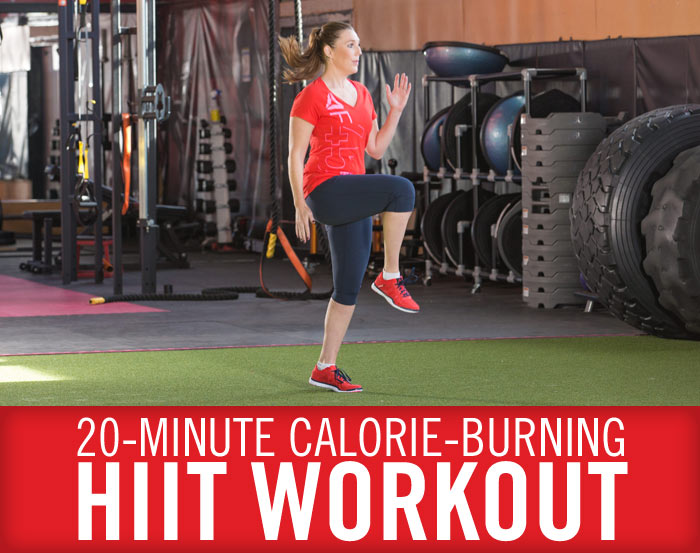
20-Minute Calorie-Burning HIIT Workout

HIIT workout

With the holiday season in full swing and the hustle to get end-of-the-year projects complete, it’s easy to stray from our regular exercise habits. Who has time for exercise when we are shopping for presents, cooking for family, running errands, traveling and attending parties? You. You have time for exercise. If your regular routine of going to the gym is getting trumped by this busy time of the year, try a high-intensity interval training (HIIT) workout that offers both fitness and calorie-burning benefits. Plus, you’ll work up a good stress-reducing sweat in a short amount of time.
High-intensity interval training features alternating bouts of all-out high-intensity exercise effort and short rest periods for a specific number of sets. These short, intense bursts of activity give you an incredible aerobic, anaerobic, strength and power workout all rolled into one. During a HIIT workout, your body metabolizes fat for fuel and after your workout your body will tap into fat stores for the energy. This makes HIIT one of the best ways to maximize caloric burn in a short amount of time. All you need is 15 to 30 minutes to reap all of these benefits of a HIIT workout.
No fitness equipment necessary for this 20-minute HIIT workout, but make sure you have water close by and a timer to keep track of the work/rest exercise intervals.
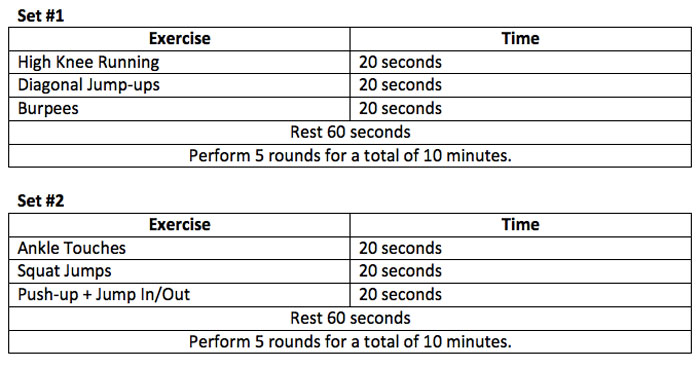
This workout includes two sets of three exercises repeated four times in row. Each exercise in the set is performed for 20 seconds followed by a one-minute rest. When set #1 is complete, move on to set #2.
HIIT workout
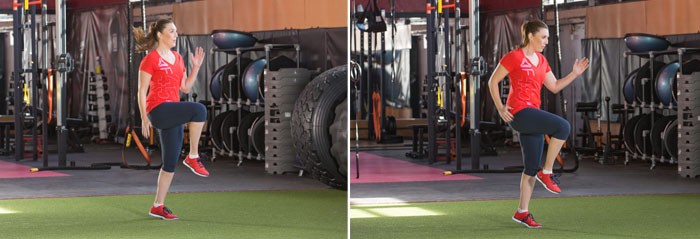
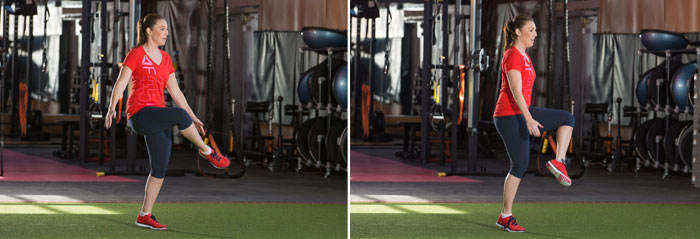
High Knee Running: Run in place, bringing your knees up toward your chest and pumping the arms as quickly as you can.
High knee running
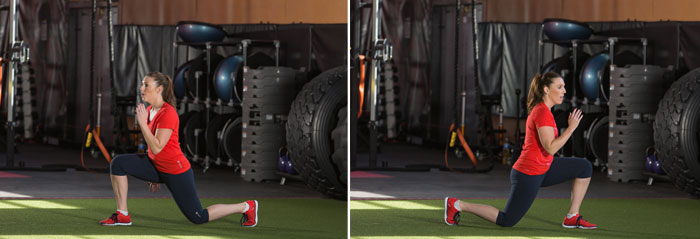
Diagonal Jump-ups: Begin in lunge position, with your right foot forward and your body turned toward the upper-right-hand corner. Push through both feet, jump up and land in a lunge position with the left foot forward and your torso facing the upper-left-hand corner.
diagonal jump ups
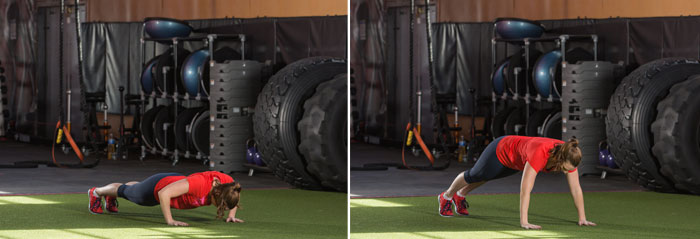
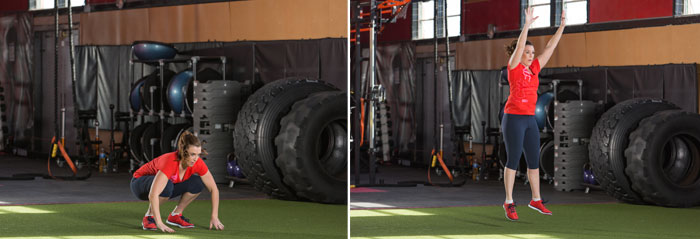
Burpees: Squat and place both hands down on the floor. Jump or walk back to high-plank position and perform one push up. Jump or walk your feet back to the squat position and immediately jump up with arms overhead.
burpee
burpee
burpee
Ankle Touches: Run in place, turning your knees slightly outward, bringing the inside of the leg up toward the chest and reaching your hands to touch the inside of your ankles.
ankle touches
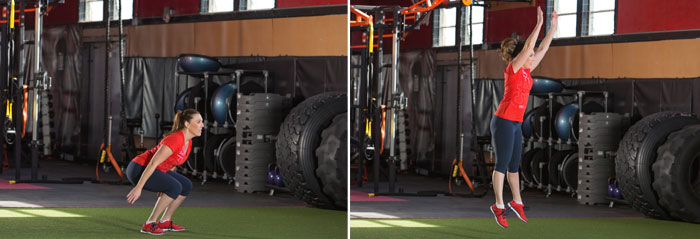
Squat Jumps: Lower down into a squat, swinging your arms back behind you. Immediately jump up, swinging your arms up toward the ceiling.
squat jumps
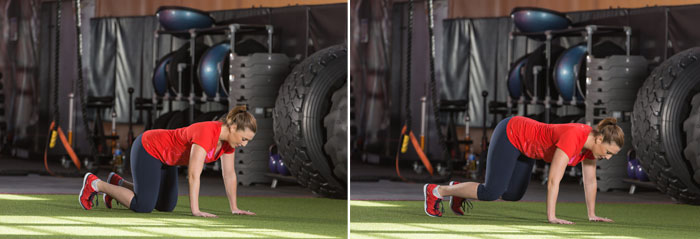
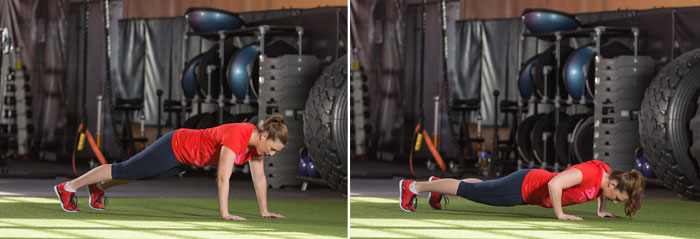
Push-up + Jump In/Out: Begin in quadruped position, with your hips over the knees and shoulders over the hands. Curl up onto the toes and lift the knees slightly off the floor. Jump or walk the legs back into high plank and perform one push up. Jump or walk the legs back into the elevated quadruped position.
push up
push up

Source : Stephanie Thielen Fitness, LLC./ Ace Fitness