Showing posts with label Cardio. Show all posts

Wednesday, 4 May 2016

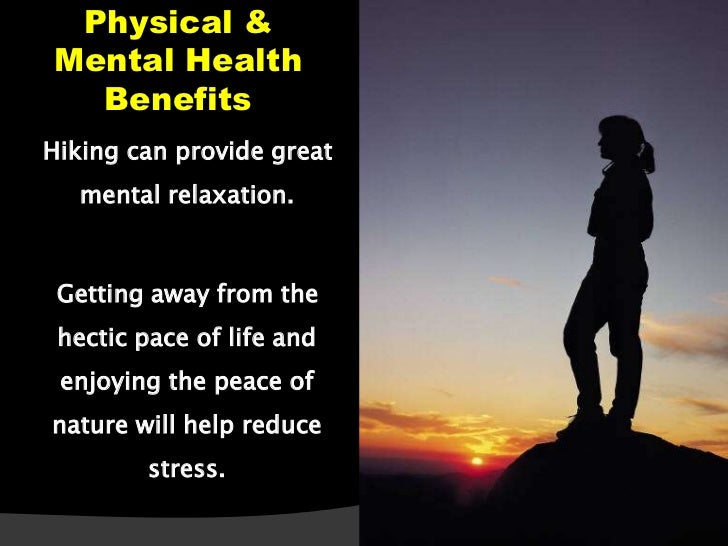
Hiking Truly Is Healthy

Hiking Truly Is Healthy
A fit body is a happy body, and one of the best ways to stay healthy is to get plenty of exercise. Hiking is an efficient way to increase your action level, while offering an excess of health benefits. Start gradually, especially if you are a bit out of shape. Invest in a sturdy pair of hiking boots and do your research first. Many hiking trails are evaluated by intensity, so get a hiking guide and start out at the level that is correct for you. Get your doctor's advice before hiking if you are pregnant or have any health issues, such as heart illness or even if you are diabetic.

Improves Your Overall Health
Hiking is an exceptional way to get outdoors and get some exercise. Hiking offers prosperity in overall health benefits and may help extend your life. Moderate-intensity aerobic exercise, including hiking at your own level, is safe for most people, according to the Centres for Illness Control and Prevention.

Lowers Your Risk of Cardiovascular Disease
Take a hike to help keep your cardiac system top shape. Regular exercise, such as hiking, helps raise your high-density lipoprotein levels and lower your triglyceride levels. This diminishes your risk of heart disease, high blood pressure and of having a stroke.

Helps Prevent and Control Diabetes
Consistent hiking helps you to control, and or even prevent diabetes by depressing your blood sugar levels. Hiking gives your muscles a workout, which transfers glucose from your bloodstream for energy. Talk to your doctor first as you may need your diabetes medications attuned when hiking frequently.

Increases Your Energy Level
Aerobic undertakings such as hiking bring in extra oxygen and fuel your muscles, organs and even body tissues. This additional oxygen provides an enhancement fuelled by a process called Glycolysis whereby energy is created when glucose is broken down and this strengthens your muscles and lungs, while increasing your stamina, attentiveness and energy level.

Lowers Your Cancer Risk
Hiking helps decline your odds of developing cancer cells. There is a lesser risk of breast cancer and colon cancer linked with regular physical exercise, and it may also drop your chances of acquiring lung cancer and endometrial cancer.

Source

Friday, 19 February 2016

Fitness Programs for Women: Four Essential Tips

Fitness programs for women are often wrought with bad advice and pseudoscience. It's no wonder that so many fitness programs for women utterly fail! There's plenty of great information out there, but it can be impossible to find amidst the gimmicks, fad diets, and ineffective workout routines. If you're looking for fitness programs for women that really work, try using the four following tips.

1. Lift Heavy Weights
Plenty of women make their way into the weight room now and again, but most are afraid that they'll get "bulky" if they lift too heavy. That's nonsense! It takes male bodybuilders years of dedicated effort to pack on muscle mass, and they've got testosterone and tons of food on their side. Not only will you not get "too big" by lifting challenging weights - you'll actually look better.
Lifts like squats, bench presses, deadlifts, and other heavy movements are great for stimulating your metabolism and packing on a little bit of lean mass. Whether or not you realize it, that's really what you want! The right amount of muscle gives you a lean, fit look that you simply can't achieve with cardio alone. Challenging yourself in the gym will also cause you to burn more calories, which means you get to eat more and still lose weight.
2. Low Fat is NOT Healthy!
Some nutritionists are still stuck in the 1980s' low-fat craze, but avoiding dietary fat is NOT going to get you the results you want. In fact, most "low-fat" products like crackers, pretzels, and other grain-based products will make it nearly impossible to get lean! They make your blood sugar levels skyrocket, which in turn causes your body to secrete tons of insulin - a hormone which actually makes your body store even more fat. If you're trying to get lean, ditch most of your carbs and eat plenty of olive oil, avocados, nuts, and even some red meat.
3. Ease Up on the Cardio
If you're going to start lifting heavy weights (which you should!), then you're also going to need to ease up on all of that cardio you're probably doing. Slaving away on a treadmill or elliptical is simply not necessary, and it eats up way too much of your time. It's great to do a few short sessions per week for your cardiovascular health, but hours upon hours of monotonous movement aren't going to help you lose fat.
However, there is a much better type of cardio for optimal fat loss: interval training! On a track, treadmill, elliptical, or exercise bike, simply alternate short bursts of all-out sprinting with longer bouts of active rest. For example, you might do eight rounds of fifteen-second sprints and forty-five second "jogs" on an elliptical machine. The whole thing will be over in under ten minutes, but the intensity of the workout will cause your body to burn more fat all day long.
4. Don't Under-eat
One of the worst things you can do in fitness programs for women is to eat too little. Your body is an adaptive machine, and it will respond to severe calorie restriction by slowing its metabolism way down. Have you ever noticed how lethargic, tired, and cold you get when you don't eat enough? Those are sure signs that your body is burning less fuel!
That's not to say that you shouldn't cut calories at all - your body does need a reason to use its fat stores for energy instead of your food. The key is to eat just little enough that you can burn fat while avoiding hunger. Focus first on the right food choices, and then start counting calories if you truly need to. Overall, it's best to take it slow and steady with your fitness programs for women and focus on losing no more than a pound per week.

Monday, 21 December 2015

5 Tips for Starting a Fitness Routine


Take the dread out of getting fit! It really doesn’t have to seem like an chore to get a fitness routine going, and stick with it. You’re most likely to follow through if workouts are planned in advance and you have realistic goals that have some flexibility.


Before you get started, remember that if you want to lose weight and feel healthy, you’ll need the right foods to fuel your body. You might like 11 Top-Rated Skinny Recipes Under 275 Calories, 5 Guilt-Free Comfort Foods with Fewer Than 275 Calories, and the 7-Day Clean Eating Menu.


1. Take Small Steps

Studies show it only takes 20 minutes of exercise for the brain to release the feel-good endorphins that lift your mood. Start with 20 minutes, then add about 10 minutes to the workout each week to ease yourself back in. If you’re really pressed for time and need a jumpstart, try Beginner’s 4-Minute Fat Blaster Workout or 4-Minute Lean-Down Workout.


2. Schedule Your Workouts

You know how it works. If you don’t schedule something, it doesn’t happen. Treat your fitness routine like any other important commitment and give it the priority it deserves. You’re worth it!


3. Try Something New

The best way to beat the holiday fitness slump is to enjoy your workout. Let’s face it. If you hate to do a specific exercise, you aren’t going to keep it up. After all, not everyone is designed to be a runner. Don’t be afraid to try new exercises and figure out which ones work best for you.


4. Find a Workout Buddy or Group

Team up with a friend who will keep you motivated and on track for success. Fitness classes are a smart way to stay motivated, too, because you can share and receive support from other class members.


5. Embrace Weights

The ideal workout combines cardio and strength training. Yes, strength training! Women are often afraid to lift weights out of fear of developing man-muscles. However, pumping iron tightens the body while boosting metabolism for faster weight loss. Try this 4-Minute Kettle Bell Fat Blaster.

These tips for jumping into a fitness routine will help get your body back in gear now that the holidays are over.

Source

Saturday, 24 October 2015

Does Fasted Cardio Provide Significant Benefits?

One recent trend that has received a significant amount of attention, both in the online blogosphere and in traditional fitness media, is the idea of performing exercise first thing in the morning on an empty stomach. The practice of exercising in a “fasted state” has been promoted as a way to burn more calories from fat than from carbohydrates, making it an effective way to boost the fat-burning effects of exercise. 

There are a couple of theories on why doing cardio in a fasted state first thing in the morning may be more effective for fat burning. For example, cortisol is a hormone that helps promote the metabolism of fat for energy. One theory suggests that, because cortisol levels are higher in the morning, exercising on an empty stomach will lead to greater amounts of fat burning. A second theory posits that, because the body’s resting metabolism continues to work overnight while the body sleeps, lower levels of carbohydrates will be available for fuel before breakfast. As a result, the body will have to rely on fats as the primary energy source for any physical activity. 

Research exists to support both theories. For example, studies have shown that fasted exercise can help endurance athletes burn higher levels of fat than carbohydrates. However, while there may be some benefit to exercising on an empty stomach, here are three specific reasons why fasted exercise may not a good choice over the long-term. 
  1. Exercise in a fasted state could burn more calories from fat, but it also could cause the body to burn protein for fuel, which would reduce the amount that can be used to help repair and build muscle tissue. Gluconeogenesis is the process of converting proteins to glucose for energy. In short, if carbohydrates (glycogen in muscle and liver, glucose in the blood stream) are not immediately available for energy, the body can convert proteins for fuel, which leaves fewer proteins available to rebuild muscle post-exercise.
  2.  
  3. The body has plenty of free fatty acids (FFAs) available for exercise. The FFAs that are not immediately converted to energy to fuel muscle activity can be redeposited in adipose tissue in the abdominal region. In other words, they will end up as belly fat. Exercising when cortisol levels are higher could lead to more FFAs circulating in the blood than can be used. So, rather than depleting levels of fat, exercise first thing in the morning could actually shift body fat to the abdominal region.
  4.  
  5. If the goal is weight loss by metabolizing as much fat as possible, it is more important to consider energy expenditure over a 24-hour period and not just at one point during the day. Monitoring energy intake and expenditure throughout the day and identifying how to reduce excessive intake and increase opportunities to move can play a more significant role in long-term weight loss than trying to burn more fat by exercising first thing in the morning. 
While it doesn’t offer a viable long-term solution, exercising in a fasted state could be a SHORT-TERM technique for helping a client achieve a specific body-composition goal. Here are three things to consider about using fasted exercise: 
  1. For years, bodybuilders and figure competitors have utilized fasted exercise to help reduce body fat prior to a competition. This is because low-intensity, steady-state (LISS) exercise below the first ventilatory threshold will rely on FFAs as the primary fuel source. To be most effective for fat burning, exercise in a fasted state should focus on LISS, where the intensity is low enough to allow the client to talk comfortably during exercise. Exercise at higher intensities will metabolize more carbohydrates and require more oxygen; therefore, the rate of breathing will increase to bring in more oxygen and exhale more carbon dioxide, which will make talking difficult.
  2.  
  3. The body is an extremely adaptable organism. If the same exercise is performed at the same intensity for an extended period of time, the body will become very efficient at producing energy to fuel the activity. Doing fasted exercise first thing in the morning could help a client move past a sticking point, but after a period of time the body will adjust to this condition. That’s the signal that it’s time to change the workout.
  4.  
  5. A client may like to exercise first thing in the morning and simply prefer doing so on an empty stomach. If this is the case, help them maximize energy metabolism by recommending LISS over higher-intensity exercise protocols. If a client wants to participate in high-intensity exercise first thing in the morning, it is important that he or she know how to properly fuel after the workout. 
It’s important to note that eating a meal or snack too soon before exercise can raise the levels of insulin, which helps metabolize and store fat. If insulin is elevated prior to exercise, the result could be fewer FFAs available for energy. A low-glycemic snack more than 30 minutes prior to exercise can provide energy for a workout and reduce the risk of elevating insulin levels. 

Finally, keep in mind that substrate utilization for producing the energy required to fuel workouts is regulated by a number of variables, including hormone levels, available nutrition substrates, enzyme activity and the intensity, duration and type of physical activity. Exercise in a fasted state could provide some short-term benefits, but the downside is that it could also limit the amount of protein available for muscle building. It’s more important to help clients identify ways to be more active throughout the day and guide them toward healthier nutrition choices than it is to recommend working out at a specific time of day. 

Source ACE :  Pete McCall Health and Fitness Expert

Monday, 19 October 2015

Cardio-Boxing for Super Fitness

Sports scientists agree that cardio-boxing is one of the best forms of exercise, because it conditions the total body and provides a complete workout for your cardiovascular and endurance systems.

The major benefits of cardio-boxing include:

 Increased Stamina
 Increased Strength
 Increased Speed
Increased Coordination

Cardio-boxing also promotes a person’s well being by strengthening their self-discipline and combined with strength training it’s well and truly the total package for self-defence and fitness and usually consists of:

 Adjusted heart rate work 
Actual boxing techniques 

 The usual workout consists of the age-adjusted heart rate work starting with 10 minutes for beginners and leading up to 20 minutes for the more advanced.  For the second part of the workout, you’ll need to perform and practice 20 minutes of actual boxing techniques.

 Cardio

The best way to measure the effects of an exercise program on your body is to check your pulse.

The easiest way to check the pulse is to place your index and middle fingers on your carotid artery or the wrist. Immediately after the exercise, count your pulse for 15 seconds and multiply by 4.

You can also check your pulse during the exercise but with safety as a first priority. To get a more precise reading of your pulse rate, purchase an electronic device from any sports store.

Now you have your exercising pulse rate or heartbeats per minute.  We’ll be concentrating at the upper end of your pulse region: the 50% - 70% ranges. 

To figure this out, deduct your age from 220. Suppose your age is 40, deduct this from 220 and you get 180. 

50% of 180 is 90 beats a minute,
60% of 180 is 108 beats a minute,
70% of 180 is 126 beats a minute and so on.

Don’t jump into 70% work straight away. Start with 50% and slowly work your way up to the 70% upper limit.

Start with no more than 10 minutes, and work up to 20 minutes. Once you’re comfortable with working out for 20 minutes at 70% then try to increase the heart rate up to 80%.

Mix up your cardiovascular activities in the gym. Use the treadmill, skipping, rower, climber, and bike and other equipment that might be available to you.


Boxing

The boxing stance is the posture a boxer takes before and after every action depending on whether you are left or right handed. We’ll be dealing with the most common; right-handed. For left-handed people, just reverse the instructions.

Stand with your feet shoulder width apart, with your left foot in front of your right foot. Your right heel should be slightly raised with your left foot flat on the floor and toes pointing ahead.

Bend your knees a little and balance your weight comfortably and evenly.
Place your elbows close to your body with your left fist held at head height and in a position that corresponds to your left foot.

The right fist should be at head height also and guarding the chin, with both elbows protecting your body and both fists protecting your chin.

This is your defensive and offensive position after throwing punches, so please practice this before going any further.  When moving forward in this boxing stance the left foot moves forward first and then the right follows.

When moving back, the right moves back and then the left follows.  When moving sideward to the right, the right foot moves first followed by the left.  When moving sideward to the left, the left foot moves first followed by the right.

Practice this moving forward, back and sideward in the boxer’s stance until it is done smoothly and quickly. Remember to keep your guard up and elbows tucked in to your sides.

Keep your head at eye level with your upper body leaning forward slightly.   In boxing it is important that punches are thrown quickly and then bought back quickly to assume a defensive posture.
             
Punching

A left jab has many uses, it can be used for both offensive and
Defensive actions. From the set stance the left arm is pushed quickly and forcefully forward, the weight is shifted to the front foot. The fist moves in a straight line and straight back again for defence.

At the moment of impact the back of the hand and the lower arm are in a straight line. Keep the right fist in the defensive position and elbow tucked into the body during the movement.

The straight right is also known as the punching hand and can be thrown with considerable force. The arm moves straightforward from the chin, the body weight is shifted to the front foot with the ball of the foot of the back leg pushing into the floor for more power.

The back of the hand is straight and pointing up at the moment of impact. The arm is then immediately pulled back for protection after the hit.

The left hook to the head and body is an effective punch for closer range work. From the set stance turn your left shoulder quickly and move your elbow up to shoulder height. The fist moves in a circular motion to the target, with the elbow bent.

Rotate your hip and body whilst pressing your front left down keeping the back of your fist pointing up and in a straight line with the lower arm. The left hook to the body is similar to the above but increases the rotation of the body

The right uppercut is also carried out at close range. Drop the lower part of your punching arm until the lower and upper arm is at right angles to each other. The back of your hand should be pointing away from you, now thrust your arm forward and upward to your target.

Shift your body weight to your front leg and rotate your hip and shoulder on the same side. Remember to keep your left fist guarding your chin during the entire movement. Now practice all your punches until they are done quickly and smoothly.

To develop speed and endurance, try punching straight left and right combinations into the heavy bag. The duration of the exercise period is the same as the rest period i.e. 10 seconds exercise, 10 seconds rest, 20 seconds exercise, 20 seconds rest, and so on. Move up higher as your condition improves.

Damian@FitnHealthy


Wednesday, 14 October 2015

Jillian Michaels Banish Fat Boost Metabolism Cardio Circuit

Jillian Michaels Banish Fat Boost Metabolism Cardio Circuit 3 fires upyour metabolism to help you lose weight fast! 

Jillian Michaels's fierceformula adds strength and ab exercises to dynamic cardio for increasedfat loss. 

Boost your body's calorie-burning power and lose up to 5pounds a week with Banish Fat Boost Metabolism.

Wednesday, 23 September 2015

Great Home Workout Exercises For Fast Muscle

Recommended muscle building at home involves total body workout targeting the entire body; chest, back, shoulders, arms, legs and abs. One should note that people with co-existing injuries, illnesses or other condition, a doctor should be consulted beforehand to avoid further aggravation of the condition.

Equipment Needed
A barbell, dumbbells of various weights, an exercise ball, a weight bench, and an exercise mat.

Few examples of workouts to try at home:

Before starting, do a warm-up session of 5 minutes of light cardio. For beginners, start with no weight for 1 set of 14 -16 reps and upgrade to 2-3 sets of 10-12 reps with enough weights as you progress

1. Bench press (chest)

Lie on a bench, step or floor, and hold a medium-heavy barbell straight up over your chest. Bend your elbows and lower the weight until elbows are at 90 degrees. Press back up and repeat.

1. Lateral raise (shoulders)

Hold light-medium dumbbells and, keeping elbows slightly bent, lift arms out to the sides to shoulder level. Lower and repeat.

2. Barbell row (back)

Hold a medium-heavy barbell and tip forward to 45 degrees, keeping your back flat. Squeeze back to pull the weight in towards the belly. Lower and repeat.

3. Back entension (lower back)

Lie face down and squeeze the lower back to lift your chest a few inches off the floor. Lower and repeat.

4. Hammer Curls (Biseps)

Holding medium-heavy dumbbells, perform hammer curls with your palms facing each other. For added intensity, stand on one leg for a balance challenge, switching legs with each set.

5. Kickbacks (Triceps)

Bend forward, keeping back flat and abs in, and hold light-medium weights, elbows bent. Straighten the elbows to engage the triceps. Lower and repeat.

6. Deadlifts (Glutes, hamstrings and back)

Stand with feet hip-width apart, and hold weights in front of your thighs. Tip from the hips and lower weights towards the floor, keeipng your back flat and shoulders back. Return to start and repeat.

7. Static lunge (quads, hamstrings, glutes)

Stand in split stance and bend both knees, lowering into a lunge while keeping your front knee behind the toe. Lift back up and repeat before switching sides.

8. Squats (quads, hamstring, glutes)

Place a medium-heavy barbell on the upper back/shoulders or hold dumbbells in either hand. Bend the knees and lower into a squat, knees behind the toes. Push back to start and repeat.

9. Bicycle (abs)

Lie on the floor and bring the knees into the chest. Straighten the right leg as you twist the body, bringing the right elbow towards the left knee. Repeat on the other side in a cycling motion.

 Damian@FitnHealthy


Friday, 11 September 2015

Five Ways to Make Your Indoor Cycling Workout Fun and Entertaining

   
 It's no secret that exercise is a critical element in a healthy lifestyle. It's also no secret that time devoted to working out at home can be tedious and easy to avoid. This article presents a few ideas for putting a little necessary spark into an indoor cycling routine. It will leave the reader looking forward to the next opportunity to take their indoor cycle for a spin.

Anyone with an eye on maintaining their health and fitness knows the importance of regular exercise. This knowledge is the major motivation behind the robust sales of home exercise equipment over the past few decades. 

Everyone starts out with abundant enthusiasm about how they plan to get on that treadmill, rowing machine or indoor cycle every day and finally get into the best shape of their lives. After all, they reason, if the equipment is readily available right inside their home, what possible reason could there be for them to fail at meeting their goals?
Reality sets in when treading, rowing or cycling gets to be monotonous and tedious. One workout looks depressingly like every other workout and the scenery never changes. This could be a recipe for failure.
Before you turn on the 6:00 news while you pump out another grueling session on the indoor cycle, consider a few more interesting options to add a little more fun to your time.
1) Buy a DVD on location. There are literally hundreds of cycling videos available. Many are road trip excursions where you can ride through the streets of Paris or along the Pacific Coast Highway. You get to enjoy the sights and sounds of another venue while you take care of your health. You can either listen to the music on the DVD or turn down the sound and use your own playlist for inspiration.
2) Buy a classroom DVD. These DVDs are instructor-led classes where you are actually part of a cycling class in a gym. Other students are exerting themselves right alongside of you as the instructor prompts you to stand, sit or increase the tension on your bike while offering words of encouragement. Some of these instructors can be hypnotically inspirational.
 
3) Create a proprietary area in your home for your cycling. Skip the living room or family room where other people and distractions abound. Create a secluded area where you can shut the door, turn off the lights, light a candle, set up the DVD player and get into the mood for your activity. Make it a special time devoted to you alone.

4) Find an exercise app or website where you can log your progress. Accountability is a great way to add inspiration to any endeavor. Find like-minded people on social media and set up challenges for each other. A competitive spirit can push you further than any sense of obligation you may feel to your exercise program.

5) Dress for success. Avoid the faded old shorts and torn tee shirt. Proper biking shorts and jersey will make you feel like the athlete you are. If you were willing to put your money into buying your own indoor cycle, you should be willing to extend your commitment by investing in one or two sets of appropriate workout garb. Looking the part will inspire you to act the part.
Working to achieve a fit and healthy body begins with a fit and healthy mental attitude. Anything you can do to add interest and spark to your workout routine will pay off in huge benefits on your cycle.

Monday, 7 September 2015

5 Components of Physical Fitness

While the definition of physical fitness can be a little complex or unclear and the definition of physical fitness can vary, most government health agencies and exercise scientists agree that there are 5 components of physical fitness related to health. 

These components provide a fairly accurate representation of how fit and healthy the body is as a whole (total or overall fitness). 

The 5 components are cardiovascular fitness (also referred to as cardio-respiratory endurance or cardiovascular endurance), muscular strength, muscular endurance, flexibility, and body composition.
Let's take a closer look at these components individually.
 
 1.) Cardiovascular fitness (or cardio-respiratory endurance or cardiovascular endurance)
Of the 5 components, cardiovascular fitness is the cornerstone that creates the pathway to improving your other fitness levels.
Cardiovascular fitness is the efficiency with which the body (the heart and lungs) delivers oxygen and nutrients to the required working muscles and transports waste products from the cells over a sustained period of time. Or to put it another way, it's the ability of your heart and lungs to work together to provide the necessary oxygen and fuel to your body without quickly reaching a high level of fatigue and tiredness.
In our daily lives, we need cardiovascular fitness to handle the physical tasks and all of the "running around" we do.
A common test of cardiovascular fitness usually involves some type of sustained running. But typical examples of physical activities that relate to cardiovascular fitness are jogging, swimming, cycling, brisk or speed walking and any type of aerobic exercises. Aerobic exercise is the best way to improve cardiovascular fitness.

2.) Muscular strength
Muscular strength is the maximum amount of force (weight or heavy resistance) a muscle or muscle group can generate in a single effort to the point that no more repetitions can be done without rest. Muscular strength is quite the opposite of cardiovascular fitness in regards to the fact that cardiovascular fitness is measured over a certain period of time. While on the other hand, muscular strength is measured in one repetition.
In our daily lives, we need modest levels of strength to be able to perform everyday physical tasks like lifting, moving, carrying, etc.
A common test to measure upper body strength is some type of weightlifting exercise, such as the bench press. Anaerobic weightlifting exercises like the bench press, leg press, shoulder press, or bicep curls are examples of the best ways to improve muscular strength.
 
 
3.) Muscular endurance
Muscular endurance is the ability of a muscle or group of muscles to perform repeated movements (or to hold a particular position) with less than maximum force for an extended period of time or until muscular fatigue. Or, to put it simplistically, it's how long your muscles can do something before getting too exhausted to finish.
Be careful not to confuse muscular endurance with muscular strength. While they can work together, they are definitely not the same. For many athletes, there may be a need to distinguish between muscular strength and muscular endurance. But for everyday people who want to easily perform their daily routines, are trying to stay healthy and fit, and just want to enjoy physical activities like hiking, biking, or just playing in the park with their children, muscular endurance plays a major role in fitness.
Common testing for muscular endurance can be dynamic (the ability to repeat contractions) or static (the ability to sustain a contraction). Dynamic tests would be to see how many push-ups or sit-ups, for example, a person can complete in a designated amount of time (e.g. 30 seconds, a minute, or maybe longer). Or, without being timed, the person could do as many repetitions of the exercise as they could until they couldn't do anymore. An example of a static test would be the flexed-arm hang whereby the performer hangs on a bar until the designated stopping time or until they become too weak to continue hanging.
Muscular endurance can be improved by both aerobic and anaerobic exercises. Some examples would be biking, step machines and elliptical machines.

4.) Flexibility
Flexibility is the ability to move the joints or any group of joints, muscles, ligaments, and tendons through their full, normal range of motion without hindrance, discomfort, or pain.
Flexibility is actually more important to physical fitness than people realize. Not only does flexibility play a big role in performing many daily tasks, but maintaining or even increasing your flexibility is critical to protecting your joints and keeping them healthy. In addition, being flexible contributes to improving your lower back health, reducing the appearance and effects of arthritis, and reducing muscle-tendon injuries.
Not everyone has the same flexibility or flexibility requirements. Your flexibility tells you how limber you are. And, when it comes to testing your flexibility fitness level, the sit-and-reach test is most often used.
Stretching is the best way to improve flexibility. And, most fitness experts recommend a daily routine of static stretches for each joint.

5.) Body composition
Body composition is the percentage of fat in your body compared to your lean body mass (muscles, bones, tendons, ligaments, organs, etc.).

Body composition is a better indicator of your overall fitness condition than body weight. So understand that your total body weight or what you see on your bathroom scale does not tell you how much fat or lean body mass (muscle) you have.
Body composition is useful in helping to determine health risks. Therefore, knowing your body composition and how it relates to your overall fitness level is essential. An optimal ratio of fat mass to lean mass is a clear indicator of good fitness.
 
Your body composition is a consequence of the extent that you perform the other components of physical fitness. In other words, when you improve the other four components, it will have a positive impact on body composition resulting in less body fat. Alternatively, when you have a high body fat content ratio, you are considered overweight or possibly obese. And, it negatively affects the other fitness components as well as your daily performance, your appearance, and your overall health.
There are several methods that can be used to calculate body composition. The best method is underwater weighing. But due to the expense, this isn't practical for the everyday person. Incidentally, if you can go to a university or some other place that is set up to do it, it would be well worth your time to check it out. Therefore, the most common method of determining your body composition is skinfold readings - using skinfold calipers and taking measurements from certain areas of your body.
A regular program involving aerobic exercise and strength training can help you decrease your body fat and increase your muscle mass; and thereby, significantly improving your body composition and general overall health and fitness.

In conclusion, you now know that being fit is not just about being able to bench press a lot of weight, but you also need to know how well you can handle running a mile, for example, and a few other things. The key is that by understanding the 5 components of physical fitness, you'll be better able to assess your fitness level and determine what specific health and fitness goals you'd like to achieve.

Source:Donald Holland Ezine

Thursday, 3 September 2015

Pre- and Post-workout Nutrition for High-Intensity Interval Training

 
High-intensity interval training (HIIT) has become hugely popular thanks to real results in shorter periods of time and extensive benefits. With busy schedules the norm, it’s no wonder so many clients and potential clients are now seeking out these kinds of workouts.

HIIT, which involves repeated sessions of relatively brief, intermittent exercise, usually performed at very high intensity, can be easily modified for various client needs and fitness levels. When combined with an expert nutrition program, personalized HIIT programs can elicit serious results and health benefits, including: 

Improve blood pressure and cardiovascular health
Improved insulin sensitivity
Improved body composition

Whether you’re adding HIIT to your own personal fitness program or ramping up client results and health benefits with this style of training, it’s important to understand the nutritional needs to support it from start to finish. While nutritional needs do vary by individual and training program, these nutrition plans and meal ideas for pre- and post-workout nutrition can help.
General Nutrition to Support a H.I.I.T. Program 

To get the most out of any fitness program, you should follow a healthy meal plan in general. Effective and well-rounded nutrition programs are based on a variety of healthful ingredients such as whole grains, fruits and vegetables, and lean proteins. The best nutrition plans provide adequate calories and macronutrients such as carbohydrates to fuel the body and provide energy stores for workouts. It’s important that these are expertly created programs that allow you to stay within your scope of practice and prevent clients adopting a restrictive diet that may inhibit their success. Adequate water is also a must to ensure complete hydration during workouts.
 
Pre-workout Nutrition for HIIT

Due to the intensity of these workouts, it’s vital to follow a healthy nutrition plan with adequate nutrition in the days and hours leading up to a workout. Plan on a moderate- to high-carbohydrate meal that also includes protein approximately three to four hours before the HIIT workout, and then another high-carbohydrate snack within an hour after the workout. Good options for a pre-workout meal include: 

Whole-wheat toast with peanut butter and banana
Non-fat Greek yogurt or cottage cheese with fruit
Dried fruit and almonds
Post-workout Nutrition for HIIT

The biggest nutritional concern post-workout is replacing energy stores (glycogen) and repairing muscles that have been broken down during the intense workout. Again, a combination of carbohydrates and protein has been shown to be most effective. Research shows that a 3:1 ratio of carbohydrates to protein within 30 minutes of completing a HIIT workout is best for replacing energy stores in preparation for the next high-intensity workout. 
 
Suggestions for post-workout nutrition are similar to pre-workout meals and include:
Whole-grain cereal with fruit and soy milk
Whole-wheat crackers with fruit and cheese
Hummus and pita bread

The best pre- and post-workout nutrition boosts energy and results—and motivation. 

Reference Gibala, M.J. (2007). High-intensity interval training: New insights. Gatorade Sports Science Institute Sports Science Exchange, 20, 2.

Saturday, 22 August 2015

10 Steps on Improving Your Metabolism

Get 10 tips on how you can increase your metabolism, naturally. You'll be surprised at how little things can affect your metabolism in a big way.

Are you sluggish and low on energy?

Do you feel like you work and work toward your weight loss goal and never seem to make any dramatic improvement?

You could be suffering from a slow metabolism. Even though you may have a slow metabolism, it does not have to destroy your weight loss efforts. You can dramatically improve your metabolism, and boost your energy levels without taking supplements.

Your metabolism simply refers to the conversion of food to usable energy by the body. It is the biological process, by which energy is extracted from food, and the net result is how fast or slowly the body burns those calories.

A few steps you can take to improve your metabolism naturally are:

Drink Water – Water is great to drink and you should be drinking a minimum of 8 to 10, glasses daily, of course, more is better. It will help increase your metabolism and flush out sodium, toxins, and fat. Drinking water before meals will fill your stomach so you feel full and prevent overeating. Avoid excess colas, coffee, teas, and sugary juices. Caffeine will dehydrate you, and the sugar will do more damage than good in the long-run.
  
 Eat Every Three Hours – Eat a small balanced meal every three hours, including snacks. Meals and snacks should be balanced, meaning they should contain a complete protein, carbohydrates, as well as natural fat. Failure to eat consistently can lead to a slower metabolism and fat storage. Also, skipping meals slows down your metabolism. To ignite fat loss you need to be consuming the right foods in a balanced manner throughout the day.

Don't Skip Breakfast – Breakfast is the most important meal of the day because it gets your metabolism running in high gear. You wouldn't drive your car to work on an empty tank, and you shouldn't start your day without adequate nourishment. Your first meal sets your metabolism for the day and keeps it going, as long as you eat every three hours. If you get up early and eat a late breakfast, you miss out on several hours of burning calories.

Don't Fear Fat – Fat has developed a bad reputation. Many people think fat makes you fat. This is false. The type of fat and how much fat you eat impacts your body fat composition. Fat is needed by the body. Those who follow a very low-fat diet have a harder time ridding their body of fat. Choose natural healthy fats such as olive oil, avocados, various nuts, flax, and natural peanut butter to receive your necessary fats.

Omit Trans Fat – Trans fat is the bad fat, the cause of weight gain, low energy, depression, cancer, and heart disease. You will never get the body you desire by eating "healthy" fast food, frozen dinners, and other processed choices. If it's man-made, it's not the best choice, and will halt fat loss endeavors. Eat the foods Mother Nature has provided to meet your fat loss goals.

Be Active Daily – Stay active at least six days a week. Take the stairs when possible or park further out to get that little bit of extra movement to keep the heart and lungs working optimally. The more movement you get daily, the better you will feel overall.

Do Cardiovascular Exercise – Cardio exercise is necessary for heart and lung health. It also burns calories. Doing cardio first thing in the morning on an empty stomach can tap into fat stores, and keep your body burning calories at a high rate for about an hour after cardio is finished. If you fail to eat adequately daily, first morning cardio on an empty stomach can work against you. Doing morning cardio on very low calorie diet can burn muscle. Another good time to incorporate cardio is in the evening after your last meal. This allows you to burn calories so you are not sleeping on them. You do not have to implement a morning and evening session, choose one or the other or cycle between the two to prevent staleness and boredom.

HIIT It – Blend some High Intensity Interval Training (HIIT) into your cardiovascular program from time to time to give your body and metabolism a good shock. The body is programmed for adaptation. Therefore, doing the same cardio format day in and day out can become stale really fast. Take one or two days a week and implement some HIIT to give the body an added shock.
 
HIIT is basically alternating low intensity and moderate to high intensity cardio training.  For example, a 20 minute HIIT session would look similar to this:

Minute 1 and 2 – Low Intensity (Walking) Minute 3 and 4 – High Intensity (Light jogging or running) Minute 5 and 6 – Low Intensity Minute 7 and 8 – High Intensity and so on…
 
Weight Train – Resistance training builds muscle, which is metabolically active tissue. The more muscle you acquire, the faster your metabolism will be.  Adding more lean muscle tissue to your body will put curves in the right places and allow you to eat more calories a day.

Listen to Your Body – Killing yourself with workouts is just as dangerous as not working out at all. Listen to your body and get proper rest. Don't train if you are ill, still sore from the previous workout, or just simply too tired. Training in such a state can cause more problems than it solves.

If any of the above fails to prove results in 4 to 6 weeks, there could be an underlying problem, such as a food allergy, sluggish thyroid, hormonal imbalance, toxins, parasites, etc. If so, I recommend searching for a natural healer in your area to determine the cause. and work from there. For the most part, proper diet, detoxifying, and herbs can correct any ailments.

Damian@FitnHealthy

Tuesday, 18 August 2015

5 Myths about the Fitness Exercises


1. Sport is for professionals. This idea applies only in the case of performance sports. The native qualities required for professional sportsmen (speed, skills, specific height, etc.) can only be developed, they can't be formed by training. As long as the aim of a regular person is not performance, almost all sports can be practiced for keeping the body in a good shape. It's all about dosing the training you chose, so that the benefits are bigger than wear and tear. Even the sports considered tough can be practiced in a 'soft' way (tae-bo, mini-triathlon, jogging, etc.).

 2. Training is tiring. This idea is true as long as it refers to consuming all your energy (muscular and hepatic glycogen), but it doesn't mean that training gets you into that state of exhaustion which would slow down the process of recovery of the body. Even in performance sports, the purpose is to have rather effective than exhausting training, so that the body can get the stimulation necessary to qualitative progress from one training to the next.

Even more than in other sports, in fitness the sportsman is spared overexerting. However, the training must not become ineffective. People can come to the gym tired after a work day and leave relaxed (physically and psychologically) and not more tired. This is extremely useful for people with sedentary jobs, but also for those who make physical effort at work. They could use the training by choosing a type of effort meant to compensate the one involved in their job.


3. Training takes too long. Again, this idea is true if applied to performance, which can only be obtained by working a lot. But also in this case short and very intense training or training for relaxation and recovery are often performed. In fitness, you can get to 20-minute training, working only super-series of fast exercises, which could involve, directly or indirectly, all the muscles. Anyway, regular training shouldn't take longer than an hour and a half. Otherwise, the body will get into the catabolic faze, when the cortisone secretions 'cannibalize' the muscles.
  
4. Any type of exercise is good for solving your problems. What's true in this refers to some particular cases like excess of adipose tissue. This tissue can be 'melted' by any kind of aerobic exercise (running, cycling, swimming) if this is continued long enough. Even in these cases it was clear that some exercises are more effective than others. There are situations when only a combination of exercises with a certain amount of each, can provide you with the results you expect. More than that, repeating the same exercise all the time can have as a consequence not only losing balance in the antagonist muscles and in the joints involved in training, but also stopping progress or even regressing.

5. You're older? No more exercises! This is true only if we refer to extremely demanding efforts (really heavy weights, fast running, jumping, etc.). There are lots of exercises adapted to different ages. Their purpose is to keep and improve health and also to improve physical shape. The development of movement parameters for older people refers especially to muscular and cardio-vascular resistance as well as mobility of the joints. Because the final purpose of training is not preparing for a competition, the exercises can be organized gradually according to their difficulty, eliminating the risk of accidents. Because it's based on perseverance, fitness can be adapted without problems for older people and even for people suffering from different affections specific to old age.

Damian@FitnHealthy


Sunday, 16 August 2015

Gavin Aquilina’s Tabata Training 101

In this article, Gavin Aquilina says we need to ask “why?” more often, in order to be better fitness professionals.

Tabata training doesn’t work!? How can somebody say that?

Tabata training would be one of the most misunderstood and misused terms in cross training, fitness and fat loss.

Quite often a high intensity circuit using a 20-second work effort followed by a 10 second recovery, repeated 8 times, is called a Tabata circuit. It might use for example, burpees, push ups or mountain climbers as a Tabata exercise and sometimes a combination. After a period of recovery the circuit is repeated 3 or 4 times over a 40 minute time period. This is not true Tabata training.

True Tabata training, is a warm up, followed by 20 seconds of work at 170% of your VO2 Max with a 10 second recovery (VO2 Max is the maximum amount of oxygen your body can use during exercise). This is repeated 8 times for a 4-minute workout.

This true Tabata protocol is very effective at increasing VO2 Max and explosive anaerobic power over a 6 week period. And in its true form, it is only a 4 minute workout. Therefore Tabata may spike your metabolism BUT it is not of great enough duration/volume to promote significant calorie burning and in turn fat loss.

The timing protocol of 20 seconds work followed by 10 seconds recovery, reflects the Tabata methodology. Determining 170% of VO2 Max for many of the selected exercises cannot be done. For example in a park or gym floor, it is very hard for me to measure and therefore do, 170% of my VO2 Max on burpees.

In actual fact if you complete the true Tabata protocol (20sec + 10 sec x 8 repeats) on an exercise bike or cycle ergometer and then give yourself a 4 to 5 min low intensity active recovery, it is impossible to complete another sequence of the Tabata protocol for 8 repeats. If your lucky you will possibly achieve 6 repeats or 3 minutes. Give yourself another 4 to 5 mins recovery and once again the numbers will drop down to around 4 repeats or 2 minutes.

It is important we ask questions such as, how can we:
Apply Tabata for fat loss?
Apply Tabata for fitness?
Complete in field VO2 Max tests and calculate Tabata speeds/distances?
Is Tabata better than long duration for increasing VO2 Max?

It is so important as an industry, that we ask more WHY’S and don’t just blindly follow a trend. Understanding what and why we are doing something is so very important.

Ask More WHY’S! 
Article by Gavin Aquilina.

Wednesday, 12 August 2015

How To Select Your Dream Crossfit Shoes?

May possibly not be considered a bad idea to choose a pair of crossfit shoes for you, however it would definitely not best if you get this choice irrationally. Before going for this kind of choice, you've got to ensure that you are making certain that the company you might be selecting is satisfying some basic options that come with the best crossfit shoes. Many of these features are already discussed the following:
1.Versatility
The one thing you shouldn't compromise may be the versatility of the brand you will choose. This means that your brand should not be limiting you to only some products. There should be a wide range of products open to ensure that you can pick the pair of shoe that truly suits your personality and overall looks.
2.Affordable Price Range
Rationally speaking, what can function as the use of this type of brand which can be offering a good quality from the product but in a type of price range that merely falls out of one's cost range? Certainly, choosing this kind of brand would simply to place an extra stress on your pocket. Therefore, it is always very crucial that the brand you will choose should be very reasonable too.
3.Longer Life from the Products
Remember, these crossfit shoes for women are high price products. You got to make certain that your brand should offer a good quality for these products which do offer a lengthier lifetime of the shoes.

The bottom line is, the best possible things to be considered while deciding on the best crossfit shoe are excellence of the shoe, cost range with the shoe, color combination or perhaps the versatility with the shoe brand and the reliability of the merchandise. Wherever you are going to locate an amalgam of these items together, you've got to ensure that this is actually the right time to strike the chord and select the shoe for adding feathers to your persona. Plus a closer take a look at all international brands currently operating on the market, probably no brand offers a better amalgam of those things than Reebok. This brand has earned significant amounts of name on the time frame and it has won the trust of the customers around the world. From quality to price range and from versatility for the life of the product, this brand is merely outstanding and having a presence of its own. What exactly are you waiting for? Have the opportunity to hold the luxury of using these inordinate couple of shoes and let your personality flair better yet, even higher and even better!

Damian@FitnHealthy

Sunday, 9 August 2015

Vibram - The Five Finger Revolution

Every few years there is an innovation that takes the world by surprise and changes our way of life to a great extent. Vibram Five Fingers is one of those revolutionary innovations that aims and promises to refashion our idea of footwear. These thin, lightweight, and glove-like protective coverings for your feet give you the pleasure of walking barefoot, while at the same time ensure that your feet remains safe from rough edges.

The company Vibram has been in the shoe-business for more than 70 years now and is renowned for making high-quality soles. The Vibram Five Fingers are made of soft and elastic Polyamide soles that can be easily stretched to hug the outline of your feet. These Vibram soles can be washed in a machine so that you can keep them clean and fresh.
If you're one of those unfortunate people, who have to wear tightly laced shoes for long hours almost every day of your life, then you probably know how much of a burden shoes can become. The human feet have nothing less than 26 bones, 33 joints, 20 muscles, and hundreds of sensory receptors, tendons and ligaments within that little space. It is not for no reason, of course. Our feet is capable of great strength, quickness, and stamina-only, we have to hone their potential. Walking and running barefoot regularly ensures that our feet are exercised for improved performance. Shoes on the other hand change the shape of feet and make the muscles dormant. For runners and athletes, who wear running shoes, the calf muscles end up taking the burden of the pressure while the feet and the toe themselves are huddled up in foam.

Vibram Five Fingers was designed to reinvent the pleasure of 'barefooting.' It allows us to go back to the beginning, the way we were supposed to live. The moment we start using the Five Fingers to move bare feet, we experience a sudden resurge of a lot of abilities that we had lost due to years of forcing our body into unnatural movement. Gradually, we start to get back our original way of walking, the pain that we used to feel in our calf muscles or around our waist suddenly vanish, and most importantly we start feeling free and happy.

The Five Fingers from Vibram was originally designed to increase the potential and performance of runners, athletes, and other people involved in adventure sports. These people invest a lot of time, money, and energy into good shoes and exercise for their feet, while totally unaware that barefoot is the best way of movement. Vibram's Five Fingers have promoted the culture of barefoot running, and now many athletes world over find the Five Fingers their best choice. The increased grip, steadiness and quickness offered by barefoot moving with Vibram Five Fingers is useful for many, who have to make quick reflex-based movements or tackle rough terrain, muddy waters, slippery sands, and the like. The Five Fingers have already become popular among people involved in climbing, fitness training, martial arts, light trekking, yoga, canyoneering, running, pilates, sailing, boating, kayaking, surfing, flats fishing, travel, and Canoeing.

There are a few things in life that are just better in every aspect and leave no room for argument. Vibram's Five Fingers is one of them. It is a product that is not dependent on its looks but on its performance. It might be a good idea to test one of them on your feet.

Damian@FitnHealthy

Tuesday, 4 August 2015

Circuit Training Explained

Combining several exercises in to a single, high energy, workout can lead to great results for anyone looking for a quick, intense, method of building muscle and losing weight. When you combine targeted exercises for women in short intense, limited break workouts, you are circuit training!
What is it?

In Circuit training you perform a series of exercises with a very short rest period between exercises. The point is to not allow enough time between sets for complete recovery.

Why Circuit Training?

- increased work capacity 

- increase in cardio fitness 

- increase in endurance


- mental toughness 

- positive changes in body shape and composition

Why does it work?

Circuit training falls under the metabolic training category of exercises. Metabolic training refers to the amount of work done over time. For example, Cardio training is just one type of metabolic training. In contrast, strength exercises such as maximum strength and maximum speed training are not considered metabolic types of training. Generally speaking, metabolic training and max intensity training are not compatible with each other. This is why circuit training does not make you faster or stronger.

However, it can accomplish these two things:

1. It helps release growth hormones. It is hypothesized that growth hormone release allows for rapid fat loss with limited muscle atrophy. This is why circuit training can be effective at helping you burn fat while maintaining your muscle size.

2. It also leads to an increased buildup of lactic acid. The accumulation of lactic acid is not a pleasant feeling and even makes some athletes feel nauseous. We've all seen the people in the gym, or even doing physical work, that push so hard they become physically sick.

The benefit is that your body learns to deal with and compensate for the acidosis and this leads to increased strength endurance. In simple terms, this allows you to perform at maximum exertion for longer periods of time.

When is it most effective?

Circuit training works best:

- in the pre-season to increase work capacity 

- in the off season to maintain work capacity, 

- if you are out of shape and want to improve your overall fitness

Building a Circuit Training Routine

Circuit training combines a group of strength training exercises with limited recovery time between each exercise. In many exercise routines up to 2 minutes is allowed, in circuit training it can be as little as 30 seconds. Barely enough time to move to the next exercise. The primary goal of a circuit training workout is to build up lactic acid and trigger the release growth hormones in your body. Done properly, you should see an increase in capacity and endurance but not an increase in either strength or speed.

When you design a training circuit, choose exercises that work large muscle groups such as back or legs and that do not require much coordination or skill. This is because your form will be a challenge to maintain as you become more fatigued. If you feel nauseous, stop. The goal is not to make yourself become sick. When you have completely rested, on your next workout, increase you amount of time you rest between exercises until you can complete your circuit. Once you can complete the entire circuit you can begin to reduce the rest intervals.


Circuit Training VS Weight Lifting:

The Benefits of Circuit Training

One of the least appreciated advantages circuit training has over weightlifting is simply time management. When you less than an hour to get in a good workout, a well thought out and designed circuit or two can be done very quickly and still provide you with huge health benefits.

Additionally, since there is so little rest time between exercises your heart rate stays elevated and you continue to burn calories long after your workout is over and you have moved on to other parts of your day.

This is on top of being able to lose weight while improving your strength endurance and maintaining your overall strength and muscle size.

The Benefits of Weightlifting

Weightlifting builds strength and size. Done through high reps and sets with low weight exercises, you build your overall strength. Done through low reps and sets with higher weight exercises, you build your overall size and mass. Weightlifting also increases bone density and strength, creates greater energy and higher metabolic function, better balance and often you perform better at sports.

The exercises you put together into a training circuit can create an effective workout routine for any woman looking for results that deliver and a body that you dream of. Hard work and staying on the program is also a huge factor when trying to achieve the desired results, but a solid, well put together workout routine is paramount.

Source Don Pascoe | EZINE 

Monday, 27 July 2015

The Benefits Of Early Morning Running Exercise

If the thought of exercising in the crack of dawn only makes you wish to hit that snooze button much more, reconsider. Exercise sets the interest rate of your day. Starting off your entire day with a bang might give you a healthier mindset which means you make healthier food choices during the day. Learn about the perks of exercising at the start of the morning. It might prevent you from making excuses and keep you motivated to get out of bed, put on your sneakers and build up a sweat.

 It's a Consistent Workout

A large barrier to getting enough being active is often the fact that its hard to fit it right into a daily schedule. Its extra hard for those who have kids, work unpredictable hours, and have a somewhat spontaneous social life. Should you commit to working out in the morning, however, you̢۪re way not as likely to have the excuse of things just appearing. Plus, you wont be exhausted from the rough day at the office. Actually, people who work out in the morning have been shown stick to their exercise plans much better than people who plan to exercise in the evening.

Habit Forming

Everyone has a morning routine. You might push the snooze button around the alarm clock three times before finally getting out of bed, or jump out of bed and head toward the coffee pot. Many people may shower before breakfast or their habit would be to shower after they eat. Your routines end up part of your nature. Exercise may become part of your morning routine and something of the most healthy habits you are able to develop. Those who exercise midday or in the evening may find that occasionally they're dissuaded from exercising due to unforeseen events. Working late or high-traffic after work might make you late for the session at the gym, so you choose to skip exercising. Exercising each morning eliminates the excuses because of not exercising. Set your alarm for Half an hour earlier than you normally wake and walk for 25 minutes before breakfast every day. If walking isn't feasible, do some stretching and body-weight exercises inside your bedroom before you have breakfast. Make morning exercise a part of your daily routine, and soon morning exercise turns into a healthy habit.
Enjoy Better Sleep

For those who have trouble falling asleep at night, early morning running exercise may help. According to a study conducted by researchers at Appalachian State University, exercising at the start of the morning improves the quality of the sleep cycle and enables you to sleep longer at night. Avoid squeezing inside a workout close to bedtime as this raises your body temperature and heartbeat, which might trigger insomnia. Understanding that you have an exercise session scheduled for at the start of the morning might keep you motivated to go to bed early which means you feel energized for your morning workout.

Better Fat burning capacity

A study by Belgian researchers published within the journal of Physiology found that male test subjects who ate an eating plan high in fat and carbohydrates, and involved in strenuous exercise for 60 to 1 hour 30 minutes before eating breakfast, gained hardly any weight despite eating a calorie-rich diet. Morning exercise might not be for everyone, but the benefits may outweigh the hassle of getting up earlier for exercise. The body continues to burn fat and calories after arms exercise. Exercising in the morning when your body -- inside a fasting state -- burns fat more proficiently may improve your weight-loss efforts. While you lose fat and gain muscle mass, the body becomes even more efficient at losing fat.

More Energy

Exercise releases feel-good compounds like endorphins that enhance your mood and energy levels, an impact that can last well in to the afternoon if you get your workout at the beginning of. Plus, exercising in the morning will help you sleep better than if you exercise later in the evening, since you̢۪re not receiving that extra energy boost as you̢۪re attempting to settle in for the night.

Better Mood

Individuals who exercise in the mornings enjoy increased levels of energy throughout the day and improved mood. Exercise energizes the brain to produce endorphins. Endorphins are usually called feel-good hormones. They produce a feeling of well-being and sometimes cause the exerciser to feel a gentle euphoria, such as the a runner's high. Individuals who engage in 30 minutes or more of moderate exercise within the mornings can benefit from natural endorphins.

Damian@FitnHealthy