Showing posts with label tone. Show all posts

Wednesday, 21 October 2015

Juicing Recipes for Health: Top 10 Healthy Juice Recipes


juicing recipes for healthI remember the first time I saw someone carrying around a Mason Jar around filled with a thick green looking substance.  Inside was a kale smoothie based off of a juicing recipe that was packed: fiber, vitamins, and all the different types of green fruits and vegetables imaginable. It was in a word, incredible.
There is no doubt that juicing has taken the health world by storm, and you can hardly go a day without seeing someone gulping down a glass full of liquid produce.  If you are looking to quench your thirst through juicing, let’s take a look at the top 10 juicing recipes for health that you can make yourself.

Classic Green Juice

This is a classic green juice recipe.  For some added zing, squeeze in a few drops of lemon, and feel free to omit the ginger if you would rather your juice not be spicy.

You will need:
  • 1 green apple
  • 1 inch knob ginger
  • 5 large stalks celery
  • 1 cucumber
  • 1 large handful parsley
  • 5 stalks kale

Pink Lady Juice

If you enjoy juices that are on the fruitier side, this recipe will work great for you.
You will need:
  • 1 pear
  • 1 beet
  • 1 to 2 inches of ginger
  • 1 ½ cups of pineapple cut up into chunks

Veggie Ginger Juice

For some spice action, this is a standard juice that mixes together different vegetables.  This recipe is a great juice for the cold months to warm up your body.
You will need:
  • 3 large carrots
  • 1 beet
  • 1 green apple
  • 4 large stalks of celery
  • 1 large handful of spinach, parsley, or other dark green vegetable
  • 1 small cucumber
  • 1 inch of knob ginger

Total Health Booster

This juice will give you a gulp of vitamins (A, B, C, E) to fuels your entire body.  It is great for promoting strong bones and younger-looking skin.
You will need:
  • 1 medium apple that is cored and cubed
  • 2 medium soft pears (such as Bartlett) that is cored and cubed
  • 1/2 cup of fresh cherries with pits removed (or frozen and thawed)
Steps:
  1. In your blender, combine the apple, pears, and cherries and blend until smooth.
  2. Strain the juice and thin with water, if desired.
  3. Before you serve, garnish your Health Booster with fresh cherries.

Antioxidant Supreme

By now, most of us are aware of the power of antioxidants.  This juicing recipe is packed with berries that are bursting with potent anti-aging benefits.
You will need:
  • 1 cup of fresh blueberries (or frozen)
  • 1 cup of fresh strawberries, halved (or frozen)
  • 2 cups of peeled and coarsely chopped mango
  • 1/4 cup of water
Steps:
  1. In a blender, combine all your fruit: blueberries, strawberries, and mango.
  2. Add water and blend until smooth.
  3. Strain juice and thin with water, if desired.
  4. Garnish juice with sliced mango, blueberries, and strawberries before serving.

Energy Upper

juicing recipes for healthFruit is natural, and the sugars from natural fruit will give you an instant boost.  And with this juice, the electrolyte-loaded coconut water will help to keep you hydrated throughout the day.
You will need:
  • 1 can of lychee in syrup, drained and rinsed
  • 1 cup of frozen and thawed sliced peaches
  • 3/4 cups of coconut water (you may choose to use regular water if you do not have coconut water on hand)
Steps:
  1. In a blender, combine your lychees, peaches, and coconut water.
  2. Blend well and until smooth.
  3. Strain the juice and thin with water, if desired.
  4. Serve and enjoy.

Immunity Booster

If you are feeling a bit under the weather, this juicing recipe is a vitamin bomb that packs more vitamins than any pill, and will definitely help ward off seasonal colds or allergies.
You will need:
  • 1 grapefruit that is peeled and cut into chunks
  • 2 medium oranges to be peeled and cut into chunks
  • 3 kiwis peeled and cut into chunks
Steps:
  1. Combine your grapefruit, oranges, and kiwis into a blender.
  2. Blend until smooth.
  3. Strain juice and thin with water, if desired.
  4. Serve and enjoy.

Post-Workout Refuel

If you workout, you are definitely doing what you need to in order to keep your body healthy and strong.  This juicing recipe incorporates protein-packed almonds that will help to build and repair your muscles.  Also, the potassium in the nuts and sweet potato will help to balance your electrolytes and fluids.
You will need:
  • 2 medium oranges peeled and cut into chunks
  • 1/4 cup of whole and raw almonds
  • 1 small sweet potato that has been scrubbed and coarsely chopped
  • 1 medium apple to be cored and cubed
  • 1/2 cup of water
Steps:
  1. In a blender, combine your oranges, almonds, sweet potato, apple, and water.
  2. Blend until smooth.
  3. Strain juice and add water, if desired.
  4. Serve and enjoy.

Detox Juice

For a full-body detox, this juicing recipe is one that is high in fiber with veggies and fruit that will help to keep things moving through your digestive tract.  It is also packed with ginger to naturally calm and soothe your stomach.
You will need:
  1. 2 tablespoons of peeled and chopped fresh ginger
  2. 1 medium beet that has been scrubbed and coarsely chopped
  3. 4 medium carrots that are scrubbed and sliced
  4. 1 medium apple to be cored and cubed
  5. 1 cup of water
Steps:
  • In a blender, combine your ginger, beet, carrots, apple, and water.
  • Blend until smooth.
  • Strain juice and add water, if desired.
  • Serve and enjoy.

Summertime Mojito

This summertime juice is a virgin mojito that is fresh, simple, and delicious.
You will need:
  • 1 cucumber
  • 1 large pear
  • 1 large handful of mint
  • ½ of a lime

Drink Healthfully

Juicing is a great way to (literally) squeeze fruits and vegetables into your diet.  Especially if you typically do not eat a lot of fruits and vegetables, juicing gives you the opportunity to fuel and replenish your body with natural sugars and vitamins.

Source

Thursday, 30 April 2015

Core Exercises - Why Are They Essential?

Core exercises are often misunderstood. Find out why you should do them, and why you need core strength and stability for any activity.

 Core exercises are vital in protecting your spine. Whether it's from everyday activities (e.g. lifting, twisting, bending) or sports performance, and crucially for you everything in-between.

Forget about linking core workouts with 6-pack abs. For those you need fat burning exercises. Get used to associating core exercises with your spine. That's how you'll get the best out of them.

Your core consists of your abs, back and pelvis. Why should you evenly strengthen all parts of your core?

Here are the 2 main reasons:

1) Avoid injury and back pain.. There are loads of reasons why we get back pain (see your doctor before any exercise for back pain). But most back pain is caused by muscle imbalances.

Weak lower back muscles and strong abdominals commonly lead to injuries. Combined with weak upper back muscles, you're prone to poor posture. Even worse if you're heavily overweight.

2) Improve your performance in ANY activity.. Your every movement is stabilised by the core muscles. No matter what sport or exercise you do, a strong core will give you that extra edge.

The stronger your core is, the better control you will have, meaning a higher quality and efficiency of that movement. Simply put, it'll be safer and easier to move your arms and legs faster and with more power. That equals better performance.

Core Exercises:

There are loads of exercises that work each part of your core separately. But to get started, do core exercises that work a combination of your abs, back and pelvis.

Your focus is on finding those deep core muscles, with subtle movements. Move on to more specific (and challenging) back and ab exercises, once you have control of these:

Deep Muscle Contraction..

Lie flat on your front and relax.
Keeping your back and hips still, lift your stomach up towards your back.
Focus your mind on the deep muscles.
When done correctly, this is a very small movement.
Hold for 5 seconds and relax.
Repeat 5 times.
Progress by holding it for longer each time, aim for 2 minutes or even longer.

Once you're used to this movement, practice it wherever you are (lying, sitting or standing). During everyday activities (e.g. standing in a queue), or even during other exercise (e.g. riding your bike).

That small movement is the basis of all your core exercises. Always focus on first contracting your deep core muscles, then initiating other exercise movements.

Plank..

Place your forearms flat on the floor and clasp your hands (create an upside down V-shape).
Lift your body so that your forearms and feet take the weight.
Focus your mind on the deep core muscles.
Aim for a straight line between your neck and ankles.
Hold for 5 seconds and relax.
Repeat 5 times.
Progress by holding it for longer each time, aim for 1 minute or even longer.
 
 Bridge..

Lie on your back, knees bent and feet flat on the floor, arms by your side.
Lift up your hips, let your shoulders and feet take the weight.
Aim to keep your feet below your knees, and a straight line from shoulders to knees.
Hold for 5 seconds and relax.
Repeat 5 times.
Progress by holding for longer each time, aim for 1 minute or even longer.

You'll feel the pressure in your lower back and bottom. Focus on working your whole core to keep your hips up. Never take the weight on your neck.

Core exercises are essential for everyone, of any age and any fitness level. There's no better prevention for back pain. Do a variation of general core exercises, and specific back and ab exercisesFind Article, and you'll really FEEL the difference

Tuesday, 24 March 2015

10 Popular Fitness Terms Defined

Every subculture has its own terminology for describing its way of life. The health and fitness subculture is no different. A few years ago, complaining about the HIIT in your WOD at your local box would have only made sense to extreme fitness enthusiasts. Thanks to the explosive popularity of CrossFit and other high-intensity training programs, we now know that HIIT refers to high-intensity interval training and WOD is an acronym for the unique Workout of the Day offered at CrossFit training facilities (commonly called a ‘box’). 
Whether you’re new to the fitness scene or have been working out in health clubs for years, you’ve probably heard certain terms thrown around, maybe even used a few yourself without really knowing exactly what they mean. Here are 10 commonly used fitness terms along with a brief explanation of the science behind each one.
Burning 
When it comes to exercise, burning is often used to refer to the feeling of when muscles experience an accumulation of metabolic waste, which creates fatigue. Acidosis is a change in blood acidity—specifically, elevated levels of lactic acid and hydrogen ions—that is often the result of moderate- to high-intensity exercise. A burning sensation in a muscle is an indication of acidosis. It’s also a sign that it is time for a recovery period to allow the body to remove metabolic waste from the working muscles and replenish the nutrients required to continue performing muscle contractions. 
Cardio 
Cardio is short for cardiorespiratory or cardiovascular exercise and refers to exercise that elevates the heart rate to pump oxygen and nutrient-carrying blood to the working muscles. Most often used for exercise performed on equipment like treadmills, elliptical runners or stationary bikes, it is important to know that ANY exercise that elevates the heart rate can provide cardiorespiratory benefits. Circuit training with free-weights or performing an AMRAP (as many rounds of a particular circuit as possible in a given amount of time) can be considered cardiorespiratory exercise. 
Core Training  
This has become one of the most popular and overused fitness terms of the past several years. It seems as if almost any fitness class, workout program or equipment will provide “core training” benefits. The “core” most often refers to the muscles that make up the mid-section of the body, including the ever-elusive six-pack. However, it is much more effective to think of the body’s core as the center of gravity and not an actual group of muscles. When we look at how the body functions during upright movement patterns such as walking, lifting an object off of the ground or moving an object from one place to another, we have to consider the fact that any muscle that attaches to the spine, rib cage or pelvis influences movement around the body’s center of gravity. 
High-intensity Interval Training (HIIT)
.. This term makes the list because it is often used to refer to exercise performed at maximal intensity. However, it’s important to remember that intensity can be subjective—what may be low intensity for some may be high intensity for others.
For individuals with a history of being sedentary or who have been dealing with chronic medical conditions that limit their ability to exercise, simply walking continuously for a few minutes at a time could be considered “high intensity.” 
Metabolic Conditioning 
Similar to HIIT, metabolic conditioning is often used to refer to high-intensity exercise performed to the point of being out of breath or experiencing muscle soreness. Here is why this overused term ought to be retired from the lexicon: Metabolism is the chemical process by which a biological organism produces energy for muscular contraction. That means that any exercise requiring a muscle contraction (which in itself requires energy) is a form of metabolic conditioning. Standing from your chair after reading this post requires your metabolism to fuel your muscles. Therefore, it is more appropriate to describe the level of effort required to perform the planned activity, such as low-intensity, moderate-intensity, high-intensity or maximal intensity. 
Mind-body 
This term is commonly used to describe a general mode of exercise such as yoga or Pilates, because they are traditionally performed with bodyweight (with the exception of Pilates programs involving equipment such as a reformer or barrel) and require concentration to execute challenging movement sequences. However, any purposeful movement, whether it’s a biceps curl or downward facing dog, requires conscious effort. Therefore, almost any physical activity that involves learning and executing movement patterns, no matter how basic, requires cognitive focus and should technically be classified as mind-body.   
Muscle Confusion 
A popular consumer-oriented fitness program claims to be based on the science of “muscle confusion.” This is simply a marketing term created to describe the physiological effect of periodization, which is a method of organizing exercise programs based on alternating periods of intensity. The concept of periodization was developed by Soviet Union sport scientists who recognized that periods of high-intensity exercise (high stress) should be followed by a period of low-intensity exercise (low stress) to let the body to fully recover from the workouts and allow the time for the physiological adaptations to occur. 
Plyometrics 
Many programs or fitness classes refer to using plyos, which is short for plyometrics. Looking at the etiology of the word, ‘plyo’ (from pleio) is a pre-fix for “more” and metric refers to length; therefore, plyometric means “more length.” This describes the physiological affect of the involved muscles during jump training (the most common application for the lower body) or explosive movements such as medicine ball throws (often used for upper-body plyometric training).  
Plyometric training was developed by Soviet sport scientists who originally referred to it as “shock training” because of the high forces experienced by the involved tissue. That’s why it’s important to perform only a few repetitions at a time to achieve the highest level of force output possible. Any program requiring participants to perform more than five or six rapid movements (i.e., jumps or explosive lifts) in a row can significantly increase the risk of injury by placing too much force on the involved tissue. 
Tabata  
A number of exercise programs and classes are called Tabata, which is an actual person. Twenty years ago, Dr. Izumi Tabata, an exercise scientist from Japan, and his colleagues conducted research on ways to improve aerobic capacity using short intervals of extremely high-intensity exercise. They found that exercising at 170% of aerobic capacity on cycle ergometers for a work interval of 20 seconds followed by a brief recovery interval of only 10 seconds, repeated to exhaustion, was extremely effective at boosting aerobic capacity. Since publishing the study in 1997, Dr. Tabata’s name has been used to refer to a protocol of high-intensity interval training featuring 20-second work intervals followed by 10-second recovery intervals for eight cycles (a total of four minutes).  
Toning 
If you ask most people what their general fitness goals, the answer often is to “tone up and get in shape.” We have come to accept the term “tone” to mean muscular definition, or the appearance of a well-defined muscle. The term is actually short for tonus, which is the technical term used to describe a state of contraction in a normally functioning muscle. Using a muscle repeatedly during a strength training exercise will leave that muscle in a state of semi-contraction, creating the defined appearance we have come to expect as the result of exercise
Source : By Pete McCall, MS
 

Monday, 23 March 2015

Body Composition: Which Numbers Matter?

Over the years, my perspective on numbers and their value has changed with respect to health and the body. Before I knew much about exercise science or even heard of the words “body composition,” the only thing I knew about was weight. And that word was “scary.” Like many females, I avoided the scale at all costs. I went by the feel of my clothes, and I didn’t want to know any numbers (not that this is bad, trusting your clothes, but the intense fear of a number isn’t great). It was like a warning alarm would sound off if I stepped on to the scale. 
I don’t know where this fear came from or why I let it dictate my perception of my health and myself. As time went on, and I pursued education in health and exercise science, I began to learn how these numbers related to body composition. I also realized that weight is pretty much as useful as my mom having an iPhone. (She has a Galaxy and giving her my phone is like handing her a foreign object she has no idea what to do with it.) My point is this: Weight is just gravitational pull on the body, mass times gravity. What does this number really tell you about your body? As it turns out, not much. You have to know the make up of the weight for it to be helpful. 
Unfortunately, accurately measuring body composition is difficult and expensive. Although there are numerous, extensive definitions of body composition, it is basically the amount of fat mass vs. lean mass. Body composition is typically reported in a percentage of fat mass. Therefore, just stepping on a scale to attain a weight will not shed any insight into how much weight is lean body mass and how much weight is fat mass. Methods that provide fairly accurate body-composition analysis include the Dual X-ray Energy Absorptiometry (DEXA), Bod Pod and hydrostatic weighing. Typically, these machines are located at exercise science laboratories and hospitals and are fairly expensive. 
Fortunately, there are economically friendly tools for measuring body composition, such as skin folds and bioelectrical impedance analysis (BIA). Skin-fold calipers measure body fat by pinching visceral fat at specific anatomic locations, and those numbers are used in a formula to estimate total body-fat percentage. Unfortunately, it can be challenge to measure at the exact anatomical site, which can make the measurement less accurate. A downside to this is accuracy on selecting the position of the site. To help improve the validity of the measurements, three measurements are taken at each site and averaged to obtain a more accurate number. 
Bioelectrical impedance sends an electrical current through the body to determine body composition. Because lean mass contains more water, it takes the electrical current less time to travel through the body and assess composition. BIA is typically assessed through hand-held devices or scales. The accuracy of this measurement can be compromised by the individual’s hydration level, with dehydration causing an overestimation of body composition, and overhydration having the reverse effect. 
Unfortunately, not many of these measurements are conducted in clinical settings, so weight and body mass index (BMI) tend to be the default measurements. BMI is a measure of mass divided by height squared. This number can provide insight into a person’s general well-being in regards to weight; however, it still does not offer a true representation of a person’s body composition. 
Waist-to-hip ratio is another common measurement and is an efficient and effective tool for assessing health. Waist-to-hip ratio measures the circumference of the waist at the smallest point and compares it to the circumference of the hips at the widest point. The higher ratio indicates greater adipose tissue exists around the abdominal region, which can signal a greater risk for metabolic syndrome and associated illnesses. 
If you have access to finding out your true body composition by hydrostatic weighing, a DEXA or BodPod—go for it. If not, some of the other methods discussed earlier will work, but they may offer a less accurate picture of your true body composition. However, if you experience improvements in these numbers over time, you can feel confident that you are making progress in improving your health.  
Finally, guard against becoming obsessed with your weight. This number does not define you, nor does it say a whole lot about your health or your body composition.

Source : By Kelley Vargo / Ace

Friday, 20 February 2015

5 Things You Should Know If You Want To Get A Flat Stomach

The reason why you have excess belly fat on your body is due to the fact that the amount of calories that you are consuming is greater in number than the number of calories that you are burning. You have to turn this the other way round if you want to get a flat stomach. In other words, increase the number of calories burnt than have been consumed. Here are 5 top tips to help you get a flat belly.

 
1. Build Muscle.
Muscles burn more calories, even while they are at rest. Lifting weights or resistance training helps to build and tone muscle but it will not turn you into a bulky bodybuilder. Body builders use a very particular exercise regimen and usually take muscle enhancing supplements to get their bulky body shape. Your resistance training routine to get a flat stomach should focus on training the largest muscle groups of the body like the legs, back, and chest.
2. Eat Less, But Frequently.
According to nutrition experts, consuming around five smaller and healthy meals everyday is a lot more effective to burn calories. This is because, every time you eat, your digestive system will burn food and in the process calories will also be burnt.
3. Cardio Workout.
You do need to include some cardiovascular activity to increase your heart rate, condition your lungs and stay healthy. But if you spend hours on the treadmill or stationery bike at the same continual pace, it is not going help you get a flat stomach so that those abs muscles start to showing. To burn fat but to get the maximum results from your cardio exercises, use interval training where you alternate between high intensity exercise with low intensity recovery periods.
4. Eat Foods That Help You To Burn Fat.
There are certain foods that do help you to burn fat. Foods like spinach, cucumber, tomatoes, carrots, watermelon, berries and apples are high in water and fibre but low in calories. Cruciferous vegetables, like brussels sprouts, cabbage, cauliflower, broccoli, turnips and watercress actually contain nutrients that help fight elements that cause the body to deposit fat in the stomach area..
5. Drink More Water.
When you want to get a flat stomach, what you drink is just as important as what you eat. Water has no preservatives, no sodium, and no calories. You can drink plenty of water without adding to your caloric intake. If you feel hungry, try drinking a glass of water first because the sensation of hunger and thirst are very similar. Drinking water can help you to feel fewer hunger pangs, so you'll eat less and that will help you to get a flat stomach more easily.
Do you want to learn more ways to lose weight and get fit? Are you confused about healthy eating? Do you want to know the best workout techniques to get the results you want?

Source By Jon Allo  / Ezine 

Monday, 26 January 2015

Complete Core BOSU® Workout

The BOSU® Balance Trainer, now a staple in nearly every fitness facility, has been around for nearly 15 years. While the product can be easily integrated into all areas of fitness, core remains the number one use for this popular piece of equipment. The unique design and unstable surface enables you to work your core in a variety of positions with comfort and appropriate challenge. Whether you’re looking for exercises to add at the end of a cardio class or you’re in need of a full core workout, the following 5 exercises will help you strengthen from the inside out.
Each exercise has start and finish photos, along with a brief description. For additional set-up and progression or regression suggestions, follow the link provided. Additional core exercises are available on the BOSU YouTube Channel.
Double Crunch
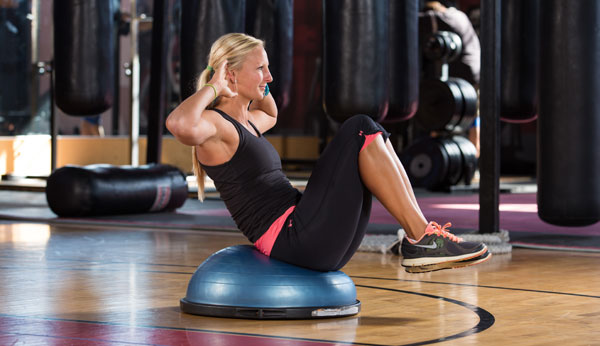
double bosu crunch
Position the small of your back in the center of the dome. Find balance with your feet off the floor, in line with the knees. The knees should be bent to 90 degrees and positioned over the hips. With hands behind the head and neck in neutral, begin by extending the lumbar spine slightly. Then, slowly flex the trunk to bring hips off the dome, slightly, and chest toward legs. Pause at the top, then slowly lower back to the starting position. To regress the exercise, perform the upper crunch with feet off the floor or on the floor. Perform 10-15 repetitions.
Lateral Balance
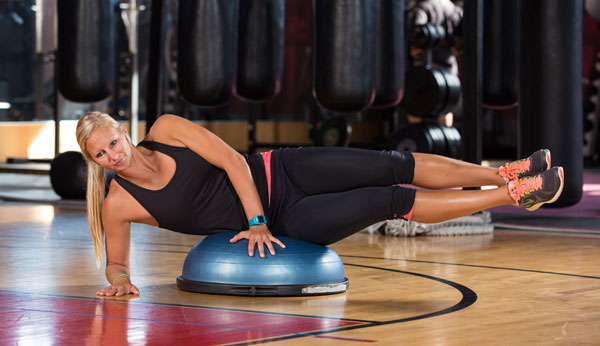
lateral bosu balance
Position your waist on the top of the dome and the forearm on the floor (elbow aligned with the shoulder). The other hand can be on the front of the dome for support as you lift both legs until they are parallel to the floor. Once you find your balance, begin to challenge it by removing the bottom arm from the floor and then the top. Hold the balanced position for 10-20 seconds. Lower and return to balance position for 2 additional repetitions.
BOSU® Supine Bicycle
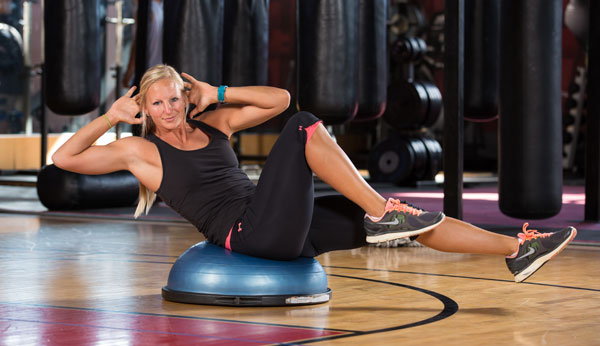
bosu supine bicycle
Position the small of your back in the center of the dome. Find balance with your feet off the floor, in line with the knees. The knees should be bent to 90 degrees and positioned over the hips. With hands behind the head and neck in neutral, begin by flexing the spine slightly and holding the ”curl” position. Begin alternating the legs in a small bicycling motion. As you become comfortable with the leg movement, add trunk rotation toward the bent knee. Explore with range of motion to increase the challenge. Perform 10 rotations to each side.
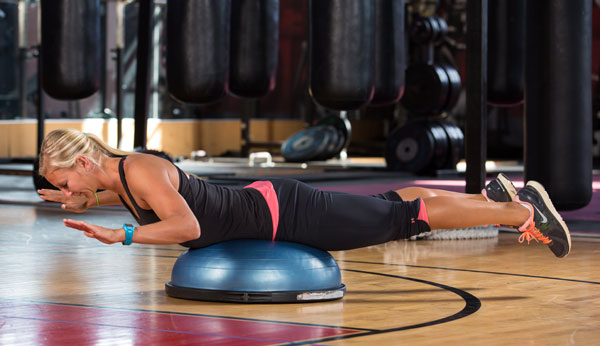
Prone Tuck & Extend
prone tuck and extend
Begin prone with stomach centered on the dome. Relax over the dome (forearms, knees and lower legs resting on the floor). Slowly extend the spine and hips until the body is parallel to the floor. Then, as you find balance, experiment with lifting the body and legs higher than parallel. Hold the balanced position for 10-20 seconds. Lower and return to balance position for 3-5 additional repetitions.
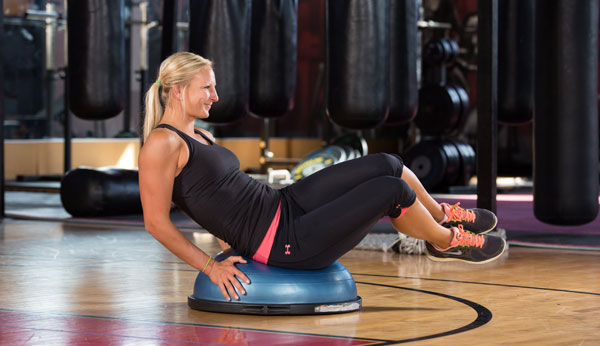
V-Sit with Trunk Rotation
v-sit with trunk rotation
Center hips on top of the dome. With hands on the sides of the dome for balance, bend knees and place toes lightly on the floor in front of you. Lean back slightly while maintaining neutral posture and begin to lift the feet off the floor to come into V-sit balance. Begin the rotation by tilting the legs to one side and the torso to the other. Then, reverse. Perform 10 rotations to each side. You can also perform the rotation with one foot lifted or both feet on the floor.
Of course, these exercises merely scratch the surface of core-focused exercises that can be performed using the BOSU® Balance Trainer. This workout was adapted from the BOSU® Complete System. Learn more about BOSU Complete. BOSU also offers an app to create 15-, 30- and 60-minute workouts. Visit the iTunes App Store or Google Play, or click here for more information. Or join BOSU at a live training to learn more about adding BOSU to your programming.

 Source Shannon Fable, 2013 IDEA and 2006 ACE Instructor of the Year