Showing posts with label workoutofday. Show all posts

Saturday, 18 April 2015

Is the Kipping Pull Up Cheating?

On the pull-up bar, the kipping is oftentimes referred to as the "cheating" pull up, however, this exercise, like the dead hang, can give you outstanding complete body benefits. The reality is, it requires some ability to master.

What is the Kipping?    It is a cutting edge pull up technique that not only targets muscle tissues, from top to bottom, but also may get your heart racing! 

While the kipping doesn't seem like a total pull-up, it is the precise movement adopted from gymnastics.You will know if you have done this properly of you were able raise yourself up by using your hips to thrust you upwards! It really is smooth and ultra powerful and is also the whole body exercise. 
 
  There is not any room for muscle isolation in kipping routine. The kip allows you to lead with your shoulders as much as your hips, while you throw your feet behind you.Differences between the Dead Hang and the Kipping The rigorous, dead hang is the usual traditional exercise that comes to mind when you think of pull ups. This is a muscle-building procedure that increases and contracts the muscles of your upper back and arms, generally the lats, biceps, and forearms. 

The other parts of the person's body is designed to remain in sufficient tension to hold a rigid structure. You begin by hanging on the bar with your arms completely extended. 
The elbows and shoulders are the only parts of the body that are expected to move. All your other joints need to stay on practically still, as they shouldn't help with the force production needed to perform the routine.On the other hand, the kipping begins with the pop from the hips that powers the body up and over the bar. Once it is completed, you continue in a quick, rhythmic fashion.
By way of effectively lifting the body with the very least amount of upper body pulling, this is a far more efficient method for raising the face on the bar. Athletes who practice kips can achieve much higher numbers with a kip as opposed to the strict dead hang.In doing the kipping pull-up your hips are forward, your feet should be in the opposite direction. 
In the same manner, when the feet are frontward, the hips should be backwards. This means that the feet is always in reverse position of the hips and shoulders. 

Your body need to either be in the front similar to a half moon shape along with your hands and feet at the back, or the body must be in a half moon shape the reverse way with your shoulder and hips at the back and feet and hands forwards.From this two pull up styles which do you think is the best?
It actually depends on the person. Sure, the dead hang pullups is the classic variation. Nonetheless, the kipping pull up is capable to become a lot more efficient. 
Either physical exercise will provide a huge benefit, the kipping requires much more coordination and use of hips, as the dead hang generally requires a lot more energy.

Source Sam Stevens

Friday, 17 April 2015

Developing A Workout Routine

If you are focusing on improving your health by losing weight and getting fit, one healthy habit you should not overlook (aside from improving your nutrition) is developing a workout routine.
Naturally this can be a bit awkward especially when starting out for the first couple months. It takes a considerable amount of effort to remove yourself from the couch or bed and get that body moving again. For many, it will be a slow process as your legs, arms, and body get used to exercising.
However once you make it past that initial stage and are able to exercise for 30 minutes to an hour, you've crossed the first and most difficult hurdle. Now the fun can really begin!
The Importance of Developing A Workout Routine

 
  The next item of business is figuring out exactly which activities you want to continue doing on a weekly basis which is why developing a workout routine can really help.
One important point to remember in regards to exercise is that you don't want feelings of boredom to creep in. These thoughts can fester leading you to slowly give up this healthy habit and that's the last thing you want to happen.

This can be compared to the types of foods you eat. It would become extremely boring to eat the same meal each and every day. Who would want to eat in this manner unless you absolutely had no other option?
You should consider exercise in the same way. Doing the same workout day after day may be fine for a couple of months but eventually you may get bored with this routine. Granted this is not true for everyone, and if you are able to run the same course 4-5 times per week month after month, then by all means stick with that.

However for those of you who like change and want to have a diversified portfolio of workouts, then creating a workout routine can really help keep you motivated and focused.
Naturally before you can create a workout routine, you need to not only have some options, but also the abilities to do the activities safely and properly. That's not to say you can't try out something new like a sport or activity you've always wanted to learn. If that's the case just be sure you get someone who is qualified to teach you how to do the activity properly.

Personally, my workout routine has grown immensely over the past two years. When I first started exercising, the only activity I did was walking - four times a week for about an hour at a time.
Sure that doesn't sound all too exciting, but my 300 pound self at the time could only handle that amount of activity safely.

After a couple of months, walking turned into hiking, then a couple of months later into jogging. Once I was able to run for an hour without feeling completely drained afterwards, I knew I had developed a newfound endurance and energy level I had not enjoyed in over a decade.
Over the past year I have experimented with a number of different activities. I started playing tennis again, attending a local Bootcamp class, biking with my dog, snowboarding regularly during the winter, a gym membership to my local LA Fitness, and even did the Insanity at-home workout program to see what that was like.
 
  These days I have a consistent workout routine that I usually stick with week after week. Monday and Wednesday is Bootcamp class, Tuesday and Thursday is tennis, and I usually either run or bike my dog on Friday and on one of the weekend days.

Maintaining this diverse workout routine keeps me motivated to stick with my plan every week. Best yet, I never go more than two days in a row without some type of exercise.
If you have had issues sticking with a consistent fitness routine, developing a workout routine so you can regularly exercise which will not only get you into better shape but you'll lose weight too! The best of both worlds.

Source Gregory L. Gomez

Saturday, 11 April 2015

Are Two-a-Day Workouts Right for You?

 
 For many people, boys and young men around the country are likely suiting up for two separate football practices a day for a tradition known as “two-a-days.” There are three primary reasons for the two-practice-a-day tradition:
  • Practicing in the early morning and late afternoon is a way to beat the worst of the heat.
  • Two practices a day are required to get the athletes in game shape.
  • Athletes need the extra time and practice to learn and commit complicated plays to memory.
Two-a-day training programs are typically divided into two sessions, one focusing on technical training and the other focusing on tactical training. The first type of training session is referred to as technical training because it focuses on the technical conditioning needed for a specific sport. Technical training can be high intensity to improve overall fitness level and refine sport-specific skills. The second type of training session is referred to as tactical training because it is structured to teach the strategies and tactics that all players need to know to function successfully as a team. Tactical training is designed to be lower in intensity to allow players to learn the movements so they are eventually able to execute plays reflexively as a reaction without needing the time for conscious thought or cognitive processing.
Are two-a-days beneficial for you?
For people with specific fitness goals, could organizing your workouts into two training sessions a day provide any benefit? The answer, of course, depends on a number of variables. To determine whether two-a-day training might be right for your needs, ask yourself the following questions:
What is your existing fitness level?
What is your specific outcome or training goal?
What do you need to improve to be successful and achieve your goal?
And, most importantly, how much time can you dedicate to your workouts?
If your reason for exercising is to improve your general health or overall fitness level, then two-a-days might not be necessary. If the goal is to achieve a specific outcome (whether performance- or appearance-based), then working out twice a day might be the most effective way to achieve that goal.
Here are a few examples where organizing two-a-day workouts might be helpful for achieving a specific goal. Of course, there are a number of variables that would determine the specific training program, so keep in mind that this list is designed to simply provide a few ideas. 
The Olympic Weightlifting Lifts: The Snatch and the Clean and Jerk. Both of these exercises require a high degree of mobility and technical movement skill, as do a number of the kettlebell lifts. If you want to improve your technical skill for specific lifts, consider training for movement skill in the morning and the actual lifting, or specific strength training, in the afternoon. The morning sessions should be bodyweight only to focus on improving range of motion, mobility and dynamic flexibility, while the afternoon workout should focus on the high-intensity training required to improve strength and power.
Adding muscle mass or developing the definition required for a figure or body-building competition requires a high volume of training for both strength training to improve muscle size and low-to-moderate cardio training to burn fat. A two-a-day training schedule might feature body part-specific strength training in the morning to increase lean muscle and definition, combined with an afternoon session dedicated specifically to cardiovascular training for burning excess calories and unwanted fat.
Specific Strength- and Power-based Competitions (e.g., Powerlifting, Strongman or CrossFit). For people training for these types of competitions, two-a-day workouts could be organized into a morning session using external weights to focus on specific strength or power exercises that will be an integral component of the competition. The afternoon session could be focused on bodyweight exercises to improve core strength, mobility or explosive jumping power to support the work being done with the external resistance. 
Obstacle Course Races (e.g., Spartan Race or Tough Mudder). If your training goal is to participate in these races, you might want to split your workouts into morning runs that alternate between distance for aerobic endurance and sprinting for anaerobic strength and afternoon strength-training sessions to improve the muscular strength and coordination required for successfully overcoming the obstacles.
Marathons, Triathlons or Ultra-marathons. If your fitness goals include training for pure endurance races, it might be a good idea to split workouts into two sessions per day to increase the volume of training required for success. For endurance races, it might be necessary to focus on a specific cardiovascular endurance session in the morning for volume training and an afternoon weightlifting session to improve the strength endurance of the legs and core muscles, which can help improve running efficiency and stride rate.

Source Pete McCall MS Ace

Thursday, 9 April 2015

Finding the Right Fitness Jump Ropes for CrossFit

Those who engage in CrossFit know that it is an intense workout and conditioning program. It has elements that are Workouts of the Day or WODs. During some of the CrossFit WODs, jump ropes are used. One of the moves participants are asked to try with the jump ropes is called double-unders. This is a move where the person jumps into the air and moves the rope under his feet two times before he lands. The double-unders are usually performed during five different rounds.
Doing any WOD that requires the use of a jump rope require the participant to have both coordination and stamina. It is emphasized that the WOD can be adjusted to meet anybody's fitness level. It stands to reason that a person who is working with one for the first time in years (or the first time ever) will need to build themselves up slowly. Some people may want to start with tuck jumps before moving on to doing double-unders. This is done with a person having his feet apart slightly, bending his knees and then jumping into the air and bringing his knees up to his chest.
Some people who participate in CrossFit feel it's very important for participants to have a jump rope that properly fits their size. Each person has a personal jump rope type that works best for them, and having the proper size and type can make all the difference.
 Some beginners use a thicker rope because it turns slower and permits the development of the correct movement when doing such moves as double-unders. Once the proper movements have been developed, it is easy to move onto a thinner, faster moving rope. 

 The last decision needed to be made is the type of rope material to be used. The two most popular types used with CrossFit jump ropes are a metal cable surrounded by a rubber sheath or a vinyl cord. There are benefits and drawbacks to both fitness jump ropes.

Vinyl cord are often slower and not very durable. The vinyl cord is known to break easily and is more difficult to turn. The metal cable ropes last longer than vinyl and move much faster. They require some experience and are a challenge for beginners to learn how to use.
When using a jump rope for a Crossfit WOD, it's important to get the proper one for your skill level and individual needs. Taking the time to develop the necessary skills before moving to the next level is important for successful WODs.

 Source Christopher Hardwick

Sunday, 5 April 2015

What To Look For In An Indoor Spin Bike For Home

For anyone who is planning to buy a spinning bike, it certainly is a good idea to learn precisely what you ought to be looking for when it comes to optimum features well ahead of time. Naturally, the spin bike you finally choose will probably be what you subsequently make use of for quite some time. Listed here are the major details to consider any time making your spin cycle purchase:

Bare minimum forty lb flywheel weight: The flywheel is the most crucial component of a spin cycle that contributes towards the normal cycling feel of road cycling. For that reason, you want to be really aware of what to look for. Opt for products that have a flywheel weight exceeding forty pounds. A flywheel near this weight can provide a far more natural riding experience as close as possible to the feeling of riding a bike outside.

Perimeter-weighted flywheel: A further part which substantially aids a road riding feel is a flywheel containing perimeter weighting. A large number of spinning bikes do have perimeter weighting and that is due to the fact of the far more organic cycling experience. This essentially tends to make the ride feel far more enjoyable, primarily for inexperienced riders.


 Handlebars: The best-case circumstance is to invest in a cycle that allows for not simply vertical movements of the handle bars, but additionally back and forwards variations. Having the ability to move the bars vertical will be particularly handy to help accomplish ideal cycling posture.
Adjustable seat: Again, try to spend money on a spinning bike that permits for up and down adjusting and also horizontal adjustment to suit virtually all physique figures.

Belt driven vs chain driven: This refers to the belt or chain that attaches the pedals to the flywheel. Now there definitely is no exact solution this choice. Generally speaking, belt driven spinning bikes are less noisy than chain driven options. However, there are significantly more chain driven spin bikes available for purchase and most of these do tend to facilitate a heavier flywheel, which we already mentioned the advantages of above.

Speedometer: You want to look for a spin bike that has a sepeedometer or console that displays the bare minimums in terms of feedback to you as the rider. For example, duration of the ride, distance travelled and then perhaps rpm and calories burned. It's incredibly tricky to achieve an optimum workout any time you aren't equipped to at least keep track of your pace and distance, which a speedometer can track for you. You can pick these up fairly cheaply, however if you have to pay a little more for a bike that has a speedometer, it'd be a rewarding expense.

In the event that the bike you purchase does not have a speedometer, it pays to exercise caution when shopping around. Be mindful if your spinning bike that contains a rear flywheel, the length of cord that connects the flywheel sensor / probe to the speedometer screen will want to be fairly long and will sometimes not reach the necessary distance.

Unique point of difference: The last thing to consider is to distinguish if the cycle has a distinctive aspect that distinguishes it from other manufacturers or products. Bikes will quite often be really similarly matched and it can be the little exceptional components that separate closely-matched bikes.

  Source :Greg C Nunan

Saturday, 4 April 2015

Complex Training: Strength and Conditioning Workout for Athletes


Up until about 40 years ago, most athletes were told to avoid resistance training because the misperception was that strength training would actually reduce their athletic performance. Of course, we now know that a proper strength and conditioning program is essential for athletes who want to reduce their risk of injury and enhance their performance. 
Athletic performance is based on a number of skills that can be developed through a sports conditioning program. This particular program focuses on improving both muscular strength and power using a technique called post-activation potentiation (PAP), also commonly referred to as complex training. 
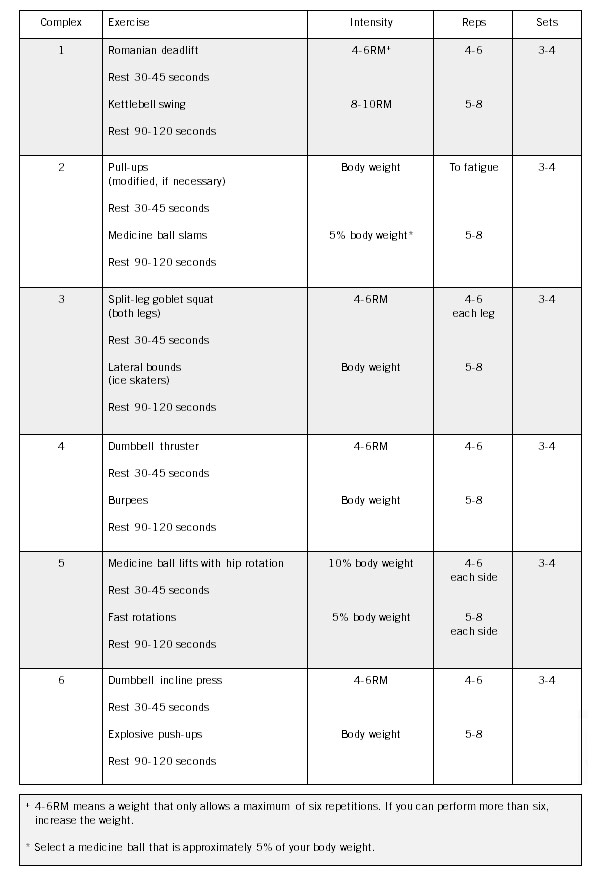
Complex training combines strength exercises from the load phase of the ACE Integrated Fitness Training® (ACE IFT®) Model and power exercises from the performance phase to improve both muscle force production (strength) and the rate of force production (power). A complex training set involves performing two exercises back to back, with a brief rest period in between. The first exercise is a strength exercise using a heavy weight for four to six repetitions (ideally fatiguing by the final rep). The second exercise is a power exercise focusing on explosive movement for five to eight repetitions. There should be a 30- to 45-second rest interval between the strength and power exercises and a 90- to 120-second minute rest interval after both exercises. 
It is important to perform a number of mobility exercises for a proper dynamic warm-up before attempting a high-intensity training program. There are two ways to do a complex workout: Complete all complex sets of one exercise before moving on to the next, or combine the exercises into a circuit. Circuit training allows you to reduce the rest time between complex sets, which increases the challenge of the workout.
 Complex Training Program 

Exercises:
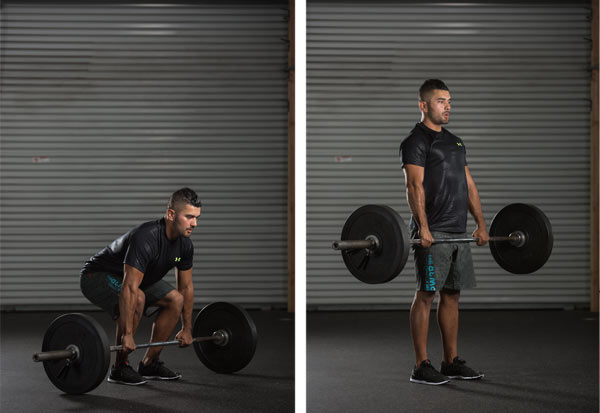
Deadlifts
 
Deadlift


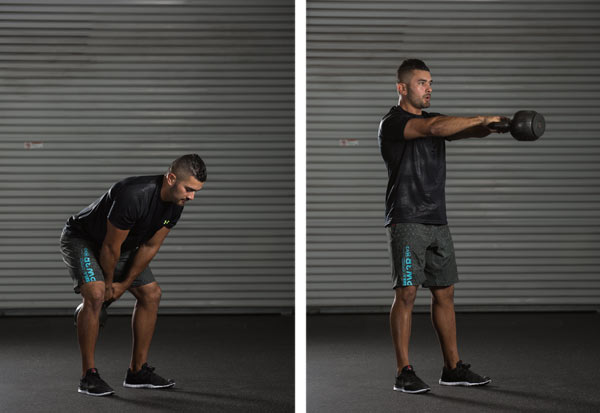
 Kettlebell Swings

kettlebell swings


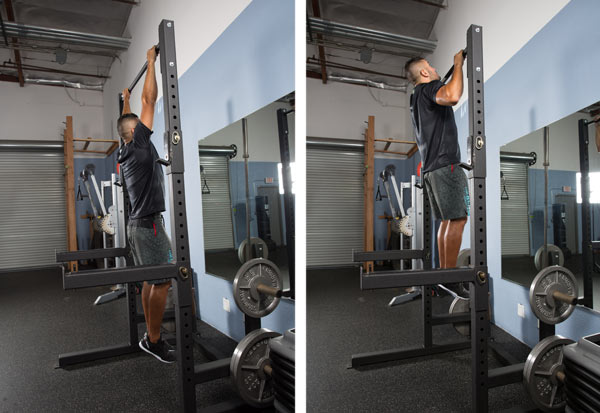
 Pull Ups

 pull up

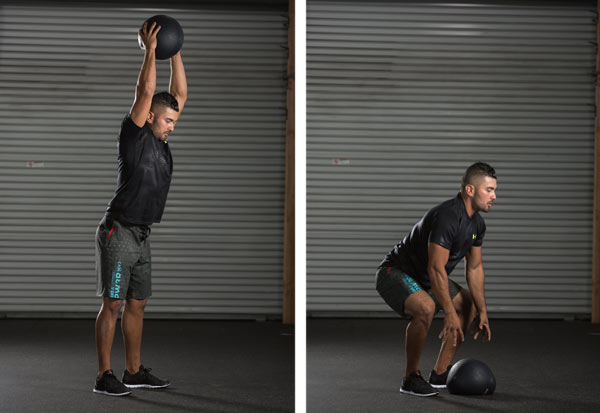
 Medicine Ball Slams

 medicine ball slam

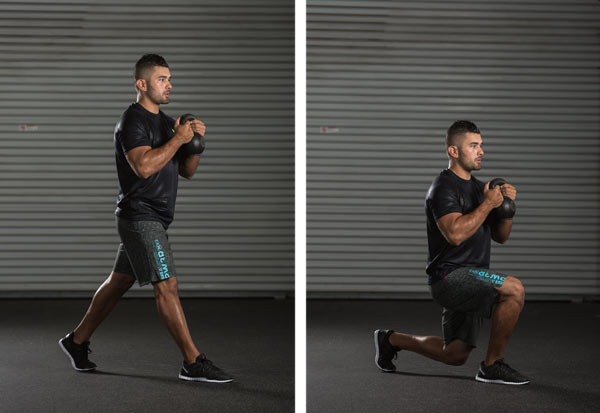
 Split-Leg Goblet Squats

 split-leg goblet squat

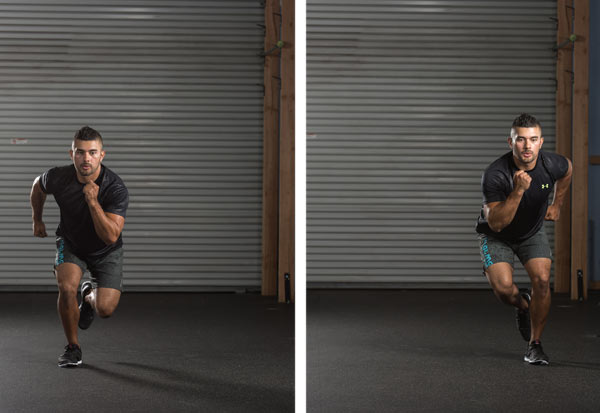
 Lateral Bounds (Ice Skaters)

 lateral bounds

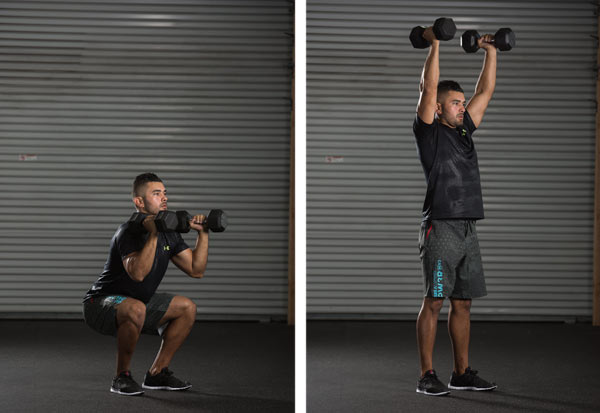
 Dumbbell Thrusters

  dumbbell thrusters

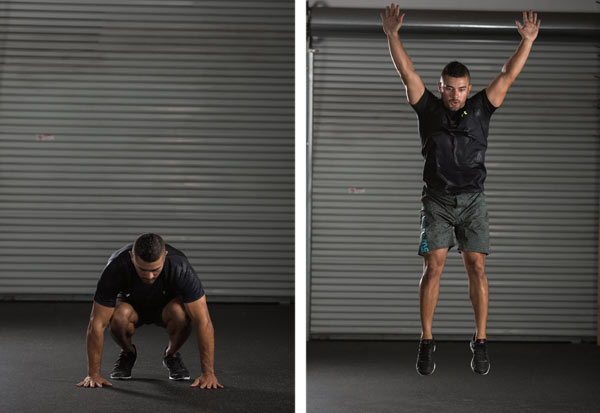
 Burpees

 burpees
 
 burpee

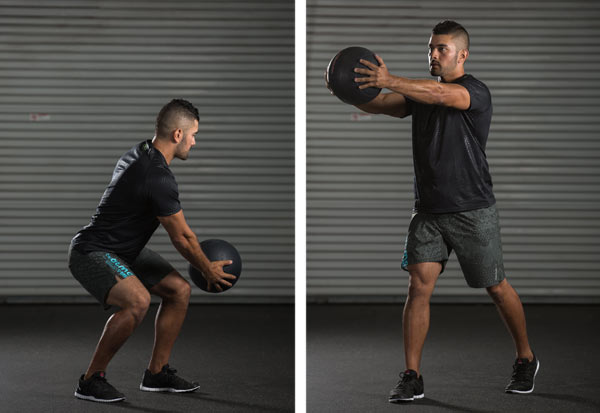
 Medicine Ball Lift with Hip Rotation
  
Medicine ball lift

 Fast Rotations

 medicine ball rotations

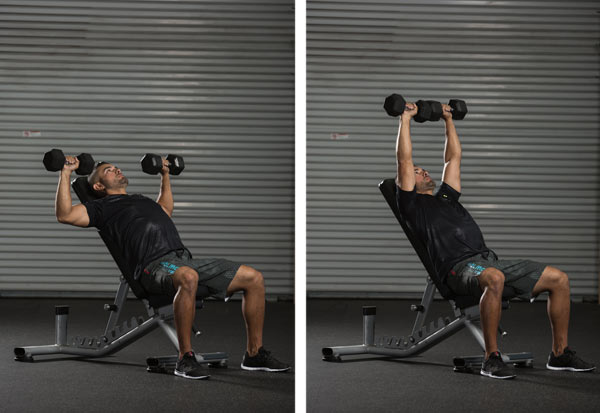
 Dumbbell Incline Press

 dumbbell incline press

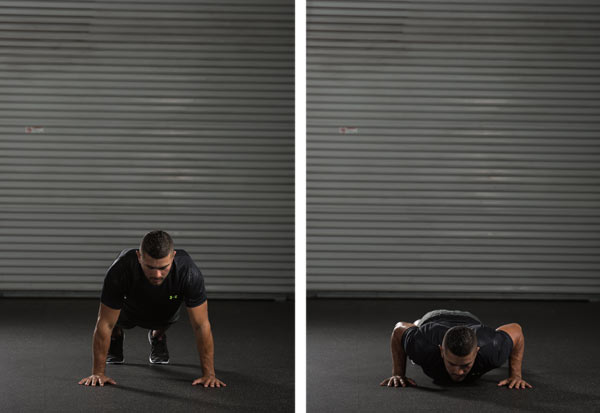
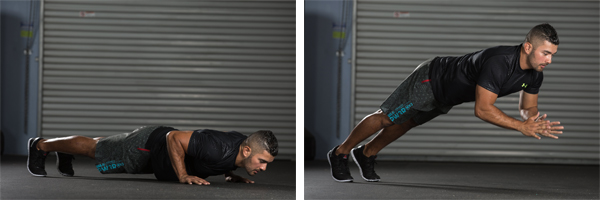
 Explosive Push Ups

 Explosive push-ups

 Source : By Pete McCall, MS/ ACE

Thursday, 5 March 2015

Are You Feeling Sick? Why Getting Into Good Shape Is Essential!

It may seem impossible to accomplish your exercise goal. But you can make severe exercise upgrades considerably more effortlessly than you believe. All that you should do is develop changes in lifestyle that may boost total physical fitness levels and help you reach your targets.
If you're just starting with workout, begin slow. Don't jump in brain initial and then try to operate several kilometers without the need of worked out well before. It is possible to end up injuring on your own and carrying out more damage than good. Instead start with a brief stroll and gradually boost the duration along with the speed. Before you know it you'll be working 5 miles without any problems.
 

Tend not to let on your own be postpone with the weather conditions. The climate in no alibi not to determine. In the event you imply to run outside the house and also you get that it is raining, work close to that. You are able to still get out and go walking in the light-weight drizzle. In case the weather is horrible, obtain an option within.
For healthy fitness remaining hydrated is extremely important. The advantages of obtaining a lot of drinking water do not stop in the club entrance, though. Aside from powering an exerciser via a challenging workout, a plentiful intake of water enhances general health and supports in digestive system each day. Overall moisture is yet another component of a plan for all round health and fitness.
An excellent suggestion to assist you lose fat is usually to exercise moderately. A number of people create the oversight of proceeding too hard at the beginning. They'll do over two hours of cardio exercise in a single period and fairly in the near future they'll burn off their selves out. It's best to select an even more moderate exercise routine.
You could be watching television, but that doesn't mean you will need to get rid of energy in the direction of your weight decrease objective. Attempt to walk set up on commercial breaks. You can even do simple strength training exercises with hand weights while you take a seat on the chair or floor. There's usually ways to press far more exercising into the day.
If you like watching tv, try out incorporating just a little exercise routine to the TV observing. Watching Television while hitting the gym may help you neglect that you are currently training, which will increase the length of your exercise routine. Try using television shows as a timer. Once you learn which a show goes for thirty minutes, explain to oneself that you simply works out for two shows.
A great health and fitness tip is always to add up reps in reverse. This can assist you in doing a lot more reps due to the fact if you strategy the end of any set, you will not be thinking about the amount of repetitions you have accomplished. As an alternative, you will certainly be thinking of just how many you possess remaining, which can help you squash out those final few reps.
Before you start your regular workout, warm up your brain. It is merely as essential to get your central nervous system completely ready for exercise, since it is to put together your muscle mass. Your central nervous system tells your own muscles when you should contract and using this method you will get more efficient exercise.


For those who have a old tree in your residence and are thinking about possessing a support get rid of it for you, you must reconsider. When you reduce up the plant yourself with the axe or perhaps a chainsaw, after which cut the logs to fire wood with the axe, you are going to give yourself a lot of wonderful workout routines and reduce your gas bill as well!
If you realise oneself having an injuries on a single aspect of your body, continue to work out with all the other to discover advantages both for. The body will be sending muscle development supplies to each side, even when merely one is operating. You will observe less of a build on the hurt area, but a obtain is a get!
An excellent health and fitness suggestion is to start off performing cable tv crossovers. Cord crossovers are an easy way to develop the interior pectoral muscle tissues. Even though it isn't the very best exercising to tack on muscle, it's continue to a pleasurable exercise that can be a great add-on right at the end of your own torso exercise routine.
To cycling more proficiently, workout by biking making use of one particular lower leg. This procedure helps you figure out how to greatest spread the task across your leg muscle tissue if you make you to take into account tugging your lower body support on the stroke's bottom part. Have each toes shut in to the pedals, but simply allow one particular remain static. The very best method is half an hour every lower-leg, then five minutes of both legs.
Although boosting your health and fitness will take a lot of operate, you can do it! By increasing your level of fitness, you do not only boost your appearance, you also improve your overall health and well being. Getting fit and keeping yourself that way can make lifestyle much easier.

Source Nichole Shedden / Go 

Saturday, 17 January 2015

How To Do A Box Jump (without face planting) Plus Advanced Box Jump Variations

It's not easy to try new movements or equipment in the gym, which I personally know. But when amazing strength and hardcore improvements become more important than obeying your comfort zone, then I can help instruct you. Box jumps are an explosive movement that trains your fast twitch muscles, give you phenomenal speed training and will make you feel POWERFUL ! Also, the equipment you need is almost as available in the gym as the 2-pound dumbbells. There the plyometric box is, just sitting there with a quirky grin, waiting for you to jump on it.


How-To Do Box Jumps
  1. Decide on the height of the box you will jump on. If you are lacking courage, start with a shorter box. In Crossfit, 20" is a standard height for girls and 24" for guys. Be brave.
  2. Face the box and mentally tell it what is going to happen. (I am going to jump on you Mo-Fo!)
  3. Stand about 12" away from the box (or where ever feels warm and coziest for you) 
  4. Start with step-ups. This is to warm up your hips and teach you the height of the box. Just alternate each leg stepping up to standing with both legs. Jump or step down. Do 5-10 on each side. 
  5. Jump on it like you mean it. When you feel ready, bend your knees a little and explode up to jump on that box! You will have so much fun, you will want to use the box at every workout, promise
  6. When jumping down, listen up! Your achilles tendon will NOT want you to jump up and down quickly. You want to extend your hips at the top of the box and then jump/step down to avoid an injury of monumental proportions.
As a useful tip! Remember that box jumps have the potential to put you in a face plant and or scrape/cut your shins if you don't make the jump. In fact, my good friend Adam had to get stitches from an failed box jump landing. Two things to avoiding this happening is to mentally focus on each jump, don't let your mind wander. When your mind wonders away from the task at hand, it makes you sloppy. And no one wants to cringe as you perform sloppy box jumps. The second is to know when your legs are jello. Shaking legs do not make for good box jumps. Push yourself but don't overdo it.


Advanced Box Jump Variations:
 Once you get the basic box jump movement down, and want more explosive movements, try these:

  1. Box jump overs. You don't jump onto the box at all, instead you jump over it like a frog (a really large, mean, burly frog).
  2. Burpee box jumps. Do a burpee but instead of clapping your hands at the end of the burpee, you jump up onto the box 
  3. Side jumps on the box. Face sideways to the box, with your right leg close, then jump to the right and land on the box. Switch sides and do your left. This requires some coordination and a little faith.

Inspiration for box jump variations?


 Source : Steph Kinzer GrassFed Strength 

Tuesday, 13 January 2015

3 Easy Full-Body Exercises, 1 Piece of Equipment

If you are looking for one very efficient piece of exercise, look no further than the kettlebell. Kettlebell workouts are famous for burning fat by increasing lean muscle while building balance and grace. Plus it is an amazing stress-reliever that relieves tension in both the muscles and the mind. The exercises are simple, yet effective.
When used correctly, kettleballs are wonderful conditioning tools. They can be used for various purposes such as:
  • Cardiovascular conditioning
  • Fat loss
  • Strength and stamina
  • Muscular endurance, especially the legs, buttocks and lower back
Choosing the Correctly Sized Kettlebell
When first starting out, choosing the correct size kettlebell to train with is very important. You need to pick a weight that is easy enough to handle but heavy enough to make you use your hips explosively to drive the kettlebell in to its correct position, depending upon the exercise that you are doing.
Most ladies would normally start with either a 5-10 pound kettlebell, while men would normally start with a 15-20 pound kettlebell. The size depends on the condition of the person exercising, so don't be afraid to drop down a size to keep proper form. Initially, more repetitions are better than more weight.
Kettlebell Basic Exercises
Before you can start on a basic routine, you must first master the three basic exercises with the kettlebell. These are:
  1. The Swing
  2. The Clean
  3. The Snatch
1. The Swing
This is a simple exercise, but extremely effective using the whole body. Standing with your feet slightly more than shoulder width apart, hold a kettlebell with knees bent. Grip the kettlebell with both hands and lift to groin height. Ensure that your back is arched and that your head is upright. Keep the weight on your heels, bending at the knees, back straight and head looking up and forwards (as if you are going to sit down in a chair). Swing the kettlebell to the rear backwards, between the legs. The weight should remain on your heels and the shins should be vertical.
kettlebell-swing.jpg
It is essential that you perfect this movement because without it, you will never have the leverage to get your hips into the movement. You should feel the kettlebell pulling you backwards and your hamstrings contracting. Pushing through your feet and legs, quickly snap/thrust the hips forward tightening the glutes and abs (This motion is similar to jumping up vertically.) Do this quick snap of the hips motion while at the same time projecting the kettlebell forwards and away from the body. Keep the arms relatively straight and bring the kettlebell to waist, chest or head height, then allow the kettlebell to freely return to the start position and repeat.
2. The Clean
Hold the kettlebell in one hand. Swing it through the legs, bring it forward, and push up through the legs from the feet. As the kettlebell comes over the top of your hand to hit your forearm, grip the handle tight and also dip at the knees. This will assist you in absorbing the impact of the kettlebell. The kettlebell should lie on the forearm with your elbow tucked into the side. The wrist should be flat, and your palm should be facing inwards towards the body.
kettlebell-clean.jpg
The Swing will test your stamina, grip, and body coordination. The entire exercise can be carried out using one hand, switching at the top or bottom of the drill. It is important to keep core muscles tight to control the kettlebell at all times.
3. The 'One-Arm' Snatch
Swing the kettlebell back through the legs as you push through the feet and legs. Bring it up, snapping at the hips, sucking the floor up with your glutes. At this point, the body should be locked; the power of your drill should now have the kettlebell well on its way up. Remember: as the kettlebell comes over, dip at the knees and grip the handle to slow the kettlebell and avoid the impact on the forearm. The entire body should be locked with total tension that includes a strong core.
kettlebell-snatch.jpg
Kettlebells can make a huge difference in your strength, core, muscle tone and stamina. The exercises are simple but effective. Losing weight is an added bonus! Enjoy!

Source  Sherry L. Granader is a Sports Nutritionist, National Speaker and Spokesperson, Author of 2 healthy cookbooks, Writer, Ghost Writer, Nationally Certified Fitness Instructor and Personal Trainer.

Wednesday, 24 December 2014

Why you should strengthen your Core Muscles

You know core exercises are good for you — but do you include core exercises in your fitness routine? Here's why you should.


Core exercises are an important part of a well-rounded fitness program. Aside from occasional situps and pushups, however, core exercises are often neglected. Still, it pays to get your core muscles — the muscles around your trunk and pelvis — in better shape. Read on to find out why.

Core exercises improve your balance and stability

Core exercises train the muscles in your pelvis, lower back, hips and abdomen to work in harmony. This leads to better balance and stability, whether on the playing field or in daily activities. In fact, most sports and other physical activities depend on stable core muscles.

Core exercises don't require specialized equipment or a gym membership


Any exercise that involves the use of your abdominal and back muscles in coordinated fashion counts as a core exercise. For example, using free weights in a manner that involves maintaining a stable trunk can train and strengthen several of your muscles, including your core muscles. You may also try several specific core exercises to stabilize and strengthen your core.

A bridge is a classic core exercise. Lie on your back with your knees bent. Keep your back in a neutral position, not arched and not pressed into the floor. Avoid tilting your hips. Tighten your abdominal muscles. Raise your hips off the floor until your hips are aligned with your knees and shoulders. Hold the position for as long as you can without breaking your form.

Core exercises can help tone your abs

Want more-defined abdominal muscles? Core exercises are important. Although it takes aerobic activity to burn abdominal fat, core exercises can strengthen and tone the underlying muscles.

Strong core muscles make it easier to do most physical activities

Strong core muscles make it easier to do everything from swinging a golf club to getting a glass from the top shelf or bending down to tie your shoes. Weak core muscles leave you susceptible to poor posture, lower back pain and muscle injuries.

Core exercises can help you reach your fitness goals

Aerobic exercise and muscular fitness are the primary elements of most fitness programs. But to have a well-rounded fitness program, consider including core exercises in the mix as well.
Whether you're a novice taking the first steps toward fitness or a committed fitness fanatic hoping to optimize your results, a well-rounded fitness program is the best way to reach your fitness goals.

Tuesday, 16 December 2014

Power Up Your Endurance With Tabata Workouts

It's a common misconception that the only or the most beneficial way to increase endurance is taking part in long, gruelling cardio workouts like running for extended periods of time on the treadmill or outside for increased running endurance and spending hours on a stationary bike to increase cycling endurance.
How Tabata Training is different:
Whilst there is some truth to these beliefs, Tabata Training introduces a whole new meaning to endurance. Due to the extremely high intensity and efficiency of Tabata Training you can choose almost any exercise or body part and increase endurance in that area.
Tabata Training is unique in the terms of how the training is done. Most cardio sessions consist of long periods of time at the same speed and / or resistance.
Whilst on the other hand Tabata Training consists of short intervals at full capacity, pushing the limits to an individual's endurance every round. Not only this, but, with the short rest times an individual is tested to the absolute extreme.
When you are tested over and over again your endurance is forced to increase to keep up with the work load that is being put onto the body. Tabata training integrates fundamentals of progressive overload into training which is what "forces the body" into change, ultimately making you stronger, quicker and more efficient at the exercise of your choice.
Endurance means to be able to "endure an unpleasant of difficult process without giving in" is it really worth running for hours until you reach the "brick wall" that runners must surpass in order to keep going or is it more efficient to be able to increase endurance in as quick as 4 minutes?
This is where Tabata Training can give a new meaning to endurance and teach you to develop a stronger, more positive mental state when training hard.
Improve in every aspect with Tabata Training
Whilst being pushed to new limits, a different exercise can be picked every single workout. Unlike fixed forms of training at the gym like treadmills, Ellipticals, stationary bikes and even running, cycling and more, Tabata training gives you the power to change up the focus each and every session. This means that whilst on your journey to losing weight and fat you can start to become a quality, well-rounded athlete.
The sky is the limit with Tabata Training. You can choose to incorporate different exercises based on your goals too. This means that if you are training for a specific sport or would like to tone up a specific area of your body, you can!
You can choose to throw in some different types of running if you are a sprinter or long distance runner for example and in summary you really are able to mix it up and continue to keep things fun and exciting each and every day.
With the simple approach with Tabata Training it is also extremely easy to track your progress which in turn allows you to see how quickly your endurance is improving session by session as you can count how many rounds you complete in a given time frame as well as the number of reps you complete.
Typically, when you take part in a form of cardio that is done out of the gym and without machines helping you it is hard to track your progress. Tabata Training is considered the cheapest, easiest and most efficient way to keep track of how things are going as well as allowing you to evaluate where your weak points are as you cycle through different exercises and compare the calories burnt to the exercise performed.

Article Source: http://EzineArticles.com/8842757

10 Fitness Trends to Look Out For in 2015

 
One of the most elusive traits coveted by humankind is the ability to predict the future. Based on the study of past events we can develop a hypothesis about what might occur, but there is no way to know for sure what can happen in the coming days, weeks or years.

This is especially true in the fitness industry. It is almost impossible to predict what new trend will encourage the masses to get up and start sweating. A specific piece of equipment, workout program or exercise technique may become popular because it helps people achieve results or because it’s just a fun way to exercise and creates an enjoyable experience. CrossFit is an example of a trend that exploded in popularity because the high-intensity exercises and varied programming of the Workouts of the Day (WOD) produce results. Plus, the group component of CrossFit, the competition-based programming and its Spartan setting creates a unique experience that is completely different than the traditional big box gym, which has helped elevate it to a fitness lifestyle.

As we begin the process of closing out 2014, it’s time to identify the programs or products that could become the next CrossFit and shape the fitness landscape in 2015. As a fitness educator and consultant who works with certification organizations, equipment manufacturers, apparel companies and health clubs, I’m in a unique position to be able to identify upcoming fitness trends. In an effort to pinpoint the trends that we will see in the coming year, I reached out to a number of other educators and industry thought leaders to develop a list of what is in store for 2015.

1. More people will utilize wearable technology to monitor and record biometric data.

Heart-rate monitors have been worn for years to monitor exercise intensity during a workout, but in the past few years a number of wearable devices have been introduced that help us track calorie burning all day long, while also monitoring our sleep habits at night. The New Year will see the release of the Apple iWatch, which is ushering in a whole new category of wearable technology that can help us develop a greater understanding of how our bodies function. The most interesting feature is that Apple’s new mobile operating system (iOS 8) will create a dashboard on your phone that can be used to monitor and record a variety of important health data that can help you live your life to the fullest.

2. Online video-on-demand workout programs will become increasingly common.

From television shows to VHS tapes to DVDs, people have long used video technology to follow a home-based workout led by an experienced instructor. Video-on-demand services have been growing in popularity and the coming year will see an explosion of online, video-on-demand workout programs developed specifically for mobile devices that will allow fitness consumers to enjoy an instructor-led workout anywhere they choose.

3. Online personal training goes mainstream.

When it was first introduced, online personal training was been considered a poor substitute for working with a real live trainer. From video conferencing to wearable devices used to record activity levels, technology has recently made it more feasible to offer personalized fitness coaching services via an online or mobile platform. The next year will see further growth in this segment as personal trainers become more comfortable using technology to offer virtual coaching services. The primary difference between video-on-demand workout programs and online personal training is that the former offers workouts for general goals while the latter delivers specific, progressively challenging programs to achieve well-defined fitness outcomes.

4. “Functional training” will recede from our lexicon and the concept of loaded movement training will become more popular.

Traditional free-weight resistance training features curvilinear movement patterns that move the resistance directly against the downward force of gravity. On the other hand, loaded movement training (LMT) is defined as the process of moving a mass through gravity (the definition of the term shifting) in a task-based, multiplanar movement pattern. LMT is the progression of functional training, which has become an overused term to describe a variety of activities more suited for a circus performance than a weight room.

5. Group-based training programs will be personalized to each individual participating in the workout.

In the past, taking a group exercise class meant moving the same way at the same time and same speed as everyone else in the room. Technology to track intensity and work-rate (via heart-rate monitors) on a screen in the front of a studio allows an instructor to provide a group workout that allows each participant to work at his or her own comfort level. While this technology itself is not new, 2015 will see a rapid growth in personalized group workout programs.

6. Participation in one-on-one personal training will decline at large health clubs in favor of small group or semi-private training programs.

Small-group training programs will continue to grow in popularity and more health clubs will feature fee-based small-group programs as the primary way to deliver an instructor-led workout experience to their members. This may be the year we see revenue from small-group programming surpass revenue generated by one-on-one personal training.

7. Workout programs will move away from pure High-intensity Interval Training (HIIT) and start featuring more intelligent program design that allows for proper recovery from the stresses of exercise.

Recovery is the component of the workout program that is most often overlooked, even though the body becomes stronger in the time period after workout, not during the workout itself. HIIT is popular because it produces results, but performing too much high-intensity training too frequently could lead to overtraining or soft-tissue injury. It also could be a reason why participants stop exercising. This is starting to change as educated fitness professionals are beginning to recognize that recovery is key for their clients’ success.

8. Trainers and clients will begin to use biomarkers to track progress from an exercise program.

For years, researchers have used hormone levels and metabolic markers in the bloodstream to study how exercise affects human physiology. As the costs of blood tests drop, 2015 will see personal trainers starting to use blood testing to help assess a client’s fitness level and physiological status. Don’t worry—personal trainers won’t be taking blood from their clients. Clients will use a dedicated collection sight to withdraw blood, which will then be sent to a lab for processing. Personal trainers will not diagnose any health issues, but instead will watch markers such as testosterone or cortisol to identify whether a client is in an optimal anabolic (muscle building) state or is experiencing a period of stress, which could elevate levels of cortisol and be an indicator of overtraining.

9. Competitive formats like American Ninja Warrior, parkour, Spartan Race and obstacle course races will continue to grow in popularity.

Thanks in part to the success of Kacy Catanzaro in the American Ninja Warrior challenge, the fact that NBC Sports is now televising Spartan Races, and the emergence of gyms designed specifically for parkour or free-running, this category of extreme bodyweight training will continue to experience exponential growth over the coming year.

10. Old-school group-exercise programs and full-service health clubs will make a comeback.

This is my long-shot, against-the-grain prediction, but I do think that 2015 may become the year for the retro workout craze as many group exercise programs that have faded from the mainstream will make a resurgence. We may see a return of programs like dance aerobics, instructor-led treadmill and stair climber-based workouts and group kickboxing classes. In addition, while small studios have turned the industry on its head over the past five years, in 2015 we will begin to see fitness enthusiasts gravitate back to multipurpose health clubs that can offer a variety of different workout experiences under a single roof.

There is no easy way to tell which of these trends could become the next CrossFit, but this list should give you an idea of what we’ll see in the fitness industry in 2015. You can use this information to plan your continuing education so you can be up-to-date on the latest trends before they become popular.

Source : By Pete McCall, MS  McCall has an MS in Exercise Science and Health Promotion. In addition, he is an ACE-certified Personal Trainer (ACE-CPT)

Monday, 8 December 2014

Women, CrossFit, and Myths part 2


Women will not get big bulky muscles because they just plain don’t have the hormones to build them. It is the difference in the hormonal profile between men and women that causes their performances to also be different. There are several aspects of a woman’s performance that will different from those of a man, all of which depend on neuromuscular efficiency, and all of which are a direct result of lower testosterone levels and the effects that testosterone has on motor unit recruitment, central nervous system excitation and other neuromuscular factors.
You might now be thinking that because there are such big differences, then it must be true what the fitness industry says about the necessity of gender specific programs and exercises. This could not be further from the truth.  Women may lack higher levels of testosterone, but we are built the same when you look at our body structures. We are not as different as bunnies and fish. Men and Women, however, both recruit motor units into the same patterns to cause muscle contractions…..just to different degrees. A real world example would be that physiologically, Aaron Rogers and your grandmother operate the same way, in the same sense that Labradors and Toy Poodles are both dogs.
What does this all mean?  That the type of stress (i.e. training / heavy strength) will cause the best results in both men and women, only the degree of results will vary.  For example, Squats work better for everybody than leg extensions, leg curls, and the Bun Blasters because of the quality of stress they produce. “Squats are performed with the same muscles by everybody, they are hard for everybody, hard enough to produce system-wide stress for everybody – and this is why they work for everybody. Men are more efficient at responding to the stress of squats in terms of elevated testosterone levels, and in this respect men can get stronger and bigger faster.”  (Rippetoe) What this doesn’t mean is that women are not served well by using “less efficient” ways to produce stress on their bodies. We just wont get as strong or big as men.
So what should we do ladies? We need to be doing barbell exercises that demand strength, balance, power, coordination, and mental focus to produce a type of stress and adaptation that is superior to either low-intensity floor exercise (or walking on the treadmill) or isolation type machine exercises (i.e. bicep curls, leg extensions). It is the stress that causes the adaptation, and the quality of the adaptation is dependent on the quality of the stress. For example, an exercise that does not involve balance cannot cause an improvement in balance. The stress on the body must target the parameters that need improvement or these parameters will not see adaptation. It is this simple fact that is ignored and/or misunderstood – by the fitness industry, and thus the value of squats, dead lifts, presses, cleans, and combinations of barbell movements with gymnastic skills and track & field skills goes unappreciated and therefore causes an incorrect education of our society.
The other unfortunate aspect is that holding businesses to these truths would complicate their businesses. It is very hard to find qualified staff to train members at optimal levels of skill and intensity. And it will continue this way as long as the standard fitness center pays minimum wage for trainers. Qualified coaches generally get paid more than fitness centers are willing to spend. All hope is not lost! This paradigm is slowly breaking down and we can thank CrossFit! As CrossFit grows and it becomes harder to ignore the results of honest work done at high intensities, the “fitness media” is taking notice. You see more stories featuring the benefits of weight training versus aerobics-only programs.
It honestly isn’t rocket science, as most things in life work in a way that you get out of an effort what you put into it.  This is something that we all know, however, we still crack and are willing to believe people who tell us otherwise.   We hear 20-min a day and you could look like this, or all you have to do is walk on the treadmill.  Unfortunately it isn’t true and we know that because we are smart people.
To summarize my experience as a CrossFit Coach and Affiliate owner for 1 1/2 years, on top of 10+ years in the fitness industry, is that not one of the 180+ women we have trained has gotten bigger and stayed bigger. I have seen a couple women get bigger as the body begins its transformation. However, bigger is temporary. Usually lean mass increases first. Shortly thereafter, a layer of fat melts off the top of the newly acquired lean mass. As soon as that happens, the women are thrilled. For the clients that incorporate a zone/paleo approach to nutrition, the results come quickly and without fail. For those that do not make dietary changes, the process takes longer. And don’t forget that strength will have longer lasting benefits than the immediate tight ass or smaller waist. It will help you open jars, carry your own groceries, move your own furniture, stay mobile and osteoporosis free so you can enjoy a long active life! So get started and pick up some heavy weights to start making the changes that you want to see.

Source Taken from CrossFit Oakland


Monday, 1 December 2014

Resistance Band Guide

  Resistance bands, also called resistance tubing, are an exercise accessory made of rubber. Common exercises can be maximized with resistance bands, as the bands increase the load requirement put on your muscles. Because of their versatility, exercise bands are an appropriate exercise tool for people of all fitness levels. Talk with your doctor before starting a new exercise routine, particularly if you have an existing health condition or injury.

Types


 The thicker your resistance band is, the more resistance it will provide. Lighter colors are generally for lighter resistance levels, and as the thickness increases, the colors of tubing get darker. You should use a resistance band that you’re able to stretch, but that is still challenging for you. When stretching your band is no longer demanding, you should advance to the next level of thickness. The varying muscles in your body have different levels of strength, so buy a variety of bands so you’ll be prepared for different exercises. Resistance bands with padded handles are usually more comfortable than non-padded, interchangeable ones.

Usage

Resistance bands are used to gain strength, flexibility and balance. Depending on the exercise, the band can either be fastened to an object such as a door knob, or you can use the band while holding onto the handles. Muscle strengthening exercises such as hamstring curls, bicep curls, squats and reverse crunches are enhanced when a resistance band is incorporated because of the force you exert when attempting to pull the band. You should perform eight to 12 reps of each exercise and two to three sets of each rep.


Benefits

Resistance bands are inexpensive, lightweight and easy to pack into luggage or a gym bag. You can use them with most calisthenic-type exercises, and their versatility will help you concentrate on your targeted muscle groups. For example, if your goal is to strengthen your hamstrings, use your resistance band around both ankles and perform single leg butt kicks while holding on to a secure surface. The resistance from the band will increase the work done by your hamstrings.

Precautions

If a resistance band is joined together at the ends to make one continuous band, the bond where it is joined can be faulty and break, leading to injury while exercising. Choose a band that is a continuous piece of rubber. When performing an exercise that requires the band to be attached to an object, be sure it is fastened securely to avoid slippage. If the rubber on your resistance band shows sign of wear, aging or weather damage, replace it with a new one. If you experience sudden or sever pain while working out with resistance bands, seek medical help immediately.

Source : Susan Presley has been a health care journalist since 2006. Her articles have been published by "Current Health" and the "American Journal of Nursing." With a Bachelor of Arts in communication from Truman State University, she is pursuing a Master of Divinity at Louisville Seminary in Kentucky.


Saturday, 29 November 2014

CrossFit Terminology

CrossFit Acronyms and Abbreviations

 AMRAP: As Many Reps (sometimes Rounds)as Possible

 
ATG: Ass to Grass
BP: Bench press
BS: Back squat
BW (or BWT): Body weight
CFT:CrossFit Total – consisting of max squat, press, and deadlift.
CFSB: CrossFit Strength Bias. A program developed by Jeff Martin and Darrell White
CFWU:CrossFit Warm-up
CLN: Clean
C&J: Clean and jerk
C2: Concept II rowing machine
DL: Deadlift
FS: Front squat
GHR(D): Glute ham raise (developer). Posterior chain exercise, like a back extension. Also, the device that allows for the proper performance of a GHR.
GHR(D) Situp: Situp done on the GHR(D) bench.
GPP: General physical preparedness, aka “fitness.”
GTG: Grease the Groove, a protocol of doing many sub-maximal sets of an exercise throughtout the day
H2H: Hand to hand; refers to Jeff Martone’s kettlebell “juggling” techniques (or to combat).
HSPU: Hand stand push up. Kick up into a handstand (use wall for balance, if needed) bend arms until nose touches floor and push back up.
HSQ: Hang squat (clean or snatch). Start with bar “at the hang,” about knee height. Initiate pull. As the bar rises drop into a full squat and catch the bar in the racked position. From there, rise to a standing position
IF: Intermittent Fasting
KB: Kettlebell
MEBBMaximum Effort Black box, term coined by Mike Rutherford. Search the forum for it. Originally laid out in one of the early Performance Menu issues.
KTE: Knees to elbows. Similar to TTBs described below.
MetCon: Metabolic Conditioning workout
MP: Military press
MU: Muscle ups. Hanging from rings you do a combination pull-up and dip so you end in an upright support.
OHS: Overhead squat. Full-depth squat performed while arms are locked out in a wide grip press position above (and usually behind) the head.
PC: Power clean
Pd: Pood, weight measure for kettlebells
PR: Personal record
PP: Push press
PSN: Power snatch
PU: Pull-ups, possibly push ups depending on the context
Rep: Repetition. One performance of an exercise.
Rx’d; as Rx’d: As prescribed; as written. WOD done without any adjustments.
RM: Repetition maximum. Your 1RM is your max lift for one rep. Your 10 RM is the most you can lift 10 times.
SDHP: Sumo deadlift high pull (see exercise section)
Set: A number of repetitions. e.g., 3 sets of 10 reps, often seen as 3×10, means do 10 reps, rest, repeat, rest, repeat.
SPP: Specific physical preparednesss, aka skill training.
SN: Snatch
SQ: Squat
SS: Starting Strength; Mark Rippetoe’s great book on strength training basics.
Subbed: Substituted. The CORRECT use of “subbed,” as in “substituted,” is, “I subbed an exercise I can do for one I can’t,” For example,if you can’t do HSPU, you subbed regular pushups.
TGU: Turkish get-up (See exercise section)
TTB: Toes to bar. Hang from bar. Bending only at waist raise your toes to touch the bar, slowly lower them and repeat.
WO, sometimes W/O: Workout
WOD: Workout of the day