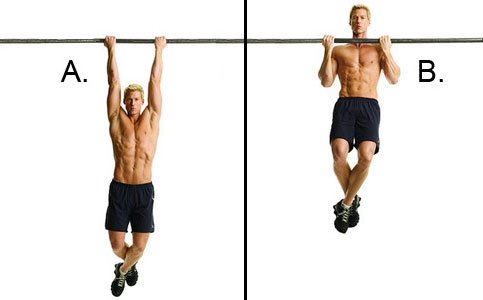
Pullups and Chin ups are an extremely effective way of building both strength and
endurance. They are very good for full body conditioning, particularly
if you are an athlete or martial artist.
Pullups are one of the most beneficial overall muscle and strength
developers. This exercise (also called a chin up) is a simple body
weight exercise for building upper body, back and core strength.
Unfortunately this exercise is often overlooked/neglected in favour of
pumping iron or machine weights at the gym.
Why do PullUps?
A pull-up is a compound, pull-type exercise which works a large number
of muscles in your back, shoulders, and arms (biceps) at the same time.
An added benefit is that it works the abs as well as burning fat.
Bonus!
Standard exercise for special forces and elite organization fitness testing
Improves grip strength significantly
Develop a V-shaped back
If you are new to this exercise or are out of practice a weight
assisted pull up machine at the gym will help your muscles adapt to this
challenging exercise. Lat pull downs machines should also help prepare
you for a non assisted pull up workout. Once you have mastered the
basics there are various different types of pull up you can do including
wide and close grip:
As a much prefer time efficient home workouts (especially
as i am a new father with a busy work schedule). Other pull up bar
include door frame pull up bars, and pull up stations, however, i have
not used these.
Pull up workouts can be made varied and challenging by integrating
them into explosive cardio circuits. There is also scope to attach
weights to yourself or use a weighted vest if you become very advanced
at pull up workouts. I am currently working on the twenty pull up
challenge, and have improved consistently since i first started.
Following a structured training program, I have achieved positive
results with good gains in my biceps, chest. triceps and shoulder
muscles. Just need to work on my diet a bit more to get those abs. Good luck with your workouts.
On the pull-up bar, the kipping is oftentimes referred to as the
"cheating" pull up, however, this exercise, like the dead hang, can give
you outstanding complete body benefits. The reality is, it requires
some ability to master.
What is the Kipping? It is a cutting edge pull up
technique that not only targets muscle tissues, from top to bottom, but
also may get your heart racing!
While the kipping doesn't seem like a
total pull-up, it is the precise movement adopted from gymnastics.You
will know if you have done this properly of you were able raise yourself
up by using your hips to thrust you upwards! It really is smooth and
ultra powerful and is also the whole body exercise.
There is not any
room for muscle isolation in kipping routine. The kip allows you to lead
with your shoulders as much as your hips, while you throw your feet
behind you.Differences between the Dead Hang and the Kipping The
rigorous, dead hang is the usual traditional exercise that comes to mind
when you think of pull ups. This is a muscle-building procedure that
increases and contracts the muscles of your upper back and arms,
generally the lats, biceps, and forearms.
The other parts of the
person's body is designed to remain in sufficient tension to hold a
rigid structure. You begin by hanging on the bar with your arms
completely extended.
The elbows and shoulders are the only parts of the
body that are expected to move. All your other joints need to stay on
practically still, as they shouldn't help with the force production
needed to perform the routine.On the other hand, the kipping begins with
the pop from the hips that powers the body up and over the bar. Once it
is completed, you continue in a quick, rhythmic fashion.
By way of
effectively lifting the body with the very least amount of upper body
pulling, this is a far more efficient method for raising the face on the
bar. Athletes who practice kips can achieve much higher numbers with a
kip as opposed to the strict dead hang.In doing the kipping pull-up your
hips are forward, your feet should be in the opposite direction.
In the
same manner, when the feet are frontward, the hips should be backwards.
This means that the feet is always in reverse position of the hips and
shoulders.
Your body need to either be in the front similar to a half
moon shape along with your hands and feet at the back, or the body must
be in a half moon shape the reverse way with your shoulder and hips at
the back and feet and hands forwards.From this two pull up styles which
do you think is the best?
It actually depends on the person. Sure, the
dead hang pullups is the classic variation. Nonetheless, the kipping
pull up is capable to become a lot more efficient.
Either physical
exercise will provide a huge benefit, the kipping requires much more
coordination and use of hips, as the dead hang generally requires a lot
more energy.
Many athletes struggle greater to do the muscle up, than they do just
about any other technique in CrossFit. While technique is the most
valuable tool an athlete has at his disposal, the development of the
muscles used in this workout will assist the athlete in exploding above
the rings, and having the kinesthetic muscle awareness to maintain
proper technique.
Many workout regimens I have seen are ineffective
while others are dangerous. Today we are going to break down some
vital workouts that, when used effectively, can help you achieve a
perfect muscle up.
#1: Strict Pull ups
In CrossFit, I feel
we focus a little too much on our kipping pull-ups and butterfly pull-up
and forget the pull-up we all did in P.E. in elementary school. The
strict pull-up is foundational for the bar muscle up. This movement
develops your latissimus dorsi, traps, supraspinatus, infraspinatus,
teres minor and subscapularis which is vital for your strength and
support for your rotator cuff. If you are unable to do a strict pull
up, there are a number of exercises you can play with to develop this
critical movement.
Negative pull-ups (start at the top and lower yourself slowly)
Ring Rows
Pendlay Rows
Isometric Pull up hold
Gymnastic Rings Archers
# 2: Develop your Core Strength
In addition to
isometric lifts and explosive power, a strong core is vital to this.
Abdominal isometric holds, like L-holds and hollow holds accompanied
with explosive core work like pike-ups and GHD situps will strengthen
the explosive muscles needed in the abdomen that you will need to get
the pop your hips need for a muscle up.
#3: Chest to Bar
The
next drill you should perfect in your quest to mastering the muscle up,
is developing a strong chest-to-bar. For this drill I want you to focus
less on stringing chest-to-bar pull-ups together, while instead trying
to bring your hips and legs parallel to the floor and pulling the bar to
your rectus abdominus. This will involve a dramatic back swing
followed by an explosive kip.
If you can master this skill and can
learn to pull that bar to your abs, you are just one step away from
flicking your elbows to the air, and finishing your muscle-up.
You will also need to develop a strong hollow and a strong arch on the ground which will develop kinesthetic muscle memory.
#4: Learning the transition from False Grip to Ring Dip Position.
As stated earlier, technique drills
are vital to this workout. While this articles scope is more focused
on the muscle development needed to do a muscle up, there is one
particular technique that simply must be practiced before one should try
a ring dip from below.
For a proper technique video on the drill I'm discussing, check out Jason Khalipa's technique video
Practicing this transition will prepare you
for the "flick" of the elbows to the sky you will need to master before
attempting your muscle ups.
Philip Gephardt is a professional fighter and owner/founder of
Factum CrossFit and MMA in Utah. Phil was a nationally ranked wrestler
before switching sports and focusing on a professional mixed martial
arts career turned gym owner
The Journal of Clinical Psychology reported jungle gym
pastimes are a thing of the past, and gone are the days when swinging
from the monkey bars is a safe activity on the playground. But is the related danger really something adults and children should be overly concerned about? Exercise today
neglects to include many functional movement patterns, like hanging or
brachiating (swinging from rung to rung on an overhead ladder or bar).
“Hanging and the much more challenging action of swinging from object
to object, uses upper body strength in a general sense. Swinging
requires the full participation of every bit of tissue from the fingers
to the lower body,” said Katy Bowman, a biomechanics specialist on natural movement and development.
Although our physical exercise capabilities have not changed from our
Paleolithic ancestors, we have mechanically engineered the functional
movements of climbing and carrying very heavy loads out of our modern
life. Our bodies are paying the price. Increased rates of osteoporosis, osteopenia, and sarcopenia,
in addition to common shoulder and back problems can be attributed to
muscle and joint weakness or imbalance. In 2006, approximately 7.5
million people were treated for shoulder injuries, and the National Institute of Arthritis and Musculoskeletal and Skin Diseases estimates 8 out of 10 people will experience back pain in their lives. So, how might we incorporate hanging and brachiating into their exercise regime?
Our bodies were genetically designed for these kinds of movements.
Paleoanthropologists suspect bipedalism in humans was directly
correlated to swinging and suspensory climbing, rather than for walking.
Just look at all babies today. The palmer grasp reflex that enables
them to grab a finger is the very same mechanism our hunter-gatherer
ancestors used to grab a branch.
In fact, babies are even strong enough during their first six months of
life to be able to suspend their entire body when gripping a bar.
The grasping reflex begins to disappear at 6 months of age, however
research suggests it is only the lack of cultivation of the capability
that reduces its appearance. For this reason alone, we should encourage our children to hang on their arms, and join in on the fun.
Where to get started?
Begin to add isometric hangs and brachiation movements to your
fitness routine a few times a week, working up to daily sessions of up
to 7 minutes. You can install a pull-up bar in your home for convenience or visit your local playground.
However, if you are a beginner or rehabilitating a shoulder injury take some of the weight off of your arms by placing your feet on the ground, either by using a low bar at playground or placing your feet up on a bench. In the supported position, your hands, wrists, elbows, shoulders and hips will be in alignment, and your knees and feet will form a 90° angle.
Active hang
From the passive position above, retract your shoulder blades back and down towards to the ground. Return to the passive position and repeat for your desired amount of time.
Brachiation Basics
Once you have built enough endurance to successfully perform passive
and active hangs, experiment with brachiation. Test your strength to see
if you can perform passive or active hangs on one arm at a time before
adding in the momentum. Try swinging from side-to-side, using each arm
as you move across an overhead ladder, like monkey bars at a playground.
As you become more skilled, the options for where you can go with your
arms are unlimited.
Feeling like the silverback king of the jungle. I know what it feels like. And soon you will too!
This is the exercise every Bar Brother wants to learn. But guess what, it’s not easy to learn.
It’s pretty damn hard (Even for a gorilla). But I have some good news.
In this blog I will give you a step by step explanation of how you can learn the muscle up. Does that sound like a plan or not?
I’m not hearing you…So I guess that’s a yes.No actually I assume that’s a yes, because everyone wants to do the muscle up!
Want to know why?
Well…Because it is probably the best upperbody compound exercise (meaning you train muscle groups) that is known to men. The pure power, coordination and technique it requires, make it a must have in your BEAST MODE arsenal. But what does it look like?
Looks cool, doesn’t it.
Most beginners want to do a muscle up immediately, but fail to
realize that doing a muscle up is not something which is ‘just done’,
you have to train for it.
Step 1: Start Doing Pull-Ups
Far before you are able to do a muscle up, you have to master your pull ups and feel comfortable with doing them.
Do as many reps as you can do and controlled as you can do.
There is no precise number, make sure you max out.
What really helps is having a number in your mind and to keep going until you reached that number.
Do not think you can do a muscle up before you can do a pull up.
It is like trying to do a marathon before you can walk. Learn to walk first.
Step 2: Make explosive moves
Because a muscle up has an exaggerated range of motion, this is what you should exactly practice.
Don’t stop when the bar is below your chin, push through and make sure it goes all the way towards your chest.
Make this movement as explosive as possible. Pull yourself up as fast as possible and then go down slowly.
Focus on an object in the distance, explode, hold it and then let go.
Explode and let go, repeat this until you master it.
Step 3: Jump yourself into the movement
Modifying your muscle up a little can help a lot in training the motion.
Remember that a muscle up is just as much technique as it is strength.
One easy way to do this is by jumping yourself into your muscle up.
– Hold the bar with both hands
– Pull yourself up
– Jump while you are pulling yourself up
– While you are pulling yourself up transition into a muscle up
As you keep practicing this movement, decrease your jumping power until you are able to do it without jumping.
Step 4: Use your motion
Especially when you do your first muscle up, using your legs an hips to generate an extra swing can be really useful.
Make sure you time your movement.
– Swing forward
– Swing backwards
– When you are in the backwards motion halfway, do a pull up full force to transition yourself into a muscle up
The more comfortable you get the less you can move your leg motion and master a straight muscle up.
Step 5: Do negatives
Negatives are really useful in learning pull-ups and muscle ups. They require less strength and are easy to apply.
Combine them with the above mentioned exercises.
Step 6: Be patient
No body was built in one day, it will take more than a day to learn a clean muscle up.
Make sure you focus on the technique instead of forcing your body above the bar.
This will only cause injuries and as a result will take you longer to master your muscle up.
This six step how to guide, if followed in a disciplined manner will
surely help you get your first muscle up. There are a lot of online
tutorials, make sure you watch them, keep practicing your skill to
unleash the Bar Brother Beast.
In addition to winning both popular and critical praise as the star of
True Blood and Magic Mike, Joe Manganiello has become known around the
world for his incredible physique. Now, from the man that director
Steven Soderbergh called “walking CGI,” comes the cutting-edge guide to
achieving the perfect body and raising your overall quality of life. Check Out Joe's Fitness Tips
Over
the last two years, I’ve had the pleasure of visiting many different
CrossFit boxes throughout the United States. Plus, I’ve been a solid
member of three different CrossFit boxes. As a result, I’ve been able to
experience many different coaching and programming styles in which each
gym brought their own specialty to the table. However, I found
something universal among most gyms: the banded kipping pull-up.
Kipping pull-ups are a high-skill exercise that requires coordination
and strength to keep the shoulder supported under a dynamic load. This
seems to be a major struggle for most novice and some intermediate
CrossFitters. I know it was for me, especially coming from a
bodybuilding background where strict isolated movements were most
common. Whether it’s because of a lack of knowledge on how to properly
teach the movement or the patience to do so, I’ve noticed that members
get thrown on the bands almost immediately.
Being educated in human anatomy (I have a CPTS from Fitness Institute
International and am ACSM certified) with a special interest/knowledge
about the shoulder, I questioned this coaching style and whether banded
pull-ups were actually affective and safe.
Recently, my fiance and I relocated a bit north of Fort Lauderdale to
the Delray Beach area in Florida, and we became members of CrossFit
Delray Beach. While finishing up a workout session one day, I started a
conversation with Laura Canteri, one of Delray’s head coaches. Laura is
a former collegiate athlete who is passionate about human performance
and program design. Once she had completed her Master of Science in
exercise physiology, she enrolled in James FitzGerald’s OPT (Optimum
Performance Training) assessment and program design courses. After
learning about her background in exercise science, assessment, program
design and coaching, I was anxious to hear her opinion on the banded
kipping pull-up.
“I can’t speak for every coach, but I believe bands do more harm than
good in terms of an athlete’s development,” Laura said. It was a breath
of fresh air to hear my concerns validated.
Laura and I discussed how the most challenging part of a pull-up is
the initial pull, which requires scapula retraction and depression. Band
tension is highest at the bottom of the movement, so the initial snap
of the band causes you to bypass the most important part of the pull-up.
Athletes who continue to use the band will never learn how to fully
activate the muscles needed for a strict pull-up and, in turn, will
never build true strength. Laura and I then went on to discuss the
importance of strength and skill in the movement.
“Its important to improve strength and skill simultaneously in all
movements,” Laura said. “However, I stress the importance of strength
before skill for kipping pull-ups due to the nature of the shoulder
joint. If someone is unable to perform a strict pull-up, they will not
possess the strength to support their shoulder in a dynamic load such as
the kipping pull-up.”
Because the shoulder is a shallow socket joint and the most mobile
joint in the human body, it’s highly susceptible to chronic shoulder
problems and/or injuries. I’m not suggesting the removal of bands from
your gym altogether, but I challenge you, whether you’re a coach at a
box or a member of one, to hold yourself to a higher standard. Teach
your members the importance of building strength and activating muscles
that support the joints before you put them under the stress of a
ballistic movement such as the kip. Program exercises that teach scapula
retraction and depression such as ring rows and, of course, strict
pull-ups.
If you’re a member of a box that allows you to use bands, start
practicing without them. Add in strict pull-ups on your own, and if you
can’t do a strict pull-up, then do jumping pull-ups and try to hold
yourself up to the bar as long as you can. I guarantee you will get
stronger and be able to do a bodyweight pull-up on your own.
Being fit and healthy is what we all want to achieve. On that journey, we hope to stay injury-free.
Stay enlightened, my friends!