Showing posts with label burpees. Show all posts

Tuesday, 1 September 2015

Body Weight Workouts for a Strong Body

Bodyweight workouts are very misunderstood and under-estimated ways of enhancing muscle tone and strength. Many trainers and fitness seekers can't see past traditional bodyweight workouts consisting of push-ups, pull-ups and dips.
 
 Both men and women can follow body weight workouts and get great results that are in line with fitness goals ranging from slimming, shaping and toning to strengthening and lean muscle building.
A big hurdle for most people to get over when considering body weight workouts for fitness is the question of, "How can a body weight workout routine replace one that uses weight training and machines?"

It is easy to see how psychology can be an obstacle in trying to help people understand that properly structured bodyweight workouts can be better than traditional weight-lifting and exercise machine workouts. Traditional workouts offer many variations, almost endless actually. Where as bodyweight workouts rely on creativity mixed with a good understanding of how the body functions and what exercises stimulate healthy and safe fitness progress.
 

Many fitness pros believe that body-weight workouts offer just a limited amount of exercise options and are very general at best, meaning that there is no ability to target and isolate specific muscle groups during a bodyweight workout. This is a big mis-perception that prevents many fitness success stories from ever becoming a reality.

Here's the reason why. When people get into the 'health club mentality' of only being able to workout with equipment, weights and machines, they set themselves up for many episodes of 'falling off the program' and failing. Bodyweight workouts eliminate this excuse.


Here's an example where bodyweight workouts are a million times more effective than regular old gym workouts. You go on vacation or you go out of town on business, or maybe to visit family for several days. So many times these events become excuses for people not sticking to their fitness plan because they 'couldn't go to a gym'. With a well-rounded, bodyweight workout program this excuse is not valid.

The right body weight workouts can be done anywhere and anytime. They can be done at home, the office, a fiend's house or even on a play-ground. And in terms of effectiveness - I can only say through personal experience with my own bodyweight workouts and those of the people who I have trained that when planned properly and followed consistently, bodyweight workouts can be even more effective than most weight lifting or machine based workout programs.

Body weight workouts offer 'fitness veterans' - a refreshing, eye-opening alternative to the those repetitive weight and machine training programs. Even more importantly, bodyweight workouts offer sedentary fitness beginners a safe, non-intimidating and effective method for starting a home based fitness program with a high probability for success.

Whether you are just beginning or you've been 'pumping the weights' for some time now, give some consideration to the benefits and advantages of properly structured body weight workouts and how they can help you move forward in your fitness and conditioning goals. Open up your mind to the possibility of a bodyweight workout being a part of your overall fitness plan and see what happens. You'll be very pleased and maybe a bit surprised with the results you experience.

 Damian@FitnHealthy

Sunday, 23 August 2015

Weight Lifting | CrossFit Straps

To begin, let's all agree that buying weight lifting straps is not brain surgery. But, there are a few things that are totally helpful to remember when trying to find the best straps for you that will meet your needs.

1. Define your own goals.
Do you want to be the next Arnold? Or just lean down and try to look better in that bathing suit that you've been afraid to put on for the past year? Being honest about what your goals are when working out in the gym is very important. The muscle-heads will need the heavy-duty, serious weight lifting straps that will enable them to throw a ton of weight around while the beach beauties will simply need another gym fashion accessory so that they can look great.

2. What exercises will you be using your weight lifting straps for?
Some people find that they use their straps for almost every exercise they perform in the gym. Others, like me, simply use them for the heavier weight exercises that put the most stress on my grip since I try to push more weight than I would normally handle. It's important to think about which exercises you'll be using your straps for so that you can make your selection based on need. Pushing or pulling or both?

3. Think about what kind of material you'd like in your straps.
OK. Some people are more into leather than they'd like you to know! But woven cotton and even neoprene weight lifting straps offer their own benefits. Consider which type of material is going to make your workouts better. And, if you're a sweaty muscle-monkey, then you may want to consider whether you can wash your straps too! They tend to get really dirty and quite stinky too.

4. Are the straps you like simple to use or do they take half your workout just to wrap around the bar and your wrist?
One thing that most people don't think about is what the straps will be like once they're in the gym using them. If they are the long strap with the loop at one end version, then you're probably the type who is planning on Hulking up huge. If you're really looking for hand protection as opposed to uber heavy lifting ability, then you may be more interested in a simpler hand grip product. Wrapping the extended material around the bar to grip more weight can be cumbersome to certain people. A simple on and off quickly type product, such as a hand grip, may be what the trainer ordered instead!
 
  
5. Think about the look you're going for at the gym too.
Yeah, I know... you're just going to work out. You don't care what you look like. Bull. Anyone who is in the gym in the first place, is thinking more about the image that they are projecting than not. And, it's really OK too. So, remember that when you're selecting the right weight lifting straps for yourself, think not only about functionality, but about aesthetics too. What do you really hope that your new found straps or grips will say about you? Egotistical callused muscle maniac or considerate baby smooth handed boyfriend with the sensitive touch? Whichever it is, make sure it works for you!

The grips that work absolutely best for my needs are a crossover pair between lifting straps and grips. They are called Gorilla-Grips. They are made of 100% leather with elastic finger loops which hold them in place on my hands. They are totally stoked for lifting super heavy weights or just for use as a protective layer between me and the germ-ridden handlebars in my spin class.
 
Source Hamilton B | Ez

Wednesday, 12 August 2015

How To Select Your Dream Crossfit Shoes?

May possibly not be considered a bad idea to choose a pair of crossfit shoes for you, however it would definitely not best if you get this choice irrationally. Before going for this kind of choice, you've got to ensure that you are making certain that the company you might be selecting is satisfying some basic options that come with the best crossfit shoes. Many of these features are already discussed the following:
1.Versatility
The one thing you shouldn't compromise may be the versatility of the brand you will choose. This means that your brand should not be limiting you to only some products. There should be a wide range of products open to ensure that you can pick the pair of shoe that truly suits your personality and overall looks.
2.Affordable Price Range
Rationally speaking, what can function as the use of this type of brand which can be offering a good quality from the product but in a type of price range that merely falls out of one's cost range? Certainly, choosing this kind of brand would simply to place an extra stress on your pocket. Therefore, it is always very crucial that the brand you will choose should be very reasonable too.
3.Longer Life from the Products
Remember, these crossfit shoes for women are high price products. You got to make certain that your brand should offer a good quality for these products which do offer a lengthier lifetime of the shoes.

The bottom line is, the best possible things to be considered while deciding on the best crossfit shoe are excellence of the shoe, cost range with the shoe, color combination or perhaps the versatility with the shoe brand and the reliability of the merchandise. Wherever you are going to locate an amalgam of these items together, you've got to ensure that this is actually the right time to strike the chord and select the shoe for adding feathers to your persona. Plus a closer take a look at all international brands currently operating on the market, probably no brand offers a better amalgam of those things than Reebok. This brand has earned significant amounts of name on the time frame and it has won the trust of the customers around the world. From quality to price range and from versatility for the life of the product, this brand is merely outstanding and having a presence of its own. What exactly are you waiting for? Have the opportunity to hold the luxury of using these inordinate couple of shoes and let your personality flair better yet, even higher and even better!

Damian@FitnHealthy

Thursday, 2 July 2015

How to do Crossfit style Workouts at Home

The bottom line is these are all workouts that (when done properly) provide unbelievable results in a short period of time. And results are what I care about.. 

Step 1: List All The Equipment and Exercises You Have Access To.

Let's start with the most obvious and fundamental piece of equipment your bodyweight. Exercises like push ups, air squats, burpees, sit ups, lunges, planks, sprints, and longer runs are all incredibly simple and effective. 
You can even add more complex movements like push up variations, one-legged squats, or Ab variations like russian twists.

Next, look at other equipment that you may have around the house. My personal favorite, and the only real piece of workout equipment that I own, is a kettlebell. The versatility of a kettlebell allows me to do kettlebell swings, cleans, snatches, presses, sumo deadlift high pulls, turkish get ups, goblet squats, and much more. I also have a jump rope which allows me to add single jumps and double unders into the mix. 
(If you are looking to outfit your home gym, these are the two things I recommend buying first.)

I know a lot of people usually have an old set of dumbbells lying around that can be used for presses, thrusters, rows, or for adding weight to traditional body weight movements like squats and lunges.
Even without a gym membership you should have no problem doing exercises like pull ups and dips. If you don't have access to a pull up bar or dip station, then you just aren't trying hard enough. A playground, tree branch, or concrete ledge can be used in place of a traditional pull up bar and a set of chairs can be used for dips. Don't be afraid to think outside the box when you don't have access to a gym full of equipment. 

The ledge in my condo's stairwell makes for a perfect place for pull ups.

Just keep in mind that CrossFit (and all good training) should be built around functional movements so you want to avoid things like crunches, bicep curls, or calf raises. 

Stick to compound exercises that place a higher demand on your entire body.

Step 2: Get Creative and List Even More Exercises.
You thought doing pull ups in a stairwell or chair dips was creative?
Not even close. Now it's time to really think outside the box.
A nearby bench or wall can be used for box jumps and step ups.
A hill or bridge can be used for incline sprints. Buckets can be filled with water for farmers' walks.
Water jugs can be used in place of dumbbells. A wall can be used for handstand push ups or wall climbs. Sand bags can be used for cleans or taken along on runs.
 
Nothing is off-limits.

The equipment that you use will most likely be things that you would find in a Home Depot rather than a Sports Authority.
If there is an object in your house that's heavy and awkward, chances are you could add it to your workouts. Just stay away from expensive electronics. 


Step 3: Fill the Bingo Hopper.
It is time to take the lists of exercises that you created in 
Steps 1 and 2 and load them into the bingo hopper.
 
What is the bingo hopper?
It's a model CrossFit uses for creating workouts with as much variety and intensity as possible. Just as your traditional bingo hopper selects bingo numbers at random, you should select and combine exercises at random when designing your workouts.

It is this variety that CrossFit says will provide your body with a unique and powerful stimulus at every workout. A stimulus that forces your body to adapt and get stronger consistently over long periods of time.

CrossFit is built around the preparation for the unknown and unknowable and the bingo hopper is the perfect representation of this viewpoint. Now that the hopper is loaded and ready to go, let's see how this equates to actual workouts.

Step 4: Create Benchmark Workouts.
There's no reason to reinvent the wheel if you don't have to, so I would start by browsing the list of CrossFit benchmark workouts, and seeing which ones you can do with the equipment you already have. Benchmark Girls like €Angie€ and €Cindy€ come to mind right away, since they require little more than your own body weight to perform.

From there, you can take other benchmark workouts and alter them to include the exercises that you can execute at home. Here are a few examples:

Fran
 Pick two high-power exercises and perform 21 reps of each, 15 reps of each, and 9 reps of each as fast as you possibly can. Record total time.
Example: 21-15-9 dumbbell thrusters and chair dips

Fight Gone Bad
Perform 5 exercises for 1 minute each. That's 1 round. Complete 3-5 rounds with a minute rest between each round. Count total reps.
Example: 1 minute each of sumo deadlift high pulls, kettlebell cleans, dumbbell push presses, goblet squats, sit ups. 
Rest 1 minute then repeat 2 more times.

The Chipper
 Pick 5-10 exercises and do 50-100 reps of each exercise. Complete all reps of one exercise before moving on to the next exercise.
Example: 50 lunges, 50 double unders, 50 kettlebell swings, 50 one-legged squats, 50 push ups, 50 box jumps, 50 hanging knees-to-elbows.

Helen
 Do 2-3 exercises for 10-25 reps each and separate each round with a 400 meter run. Record total time.
Example: 3 rounds for time of 21 jumping air squats, 12 handstand push ups, 400 meter run.

Karen
Perform 150-200 reps of the same exercise as fast as you can.
Example: 150 burpees for Time

Tabata Intervals
Pick an exercise and do 4-8 straight rounds of 20 seconds of work and 10 seconds of rest. Do this for 4-5 exercises with no additional rest in between. Record total reps.
Example: Tabata Abs. 6 sets each of sit ups, Russian twists, knee tucks, and leg raises.

Step 5: Vary your Workouts, Record your Results, and Test Benchmark Workouts on a Regular Basis.
Just as the bingo hopper model suggests, rarely should you repeat the same workout within a few weeks or even months of each other. Continue to create and execute new workouts, and use the benchmark workouts that you created in Step 4 to test your progress a few times a month.
The secret sauce of CrossFit is measuring the variables of a workout so you can compete with yourself in every training session. 

Record every workout that you do, along with the weight that you used and the time it took you to finish. This evidence-based approach to fitness will show you how you are improving over time so you won't have to rely on faulty measuring tools like a scale or your memory to tell you if you are becoming more fit.

I would recommend adding 2-3 days of CrossFit/metabolic conditioning to the 2-3 days of compound strength training that you are (hopefully) already doing. This should give you the fastest results in the least amount of time and we like results.
 

 Damian@FitnHealthy

Wednesday, 10 June 2015

Andrea Ager Crossfit

One of these individuals is Andrea Ager. Andrea's journey began with a simple talk in college from a friend who motivated her to take up the sport. This saw her train for 3-4 hours each day before going to work. She finally moved all her focus to CrossFit training. As the years have gone by she has slowly grown her training for CrossFit and improved the gains that she has gained from the training regime.

At the beginning her focus was on pushing volume and heavier loads. This was intended to increase the power strength that she had. Over the years she has moved more to concentrate on strength. She has also noticed that the hardest part of the training is usually on the specialized and unspecialized training days. These especially are aimed at pushing one to the limit. But with five days of training and doing lots of volume one gets to adjust to the training regimen. The fact that one has a good number of workout music from which to select from adds to the fun of the training and boosts one's morale when undertaking their training.


This is actually a fact that has been proved scientifically. This is in regards to the fact that listening to music while undertaking the training helps one improve on the overall gains that they achieve from their training. 

This is not just in CrossFit training but in all other major types of sports. It also helps to build a playlist that contains some of your favorite songs.

The other part of any fitness regime lies in following the right diet. So too does CrossFit call for eating right to complement the training that one is undertaking. Andrea's diet includes a lot of protein, but so too does it include taking in the right type of carbohydrates, vitamins and fibers. The protein source that one uses should also be the right kind of protein. In this case lean meat and white meat are the most preferred sources of protein. Foods like avocado also provide one with fats that help in fueling the body through the training regimen that one is undertaking as well as the fiber that the body needs to ensure effective digestion. It is also important that one has their cheat days in order to reward the body for all the hard work that it is undertaking during the training period. Andrea's favorite cheat meal is cookie dough ice cream or chocolate.

Source: Written with thanks by Becky Watson

Monday, 8 June 2015

Have You Ever Wondered What CrossFit Is Exactly?

Have you ever wondered what CrossFit is exactly? Well, I'm here to explain to you what it is and how I feel it would be perfect for you. By definition, CrossFit is constantly varied, high-intensity, functional movements. 

To explain more in detail:

CONSTANTLY VARIED - Never doing the same workout twice unless you repeat a workout to test your progress. Basically, not allowing your body to adapt to the same constant movements.
HIGH INTENSITY - How much weight a person move over the longest distance in the shortest amount of time. Another way to look at it is power and intensity. The hope of the CrossFit community is for one day to have a person who can run a sub 5 minute mile as well as deadlift over 500 pounds.


FUNCTIONAL MOVEMENTS - Movements that we as humans were built for. Movements that are natural and safe. Moving furniture, for example, is the same as a weightlifter performing a deadlift move. Both movements require the weight to be transfers from the floor in a similar manner.

 
 CrossFit can be performed by anybody, at any age, and at any fitness level. This is the primary reason why I believe it is for you. The CrossFit community is so welcoming and encouraging. When you feel you can't complete that last repetition in your workout, the other patrons are there to cheer you on. People from the ages 10 to 75 are currently participating in CrossFit because it is scalable for all levels of fitness.

Each day you enter your "Box" (another name for gymnasium) the workout of the day (WOD) will be posted on the white board. There is no thinking involved and all you need to do is workout. The workouts are preprogram and the coaches will explain/clarify them as well as review the functional movements used during the workout to ensure they are preformed correctly to help avoid injury.
 
 A commonly asked question is will I get hurt. I believe you can get injured in any sport not just CrossFit. So, yes, there is a possibility. However, you are at risk of getting hurt every time you step out of bed. Always practice good form, listen to your body and rest when you need to. Another great focus to keep you body health is to do mobility and really stretch so that you can prevent injury.

So, why not give it a try? Look up your local box and go see what it is all about. The best part about CrossFit is that it can be done anywhere with minimal specialized equipment. If you have to travel for vacations or business, you do not have to stop working out. Simply drop in at any local box in the town you are visiting and believe me, you will be welcome as one of their own. 

CrossFit is truly an amazing worldwide community. Get started today!

Source: Camille Dougherty

Saturday, 4 April 2015

Complex Training: Strength and Conditioning Workout for Athletes


Up until about 40 years ago, most athletes were told to avoid resistance training because the misperception was that strength training would actually reduce their athletic performance. Of course, we now know that a proper strength and conditioning program is essential for athletes who want to reduce their risk of injury and enhance their performance. 
Athletic performance is based on a number of skills that can be developed through a sports conditioning program. This particular program focuses on improving both muscular strength and power using a technique called post-activation potentiation (PAP), also commonly referred to as complex training. 
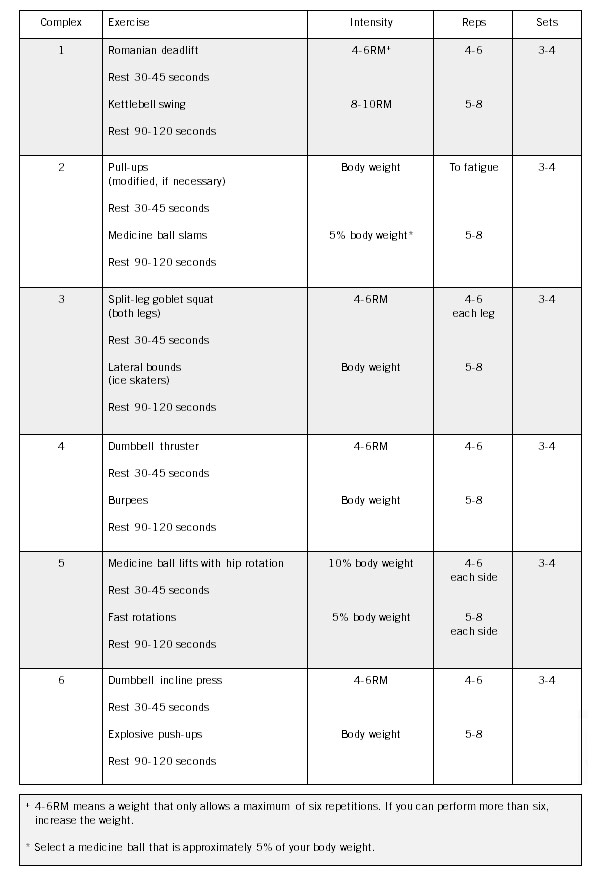
Complex training combines strength exercises from the load phase of the ACE Integrated Fitness Training® (ACE IFT®) Model and power exercises from the performance phase to improve both muscle force production (strength) and the rate of force production (power). A complex training set involves performing two exercises back to back, with a brief rest period in between. The first exercise is a strength exercise using a heavy weight for four to six repetitions (ideally fatiguing by the final rep). The second exercise is a power exercise focusing on explosive movement for five to eight repetitions. There should be a 30- to 45-second rest interval between the strength and power exercises and a 90- to 120-second minute rest interval after both exercises. 
It is important to perform a number of mobility exercises for a proper dynamic warm-up before attempting a high-intensity training program. There are two ways to do a complex workout: Complete all complex sets of one exercise before moving on to the next, or combine the exercises into a circuit. Circuit training allows you to reduce the rest time between complex sets, which increases the challenge of the workout.
 Complex Training Program 

Exercises:
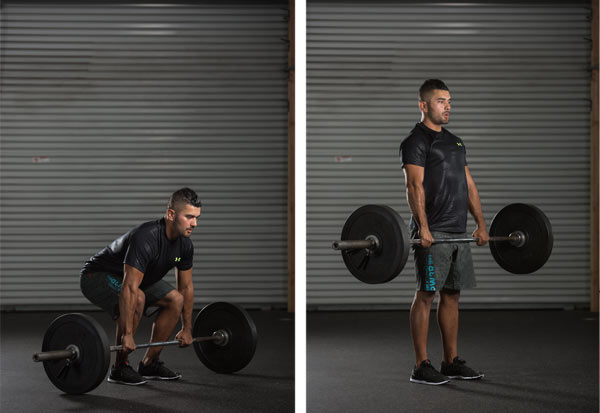
Deadlifts
 
Deadlift


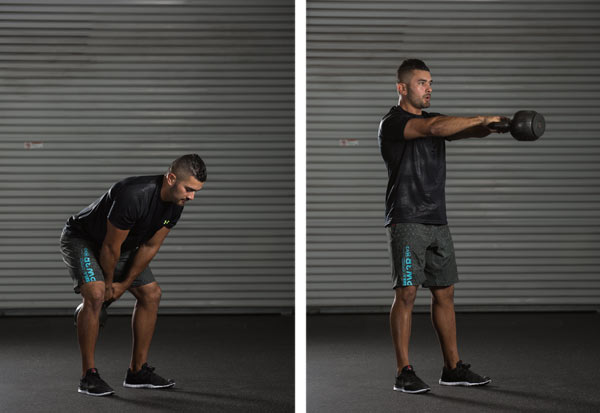
 Kettlebell Swings

kettlebell swings


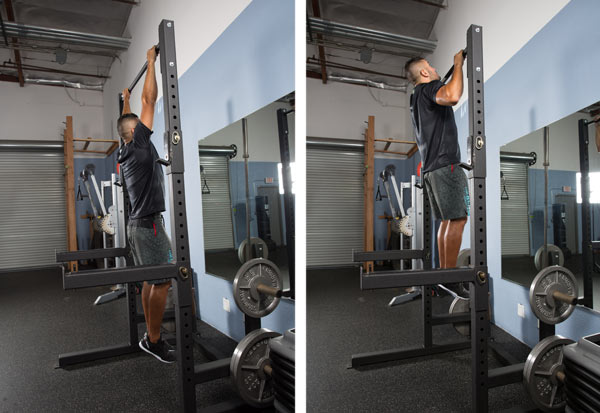
 Pull Ups

 pull up

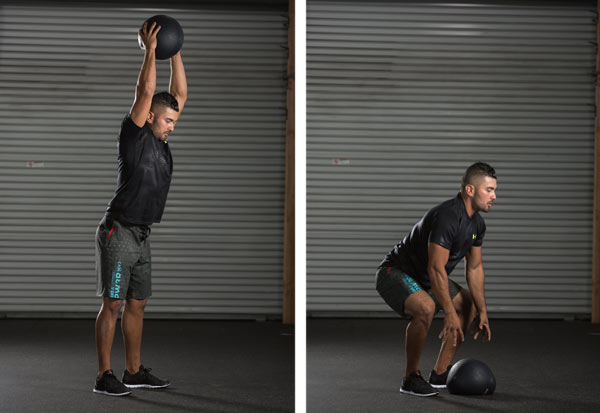
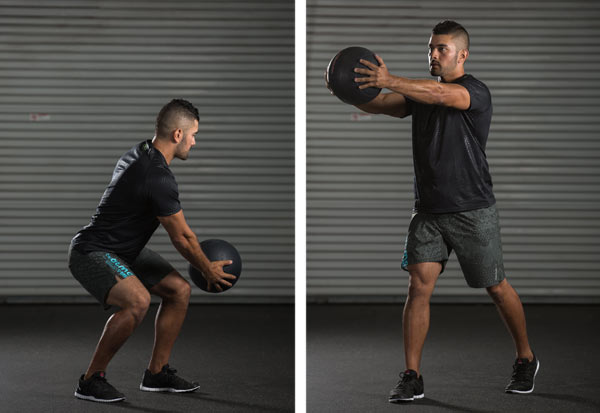
 Medicine Ball Slams

 medicine ball slam

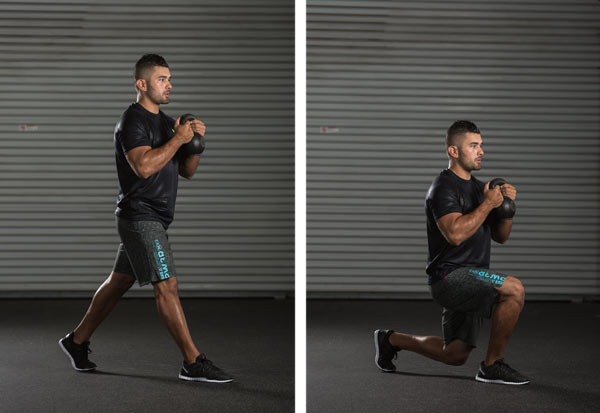
 Split-Leg Goblet Squats

 split-leg goblet squat

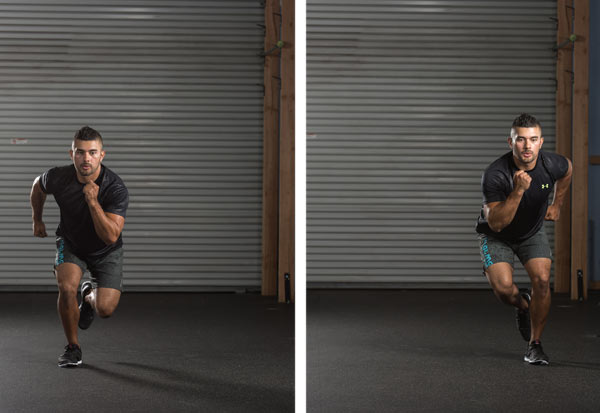
 Lateral Bounds (Ice Skaters)

 lateral bounds

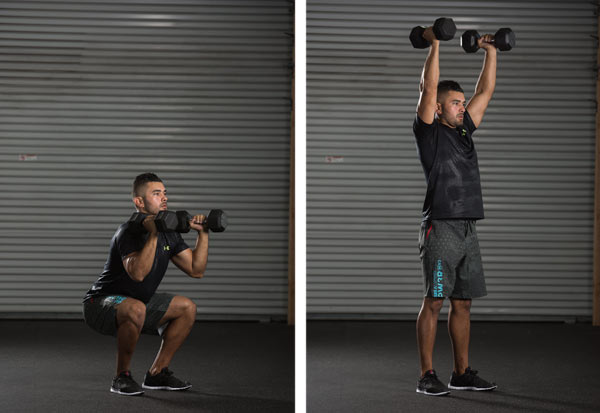
 Dumbbell Thrusters

  dumbbell thrusters

 Burpees

 burpees
 
 burpee

 Medicine Ball Lift with Hip Rotation
  
Medicine ball lift

 Fast Rotations

 medicine ball rotations

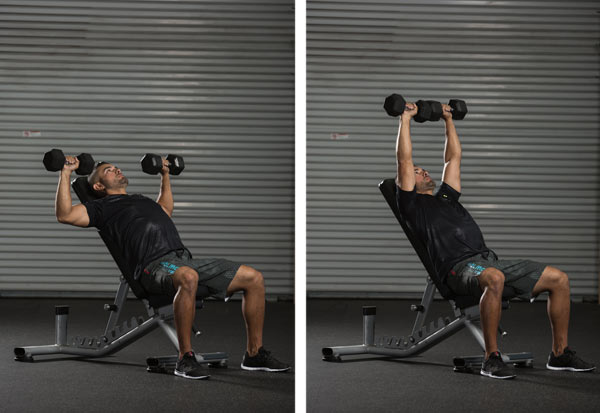
 Dumbbell Incline Press

 dumbbell incline press

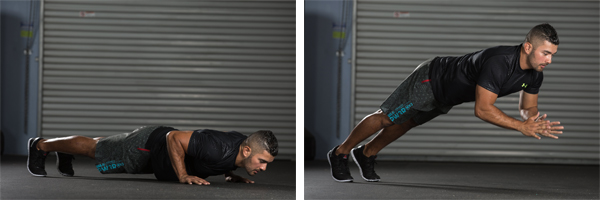
 Explosive Push Ups

 Explosive push-ups

 Source : By Pete McCall, MS/ ACE

Thursday, 18 December 2014

Tabata For Fat Burning: The Anaerobic And EPOC Effects

Tired of being overweight? Sick of not being able to wear the clothes you want to wear? Ready to change? One good way to burn fat and build lean muscle is by using the 4 minute Tabata Workout.
 

The Tabata Game Plan:
You're going to do twenty seconds-yes, I said twenty seconds-of really, really, really intense aerobic exercise. Then you're going to stop and do nothing at all for all of ten seconds.
Then you're going to do your exercising again, and keep it ramped up to the ultimate level-for all of twenty seconds. Then you get ten seconds to get back to feeling like a human again. And then you'll be doing that maximum intensity stuff again, for twenty more seconds, and when the timer gets off, you catch your breath-for exactly ten.
Keep on with this rhythm, until you've done 8 rounds of twenty-second bursts of fat torching radically intense exercise.
Creating The Anaerobic State
In the past, fitness experts have advocated the "fat burning zone," which, basically equates to 1 hour of steady cardio, such as, that on a treadmill or exercise bike.
This slow methodical cardio process had become old news since science has shown that intense work intervals followed by short rest periods is what facilitates what is known as the anaerobic state, and this exact state is what allows for the most fat burning.
Anaerobic literally means "without oxygen," where you will be gasping for breath, and often feel like you are unable to catch your breath. This is the ideal zone for fat burning, increasing endurance and stamina and strength training for the muscles. In the Anaerobic state the body begins to use carbs for energy instead of fat.
HIIT is one of the most well-known and widely used protocols to create this anaerobic state, though, Kettlebell training does it as well. But, Tabata really takes it up a few notches and includes some of the most gut wrenching, breath catching moves with the shortest workout time that results in maximum fat loss, extreme metabolism boost and consequent calorie burning for hours after the workout is over.
EPOC And Metabolism
The practice of alternating short recovery periods with maximum effort allows the body to push itself beyond its perceived threshold, and that initiates a chemical response and neuro-endocrine reaction.
Elevating the metabolic rate is the key to burning body fat! Contrary to what so many people focus on, the goal is not so much the calories or fat burned during the workout, but, what is burned continuously after the workout.
And the only way to use carbs as energy during the workout is with intense intervals that raise the resting metabolic rate. During very intense bursts the heart rate soars and as you struggle and gasp for air you will naturally react by taking in more oxygen in the rest periods and this extra oxygen is what will raise the metabolic rate. This process is known as excess post-exercise oxygen consumption (EPOC).
Tabata is the fastest and shortest workout option to create EPOC, and the anaerobic state, which, is so effective at torching body fat.
Choosing The Right Moves For Tabata
What exercise you choose to do will depend on your personal physical state and what you're comfortable with. The type of exercise you do for a Tabata session has to be one that you are very familiar with, and very good at.
Still, if you're not good at any exercise, don't worry. You can teach yourself anything. What you'll have to do is to do some mock-up Tabata sessions at a more normal level, just to get yourself used to the way it works.
Form is very important in body weight exercises, and if you start by trying to go fast, or aim for too much intensity outside of your fitness level, you'll lose out in form and the exercise will be of little value.
Burpees
One good exercise to use with the Tabata protocol is burpees-they'll give you a full-body workout with no extra equipment.
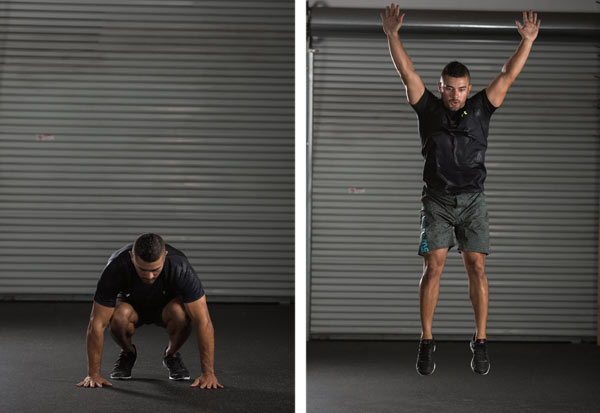
1. You start out standing straight and tall, hands stretched over your head.
2. Then get down into a squat, hands down on the floor, and from there go into a plank.
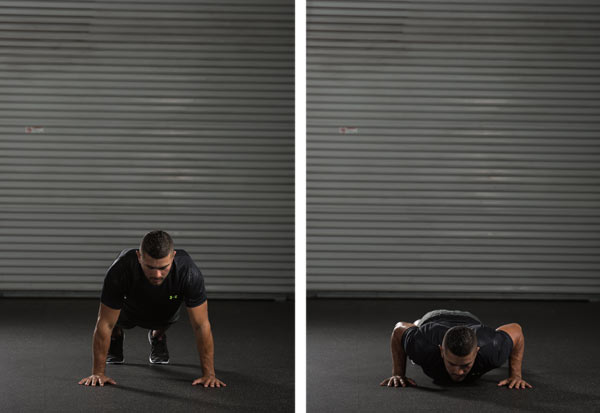
3. Go down all the way, like the lower side of a push up; push yourself up, then jump back up to the squatting position and back up to standing.
4. Then one quick jump up, and you're ready to begin again.
If you haven't done burpees before, or it's been a long time since you've done them, start by just doing four or five of them slowly, keeping good form. Tomorrow do ten, and the day after that, fifteen.
When you feel comfortable with the rhythm of this exercise and can do it pretty fluently you're ready to incorporate it in an all-fire intense Tabata workout.
There are many other moves that can be done, some of which are simpler, and some are more completed. Even jumping jacks and sit ups can work in Tabata when they are executed in fast and continuous reps for the full 20 seconds.
Timing
You'll need a stopwatch or some way of measuring seconds. A free Tabata app on your smartphone-there are several to choose from-is an easy way of getting it done.
When the counter starts, start doing burpees as if your life depended upon it, as if there was an atomic bomb about to go off and blow you and your loved ones to bits if you did any less than the maximum number.
When twenty seconds are up, stop. Wait ten minutes, and then go at your fastest, most intense pace again for twenty more seconds.
When you've done eight twenty second sessions you'll have completed your fat-torching Tabata workout routine.

Article Source: http://EzineArticles.com/8842766

Wednesday, 17 December 2014

Tabata Versus High Intensity Interval Training: Are They The Same?

The question of the similarities and differences between Tabata and HIIT is an interesting one, so let's look into this further.
Tabata is high intensity interval training. It's a subset, a particular form of high intensity interval training (HIIT), but, there are certainly other forms of high intensity interval training out there that are not Tabata. But, HIIT is NOT Tabata, and should not be confused with it when it comes to the correct protocol of how Tabata is executed.
What high intensity interval training (HIIT) means is that you're doing some physical activity at a really, really intense level for a specified interval, and then you either rest or do a less intense activity for another specified interval.
HIIT Protocol
You go in waves, switching between intense activity and a recovery period. For instance, under one HIIT protocol you might do thirty seconds of intense activity, followed by twenty seconds of moderate-level activity as your recovery block. Then you'd ramp it back up to the really intense stuff, and hold that for thirty seconds more; and when that is done, get twenty seconds of recovery.
Tabata Protocol
Tabata is a particular form of high intensity interval training that many feel gives the body the optimal workout.
The Tabata protocol is much more specific than HIIT. It calls for exactly 20 seconds of high-intensity exercise followed by a 10 second rest, and this sequence is done exactly 8 times. There is no variation.
Also, for those 20 seconds the moves you execute must be at maximum capacity and exertion level, with all the energy possible, at max rate, without any tapering off or slowing down. Then only 10 seconds to catch your breath.
The Main Difference
The main difference between Tabata and HIIT is that the timing of the intervals in the protocol for Tabata is very specific and must be followed. While HIIT may allow for longer intervals or longer rests, and some regimens actually do not use rest periods, but, instead incorporate slower movement as the rest period, Tabata does not.
And the intensity with which moves are executed must be at max force with Tabata, they should literally want to make an experienced athlete and advanced level fitness buffs want to puke.
The Similarities
Both HIIT and Tabata use intense intervals. Both share many of the same moves, though the intensity levels and rest periods vary. Moves, include, burpees, mountain climbers, lunge jumps, squat jumps, intervals on exercise machines, for example, bikes or treadmills.
Other Forms Of HIIT
Tabata high intensity interval training is not the only type of high intensity interval training out there, by any means.
There's the Peter Coe regimen; a ultra-fast 200 meter run, then thirty seconds of rest, then another 200 meter. This regimen was used by coach Peter Coe in the 1970s.
There is also the Gibala regimen, developed by Professor Martin Gibala and published in 2009 as three minutes warm up, sixty seconds of intense exercise and seventy five seconds of rest. This gets repeated eight to twelve times, three times a week.
The Timmons regimen was developed by Jamie Timmons, professor of systems biology, and published in 2012. Here two minutes of gentle exercise - slow biking on a stationary bike-is followed by twenty seconds of high intensity. The high intensity and recovery intervals are each repeated three times, three times a week.
All of these are examples of high intensity interval training. They are not Tabata exercise regimes, though; the Tabata name is only given to high intensity interval training that follows the exact protocol set out by Tabata in his 1996 paper-20 seconds intensity, ten seconds rest, repeat eight times.
There are some high intensity interval training programs marketed as 'Tabata style' which typically use the basic form of Tabata's ideas, but, mix it up a bit by introducing periods of different exercises in various orders.
The most straightforward Tabata high intensity interval training goes through just one exercise at a time, a practice which enables you to really focus on putting your all into it.
Getting Started With Either Workout
Tabata and HIIT are both advanced level fitness routines. Both of these are highly intensive forms of training that are not typically recommended for beginners. If you want to start, it is better to begin with HIIT on a small scale and work your way up.

Source: http://EzineArticles.com/?expert=John_Rivers

Saturday, 29 November 2014

CrossFit Terminology

CrossFit Acronyms and Abbreviations

 AMRAP: As Many Reps (sometimes Rounds)as Possible

 
ATG: Ass to Grass
BP: Bench press
BS: Back squat
BW (or BWT): Body weight
CFT:CrossFit Total – consisting of max squat, press, and deadlift.
CFSB: CrossFit Strength Bias. A program developed by Jeff Martin and Darrell White
CFWU:CrossFit Warm-up
CLN: Clean
C&J: Clean and jerk
C2: Concept II rowing machine
DL: Deadlift
FS: Front squat
GHR(D): Glute ham raise (developer). Posterior chain exercise, like a back extension. Also, the device that allows for the proper performance of a GHR.
GHR(D) Situp: Situp done on the GHR(D) bench.
GPP: General physical preparedness, aka “fitness.”
GTG: Grease the Groove, a protocol of doing many sub-maximal sets of an exercise throughtout the day
H2H: Hand to hand; refers to Jeff Martone’s kettlebell “juggling” techniques (or to combat).
HSPU: Hand stand push up. Kick up into a handstand (use wall for balance, if needed) bend arms until nose touches floor and push back up.
HSQ: Hang squat (clean or snatch). Start with bar “at the hang,” about knee height. Initiate pull. As the bar rises drop into a full squat and catch the bar in the racked position. From there, rise to a standing position
IF: Intermittent Fasting
KB: Kettlebell
MEBBMaximum Effort Black box, term coined by Mike Rutherford. Search the forum for it. Originally laid out in one of the early Performance Menu issues.
KTE: Knees to elbows. Similar to TTBs described below.
MetCon: Metabolic Conditioning workout
MP: Military press
MU: Muscle ups. Hanging from rings you do a combination pull-up and dip so you end in an upright support.
OHS: Overhead squat. Full-depth squat performed while arms are locked out in a wide grip press position above (and usually behind) the head.
PC: Power clean
Pd: Pood, weight measure for kettlebells
PR: Personal record
PP: Push press
PSN: Power snatch
PU: Pull-ups, possibly push ups depending on the context
Rep: Repetition. One performance of an exercise.
Rx’d; as Rx’d: As prescribed; as written. WOD done without any adjustments.
RM: Repetition maximum. Your 1RM is your max lift for one rep. Your 10 RM is the most you can lift 10 times.
SDHP: Sumo deadlift high pull (see exercise section)
Set: A number of repetitions. e.g., 3 sets of 10 reps, often seen as 3×10, means do 10 reps, rest, repeat, rest, repeat.
SPP: Specific physical preparednesss, aka skill training.
SN: Snatch
SQ: Squat
SS: Starting Strength; Mark Rippetoe’s great book on strength training basics.
Subbed: Substituted. The CORRECT use of “subbed,” as in “substituted,” is, “I subbed an exercise I can do for one I can’t,” For example,if you can’t do HSPU, you subbed regular pushups.
TGU: Turkish get-up (See exercise section)
TTB: Toes to bar. Hang from bar. Bending only at waist raise your toes to touch the bar, slowly lower them and repeat.
WO, sometimes W/O: Workout
WOD: Workout of the day