Showing posts with label spin class. Show all posts

Friday, 11 September 2015

Five Ways to Make Your Indoor Cycling Workout Fun and Entertaining

   
 It's no secret that exercise is a critical element in a healthy lifestyle. It's also no secret that time devoted to working out at home can be tedious and easy to avoid. This article presents a few ideas for putting a little necessary spark into an indoor cycling routine. It will leave the reader looking forward to the next opportunity to take their indoor cycle for a spin.

Anyone with an eye on maintaining their health and fitness knows the importance of regular exercise. This knowledge is the major motivation behind the robust sales of home exercise equipment over the past few decades. 

Everyone starts out with abundant enthusiasm about how they plan to get on that treadmill, rowing machine or indoor cycle every day and finally get into the best shape of their lives. After all, they reason, if the equipment is readily available right inside their home, what possible reason could there be for them to fail at meeting their goals?
Reality sets in when treading, rowing or cycling gets to be monotonous and tedious. One workout looks depressingly like every other workout and the scenery never changes. This could be a recipe for failure.
Before you turn on the 6:00 news while you pump out another grueling session on the indoor cycle, consider a few more interesting options to add a little more fun to your time.
1) Buy a DVD on location. There are literally hundreds of cycling videos available. Many are road trip excursions where you can ride through the streets of Paris or along the Pacific Coast Highway. You get to enjoy the sights and sounds of another venue while you take care of your health. You can either listen to the music on the DVD or turn down the sound and use your own playlist for inspiration.
2) Buy a classroom DVD. These DVDs are instructor-led classes where you are actually part of a cycling class in a gym. Other students are exerting themselves right alongside of you as the instructor prompts you to stand, sit or increase the tension on your bike while offering words of encouragement. Some of these instructors can be hypnotically inspirational.
 
3) Create a proprietary area in your home for your cycling. Skip the living room or family room where other people and distractions abound. Create a secluded area where you can shut the door, turn off the lights, light a candle, set up the DVD player and get into the mood for your activity. Make it a special time devoted to you alone.

4) Find an exercise app or website where you can log your progress. Accountability is a great way to add inspiration to any endeavor. Find like-minded people on social media and set up challenges for each other. A competitive spirit can push you further than any sense of obligation you may feel to your exercise program.

5) Dress for success. Avoid the faded old shorts and torn tee shirt. Proper biking shorts and jersey will make you feel like the athlete you are. If you were willing to put your money into buying your own indoor cycle, you should be willing to extend your commitment by investing in one or two sets of appropriate workout garb. Looking the part will inspire you to act the part.
Working to achieve a fit and healthy body begins with a fit and healthy mental attitude. Anything you can do to add interest and spark to your workout routine will pay off in huge benefits on your cycle.

Saturday, 13 June 2015

Want to be a Better Hill Climber on your Bike...

If you ask most people where their cycling weakness lies, they will more often than not say hill climbing. Nothing sucks the snap from your legs quicker than a steep uphill grade but nothing is more satisfying than conquering a tough hill. - This applies also on a SPIN Bike
 
If your goal is better fitness you can't get a better workout than a ride that hits hill after hill. As a coach, the most common questions I get revolve around how to be stronger on the hills.

Here are the four key areas that affect your ability to go uphill fast.

Climbing Power
Climbing well requires both cardiovasular and muscular endurance. Without getting too technical, the best way to get better at hill climbing is to climb. Hill repeats where you climb to the top, turn around, descend to the bottom and repeat are a great way to get a lot of hill work in a short workout. My favourite is to head out to local hill that is about 1 km long. It's challenging with a few steep pitches with good visibility at the top and bottom, making it safer for turning around when doing repeats. Early in the season I'll have athletes do 5-6 repeats, building to 15-20 further into the season.
When training to climb better it is important to work on both seated and standing climbing. Standing up when you hit a steep section is a good way to get up quicker and spread the load over more muscles but it only works if you work at it. When doing hill repeats, alternate doing one time up seated and the next standing. Just remember to switch a gear or two harder before you stand up as your cadence drops when you stand.

If you are a mountain biker, then heading up to your local ski hill is the best place to work on your climbing. You can do either long or steep and as it takes less time to go down than up you will spend more of your ride time climbing.

Bodyweight
This one is really simple. For the same fitness, the lighter you are the faster you will go up hill. Power to weight ratio is an exact science among pro roadies. For every 5lb you lose you will be 30 seconds faster over 5km of climbing at 7 percent grade. If like me, you can't see your abs then work at cutting weight and you will see a big improvement in your climbing ability. Don't lose weight too quickly though as it can negatively affect your power output. 1-2 lb per week is a safe level of weight lose without sacrificing energy you'll need to train.

Core and upper body endurance
The legs are the prime movers on the bike but the support muscles like your arms, abs and lower back work constantly while riding. Over time they get tired and your pedaling form suffers. When it comes to climbing they work even harder so the fitter you are in your support muscles the longer and faster you will be able to climb. While your core can be the weak link on the bike the best way to train it is off the bike cross training. See the workout below to improve your core fitness and climb better.

Mental focus
I won't lie to you, climbing is hard work. That is where both the challenge and reward come from. Part of climbing well is mental. Don't look upon that big hill with dread. See it as a challenge to overcome. Keep telling yourself in your head that you are a good climber. Attack the little climbs like you own them.

Core Workout to improve your hillclimbing
Do this workout 2-3 times per week and you will notice an improvement in your cycling within 4 weeks. Try to do the workout with as little rest as possible between exercises. Do a set of each exercise, moving to the next immediately for a total of three circuits. 

As you become fitter build up to a total of 5 rounds.

3 rounds
15 dumbbell swings
15 Spiderman pushups
15 Sumo deadlift high pulls
15 seconds each of front planks and side planks to each side (build to 30 seconds)

This workout won't take much time but will do a lot to improve your hill climbing. Put in consistent work and you will see progress in a very short time.

 Source: Winston Endall |GO

Wednesday, 20 May 2015

Zwift-The Future Of Indoor Cycling


Cycling is Social.

Here at Zwift we believe that the best parts about cycling are the places you go and the people you go there with. Outdoor cycling is great. But weather, traffic, time constraints and distance from other cyclists can take the fun out of it. That’s why we’ve created a new destination that places you and your bike into immersive, detailed, 3D landscapes with other cyclists from around the world.
Now you can ride with anyone at anytime. Packed with real-time stats, stunning lifelike graphics,
and the latest in massive multiplayer online gaming, Zwift has kicked up the indoor cycling experience. We think it’s the greatest innovation in cycling since the bicycle.


Source http://zwift.com/index 

Sunday, 17 May 2015

Living a Healthy Life

We’re so busy racing through our day to day lives that we don’t take the time to look after ourselves. It’s really no wonder that so many of us are tired and run down. What are some simple things that we can do to improve our quality of life?

In the fast paced world that we live in it can be easy to neglect our health and wellness. We’re so busy racing through our day to day lives – family, friends, work, social engagements – that we don’t take the time to look after ourselves. It’s really no wonder that so many of us are tired and run down. What are some simple things that we can do to improve our quality of life?

Drink Drink Drink…

You’ve heard it a million times and you’ll probably hear it a million more – drink more water!


Think about it: The human body is 72% water. A 5% drop in fluids creates a 25-30% loss in energy. A 15% drop in fluids causes death! At this point in time 66% of us aren’t drinking enough water, so over half the population isn’t running on all six cylinders to begin with – before things like bad air, bad food and stress take their toll.

It’s not really a difficult thing to remedy. Just drink one glass of water every half hour or so – or 10-12 glasses of water per day – and you’ll notice a huge jump in your energy levels.

Living Food – Loving Life!

A little known fact is that heating food above 116°F destroys much of the nutrient content. Considering that we already aren’t eating enough veggies, that’s a fairly substantial problem. Nutritionists recommend five serves of fresh vegetables per day. How many of us are actually taking that advice?

A great way to get the nutrients found in fresh veggies without spending all day at stove or eating raw celery sticks is to juice your veggies. Make sure that you own a good juicer (some juicers expose vegetables to heat created by friction during juicing, which breaks down important enzymes), grab some fresh vegetables and drink your way to good health. It takes a fraction of the time (there’s no cooking involved, for one thing) and it’s convenient. You can take your juice to work and even give some to the littlies for school lunches!

Wheatgrass in particular is an excellent source of nutrition. It’s high in chlorophyll (sometimes described as ‘plant blood’ because it closely resembles human red blood cell molecules) and has over 100 elements that the body needs. Fresh grains are another excellent source for vitamins and minerals.


Energy In – Energy Out

Exercise is another dirty word for most of us. The thing is, exercise doesn’t have to be horribly time consuming or mind-numbingly boring. There are plenty of options.

Now you can add Yoga, Pilates, HIIT, Spin classes and a whole range of new workout options.

If you don’t really have the time or money for the gym, or prefer to spend your mornings/nights at home, then try an exercise bike or walker. I’d be lost without my SPIN – I set it up in front of the television and peddle away merrily during my favorite shows.

An excellent way to get back into a physical routine is to start slowly. Ridiculously slowly, it may seem. For the first couple of weeks, walk/ride for 5 minutes per day – exactly 5 minutes, no more, even if you think you could continue. When the 2 weeks are up, increase to 7 minutes, then 10 minutes, 12 minutes… continue to gradually increase your activity until you’re at a level that you’re comfortable with.

It may sound a little silly, but it works. In effect, you trick your body into producing more energy. You’re building your exercise time up so slowly that your body doesn’t really realise what’s happening. Follow this method and, before you know it, you’ll be comfortably exercising within your limits every day.

So, folks, that’s the basics. If you can rearrange your life a little to allow for better eating habits and a little exercise, and if you remember to just drink a glass of water every half hour or so, you’ll be well on the way to living a healthy life. On a final note, don’t forget to take some quiet time for yourself. Meditating is an excellent way to minimize stress. You don’t have to sit around for hours, just give yourself 5 minutes of quiet time every day – even in the shower, if that’s the only place where you can get time out – and have a little catch up with yourself.

And, last but by no means least, laugh! In fact, laugh like a loon – the louder the better! You’ll be amazed at how much such a simple thing can lift your spirits!
 
 Damian @FitnHealthy

Friday, 10 April 2015

Take A Ride On A Spinning Bike, And Stay Healthy

The Exercise bike was introduced to the world in the 1980s. Initially they were created to provide training workouts during the winter months for cyclists. The normal exercise bike is housed in a heavy constructed frame. This frame has been designed to provide a solid base yet with flexibility so that it can be moved on the gymnasium floor easily. Also, bikes can be aligned side by side or placed at random depending on the class.

There is a big wheel at the front and a flywheel which is adjustable. This gives a pressure or tension element as needed depending on your fitness level. All adjustments can be made through turning a knob at the side. There is a connection between the large wheel and pedals, the latter containing straps to hold the feet of the cyclists in place safely. The bar of the Spinning Bike [http://www.spinningbike.co/spinning-bike-reviews/] is normally shaped like the letter W so as to enable the cyclist to reposition their arms.
  
 Spin cycling offers a tremendous amount of benefits which are a boon to the fitness-conscious. One of the major ones is the fact that one can ride day or night without being concerned about bad weather. Added to this is a further benefit of a low impact exercise, easing stresses on the body.

Spinning bike workouts, unlike a lot of other forms of keep fit exercise is not stressful to the joints and muscles. This is not the case with, for example, running or jogging. This exercise produces a very beneficial effect on your cardiovascular system. One can say that these benefits alone place this workout equipment at the very top of any other form of indoor workout. It is alleged that the spinning bike can help one to melt off hundreds of calories in an hour of exercise! Not only that but you will receive a full body exercise to boot.

You won't find as a rule your spinning bike offering much in the way of comfortable features. They are usually very basic. The basics of the sport are easy to master and one can progress very quickly -- indeed if you are gifted and hard-working you could even reach professional standard if you wished. A question that is often asked is how does one keep one's mind focused and unclouded by tedium? The answer usually given is to take your MP3 player along to the sessions. You will then have an opportunity to listen to music, an audio book, or even learn that language you promised yourself -- Italian, Spanish, French etc. Why not exercise your brain -- after all it is part of your body!

If you had a good time in your childhood riding your bike, there is absolutely no reason why you couldn't get the same buzz and buoyant health from the sport of spin cycling. It need not be overly expensive but if you wanted to treat yourself to items such as a gel pad for your saddle, or a sports top or a special water bottle they are all available at clubs or online.

There are numerous spinning bike clubs and associations around today. So you have no excuse to not get started right away. A quick surf on the Internet will be helpful. Your constant motivation will come from the boost in fitness and fun you will receive from this great sport.

Sunday, 5 April 2015

What To Look For In An Indoor Spin Bike For Home

For anyone who is planning to buy a spinning bike, it certainly is a good idea to learn precisely what you ought to be looking for when it comes to optimum features well ahead of time. Naturally, the spin bike you finally choose will probably be what you subsequently make use of for quite some time. Listed here are the major details to consider any time making your spin cycle purchase:

Bare minimum forty lb flywheel weight: The flywheel is the most crucial component of a spin cycle that contributes towards the normal cycling feel of road cycling. For that reason, you want to be really aware of what to look for. Opt for products that have a flywheel weight exceeding forty pounds. A flywheel near this weight can provide a far more natural riding experience as close as possible to the feeling of riding a bike outside.

Perimeter-weighted flywheel: A further part which substantially aids a road riding feel is a flywheel containing perimeter weighting. A large number of spinning bikes do have perimeter weighting and that is due to the fact of the far more organic cycling experience. This essentially tends to make the ride feel far more enjoyable, primarily for inexperienced riders.


 Handlebars: The best-case circumstance is to invest in a cycle that allows for not simply vertical movements of the handle bars, but additionally back and forwards variations. Having the ability to move the bars vertical will be particularly handy to help accomplish ideal cycling posture.
Adjustable seat: Again, try to spend money on a spinning bike that permits for up and down adjusting and also horizontal adjustment to suit virtually all physique figures.

Belt driven vs chain driven: This refers to the belt or chain that attaches the pedals to the flywheel. Now there definitely is no exact solution this choice. Generally speaking, belt driven spinning bikes are less noisy than chain driven options. However, there are significantly more chain driven spin bikes available for purchase and most of these do tend to facilitate a heavier flywheel, which we already mentioned the advantages of above.

Speedometer: You want to look for a spin bike that has a sepeedometer or console that displays the bare minimums in terms of feedback to you as the rider. For example, duration of the ride, distance travelled and then perhaps rpm and calories burned. It's incredibly tricky to achieve an optimum workout any time you aren't equipped to at least keep track of your pace and distance, which a speedometer can track for you. You can pick these up fairly cheaply, however if you have to pay a little more for a bike that has a speedometer, it'd be a rewarding expense.

In the event that the bike you purchase does not have a speedometer, it pays to exercise caution when shopping around. Be mindful if your spinning bike that contains a rear flywheel, the length of cord that connects the flywheel sensor / probe to the speedometer screen will want to be fairly long and will sometimes not reach the necessary distance.

Unique point of difference: The last thing to consider is to distinguish if the cycle has a distinctive aspect that distinguishes it from other manufacturers or products. Bikes will quite often be really similarly matched and it can be the little exceptional components that separate closely-matched bikes.

  Source :Greg C Nunan

Thursday, 8 January 2015

Indoor Cycling: The Breakdown on Bike Set-Up

If you are looking for a cardio workout that offers a big calorie payoff with minimal impact on your hips, knees and ankles, indoor cycling is a great option that delivers on both fronts. With a little bit of know-how you can ensure that an indoor cycling class is the most challenging workout of your week—and also the most enjoyable. Below are some tips to make sure you are never “spinning your wheels.” If you are a new rider, these bike fit tips will help set you up for success, and if you are getting back on the bike after some time away, here is a refresher to help maximize your time in—and out—of the saddle.
Bike Fit
If you’ve ever tried to go for a run in shoes that are too big or too small, you can appreciate the importance of having equipment that fits. While you can still do the activity with an improper fit, it’s not comfortable, efficient or enjoyable, and over time can lead to injury. The same is true with your indoor cycling bike. Fortunately, it’s easy to get a safe and comfortable Quick Fit* in just four simple steps that will see you through your first few classes.

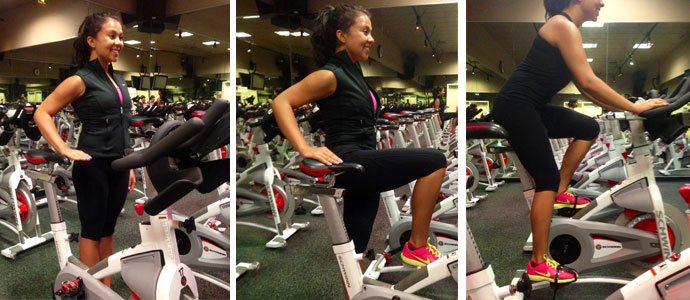
Step One: Saddle Height
Bike saddle height
The purpose of this adjustment is to put you in a comfortable and powerful riding position, where your leg is lengthened as much as possible when the pedal is at the floor, but you are comfortable in the saddle and feel you can easily reach this bottom-most position. Stand on the floor to one side of the bike, next to the saddle and facing the handlebars. Locate the top of your pelvis by feeling with your fingers for your hip bone or lift your thigh until it is level with the floor and notice where the crease of your hip folds (it will be easiest to use the hip/leg closest to the bike). Adjust the saddle up or down until it is approximately level with this place.

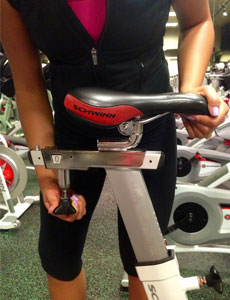
Step Two: Saddle Forward/Backward
Saddle Forward/Back
This saddle adjustment is designed to allow you to align your knee in “neutral” over the pedal, much like when you are correctly performing a squat or a lunge and your knee tracks over your foot, but not beyond your toes. The center of this adjustment fits the average rider, and on some brands of indoor cycling bikes this will mean an accurate fit for more than 80 percent of exercisers. It’s a great place to begin when you are setting up your bike without the help of an instructor. Simply loosen the adjustment that moves the saddle forward and backward and notice how far it moves in both directions. Position the saddle in the middle of this space.

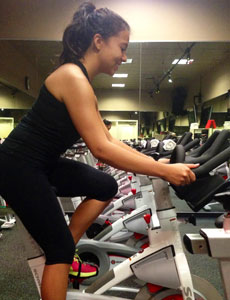
Step Three: Handle Bars
Bike Handle Bars
Adjust the handlebars up or down and, depending on the brand of indoor cycling bike, forward and backward, so that you can reach them comfortably while keeping a tall back, an open chest, relaxed shoulders and a small bend in your elbows. On most bikes there are several places to put your hands on the handlebars. Rest your hands on the spot that feels most comfortable to you, while keeping your fingers relaxed (no gripping!) and your wrists long from elbow to fingertips. You should expect that your favorite place for your hands will vary depending on whether you are seated or standing up.

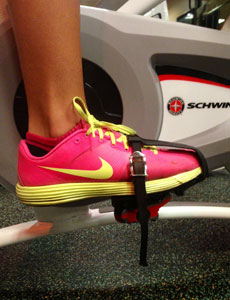
Step Four: Foot Placement & Test Drive
Bike foot placement
Get on the bike and place your foot in the tennis-shoe cage. Position the ball of your foot in the center of the pedal, which will help you maximize each pedal stroke with the most amount of power. Now tighten up the strap. Take a few pedal strokes both in and out of the saddle to test how your new bike adjustments feel. Change anything that isn’t quite right now before living with it for an entire workout and tighten down all the adjustment knobs before beginning your workout. When you are seated, remember to sit toward the back of the saddle where the most cushioning is and point your tailbone more toward the wall behind rather than toward the floor beneath you. This will make for a lighter feeling in your seat and allow you to keep your upper-body posture tall and tension free as described above.


Source Julz Arney Julz Arney embodies all-out energy and motivation! As an ACE-certified Group Fitness Instructor with 22 years in the fitness business

Monday, 5 January 2015

Indoor Cycling and Spin Classes - How to Get the Most From Your Workout

The topic of spin classes came up at our local health club a few days ago. During the course of a few minutes of very interesting conversation, one thing became clear. People either love indoor cycling, or they hate it! There seems to be very little middle ground.
If you're looking for a low impact cardio workout, indoor cycling is one of your best options. But just like any fitness activity, you'll want to make sure you're stacking the deck in your favor for the best odds of success. There are a few essentials to consider if you want to get the most benefit from your cycling workout.


The first time I participated in a spin class, I'll admit to being just a bit intimidated. All of my fears were unfounded though, just as soon as I embraced a few key concepts. In fact, most people I've talked to who didn't enjoy the classes ultimately didn't get the most from their workout, leading to disappointment and not trying again.

Here's three tips for indoor cycling participants:

1. Make sure you're wearing proper clothing, and keep that water bottle handy. Running shorts and sweats are not designed for indoor cycling. Get yourself some biking shorts, or at least wear shorts with extra padding and comfort in the inner thigh area to prevent discomfort. As for water, you'll want to be ready to consume plenty, both during and after class.
2. Remember, this workout is about you and not what other participants are doing. All too often, it's easy to get caught up in the enthusiasm of the class, despite what your body might be telling you. Listen to your body and follow suit. Make adjustments as necessary.
3. Make sure your seat is adjusted properly. This is the most common mistake in spinning classes. Your seat should be at a height where your knee angle is about 85% straight during the downstroke. If your seat is too high or too low, you'll risk injury and you won't get the most from your workout either. If you need help determining the proper height of your seat, ask your instructor for guidance.
Finally, ask yourself about your fitness level, and be honest with your response. Intensity levels in spin classes vary, and some can be too intense for beginners. Don't be discouraged. Instead, modify the workout to your level and make a goal to increase your capabilities over the following weeks and months.
If you're just starting, consider working on your form and conditioning on a stationary bike before participating in a spinning class. This way, you can increase your fitness level and get acclimated to indoor cycling. In just a few short weeks, you'll be ready for a great spin class workout!
Jim Hofman is an author who lost 25 pounds in six months just from adding spinning classes to his workout regimen. For more tips, strategies, and recommendations, be sure to visit Jim's recommended resource site devoted to biking and indoor cycling http://www.cycling101.info

Source: Jim Hofman / http://www.cycling101.info / Ezine 988746

Thursday, 4 December 2014

7 Major Benefits of a Spin Class

One of the best indoor workouts is a spin class. Below are 7 reasons why you should incorporate spin classes into your weekly workout routines.

You can train all year long – Spinning is great, because it can be done all year long...and it's indoors. That means you'll enjoy a bike ride without having to navigate through crazy drivers, pot holes, ice, rain, or strong winds. A 30-45 min spin class is equivalent to about 8-10 miles. A full hour, depending on how fast you pedal, can give you closer to 13 miles!

You workout harder to awesome music – Each instructor uses a different flavor of music. So whether you like pop, hip hop, oldies, rock, or a mixture of everything you can try out new instructors to see who has a similar taste in music to you. However, no matter what type of music is played, you’ll always get a great workout and feel pumped, since all spin classes use high tempo songs to get your legs moving.

Burn a ton of calories with interval training – Another great thing about spin classes are that they use interval training to rotate between sprints, hills, time out of the seat and rest periods. You'll keep your heart rate up the whole time without being overly fatigued. Interval training also gives you the highest calorie burn for the amount of time spent working out.


 Tone more than just your legs – Spin classes tone more than just your legs. You need to use your core when you are pedaling out of the seat in order to stabilize your body. You also activate your glutes when spinning to deliver a fully toned lower body. At both Ravenswood and Edgewater fitness centers we offer several spin classes that also include a yoga or strength training section to give participants a full body workout.

Ride at your own speed – While our instructors encourage participants to ride faster and with more resistance every class, participants are in full control of their resistance and speed levels. This makes spin classes perfect for all experience and fitness levels.

Give your joints a break – Spin classes give your joints a nice break from other classes like bootcamp, tabata, and zumba that use a lot of high impact exercises that can put a lot of pressure on your joints.

De-stress and Re-energize – Exercise in general relieves stress and provides energy. However, spin classes in particular allow participants to get lost in their workout, since the movements are simpler and require little concentration.

Sunday, 23 November 2014

Spin Class 101


I've found that the best classes are the ones with an instructor whose style you like the best and who plays the best music.  If you've never taken a spin class, just arrive a few minutes early and talk to the instructor.  They will help you adjust the bike to your height and explain how to dial up or down the intensity.  You can go at your own pace though and work as hard as you feel comfortable. 
Spinning is such an awesome workout and not just for your legs.  Some teachers have the participants do push-up motions on the handlebars, etc.  Unless you sneak out of the class early, you are pretty much guaranteed a good 45-minute workout.  Being in a class definitely helps you keep going, as opposed to when you're on your own, you might have quit earlier.  I've read that spin class burns between 400-600 calories and, depending on how fast you pedal, a 40 minute class is the equivalent to 15-20 road miles.  
My word of caution is definitely bring a large bottle of water with you to class- and a towel.  It gets pretty sweaty- in a good way!  Oh, and you might be pretty sore in the "crotch region" after the first couple of classes- sorry, no real way to avoid that, but you can buy padded shorts or a seat pad that actually does help.  I've used one before, but then forgot to take it off the bike seat/saddle and left it behind. You don't need special shoes, regular tennis shoes work fine, but if you get to liking the class so much and you're doing it often, they do make special shoes that clip into the pedals as opposed to your regular tennis shoe being strapped to the pedal.

One more thing, about group classes in general- if you find one you like and start going regularly, you'll end up seeing the other "regulars" and it gets to become kind of a connection-sharing thing.  You become friendly with the other members and get used to meeting up with them at class and that can be inspiring and fun to have a regular group of people to workout with.  You never know who you'll meet- just sayin.
 

Thursday, 13 November 2014

Know Before You Go: Spin Class


Hop on a bike without a helmet? Mom would definitely shake her head. But there’s an exception to every rule: Indoor cycling (aka “spinning,” its trademarked name) is a cardiovascular, butt-kicking workout that takes us on a stationary but sweaty ride of our life. Read on to learn what makes this bike different than hopping on an ordinary two-wheeler.

You Spin Me Right Round — The Need-to-Know

More intense than a stationary bike (and that 3rd grade tricycle), indoor cycling keeps things cool with bumpin’ music and a killer class atmosphere. Expect to sit tight for 30 to 75 minute sessions, which can burn up to 900 calories (take that, Bikram yoga!). The intensity varies throughout the class, thanks to changing up body position, pedal speed, and resistance. And get ready to listen up: The instructor will yell out instructions to imitate a real ride of climbs, sprints, and coasts. The best part? Most bikes can track mileage, pulse, and calories burned to record progress throughout the class. In some special classes, the pedaling is even mixed with upper body workouts, resistant bands, or a themed adventure (Michael Jackson tribute, anyone?).
Spinning® is definitely no ride in the park, though. It guarantees to amp up VO2 max (the rate oxygen is carried to the muscles), a sign the body is being pushed . All that pedaling will tone up muscles, too, working the quads, hamstrings, glutes, calves, and core. Studies have also found that indoor cycling can help shed unwanted pounds and potentially ward off migraines, while keeping impact on the joints to a minimum . Now that’s a #winning combo.

Ride or Die — Your Action Plan

Whether you’re a spin class newbie or simply brushing up on the etiquette, here are some tips for a successful joyride:
  • Suit up. The body will definitely work up a sweat, so throw on moisture-wicking clothes to keep cool n’ dry. As for the feet, cycling shoes are required for some classes, but normal athletic kicks will work fine in most cases.
  • Take a seat. If it’s an option, reserve a bike online to guarantee a spot in the class. Otherwise, get there early to snag a seat! And newbs, don’t head straight to the back: Getting a bike up front will make it easier to follow along.
  • Adjust your saddle. Create the perfect fit on the bike. The right height on the seat is when one leg is at a 30-degree angle at the bottom of the pedal stroke. The seat should also be able to slide forward or back depending on what feels best. As for the handlebars, position them so the neck and back doesn’t strain. And strap or clip in the feet: The balls of the feet should rest on the center of the pedal and the kneecap should be aligned directly with the center, too.
  • Know the numbers. These bikes have a different kind of lingo: Some instructors call out numbers for different hand positions on the bars. Gripping the center of the bar is usually “Position 1,” home base for warm-ups and cool downs. “Position 2” is where the hands will be for most of the class — right on the bar that crosses the body. And “Position 3” is normally only used when standing and climbing up those “hills.”
  • Insist on resistance. There are no real gears to change, but there is a resistance knob (or computer!). This will control how hard the muscles need to work to increase RPM (that’s bike talk for revolutions per minute).
  • Towel off. Keep a towel draped over the handlebars for easy access — we’re sure that face may need a wipe off here and there. And swigging water is encouraged mid-ride to stay hydrated (although the spin n’ sip may take some coordination…).
  • Choose wisely. Love the club? Choose sessions with dimmed lights or a disco atmosphere. Or, if seeking more adventure, opt for classes that bring the outdoors to the studio. Studies show the fun factor is increased when the mood is juuust right .
Indoor cycling puts things in full gear with its awesome tunes, control over resistance and speed, and overall intensity. Hop on to the nearest bike and give this class a go!

Source
Indoor cycling specialist and co-owner of Pedal NYC Ray Wallace