Showing posts with label Plank. Show all posts

Tuesday, 1 September 2015

Body Weight Workouts for a Strong Body

Bodyweight workouts are very misunderstood and under-estimated ways of enhancing muscle tone and strength. Many trainers and fitness seekers can't see past traditional bodyweight workouts consisting of push-ups, pull-ups and dips.
 
 Both men and women can follow body weight workouts and get great results that are in line with fitness goals ranging from slimming, shaping and toning to strengthening and lean muscle building.
A big hurdle for most people to get over when considering body weight workouts for fitness is the question of, "How can a body weight workout routine replace one that uses weight training and machines?"

It is easy to see how psychology can be an obstacle in trying to help people understand that properly structured bodyweight workouts can be better than traditional weight-lifting and exercise machine workouts. Traditional workouts offer many variations, almost endless actually. Where as bodyweight workouts rely on creativity mixed with a good understanding of how the body functions and what exercises stimulate healthy and safe fitness progress.
 

Many fitness pros believe that body-weight workouts offer just a limited amount of exercise options and are very general at best, meaning that there is no ability to target and isolate specific muscle groups during a bodyweight workout. This is a big mis-perception that prevents many fitness success stories from ever becoming a reality.

Here's the reason why. When people get into the 'health club mentality' of only being able to workout with equipment, weights and machines, they set themselves up for many episodes of 'falling off the program' and failing. Bodyweight workouts eliminate this excuse.


Here's an example where bodyweight workouts are a million times more effective than regular old gym workouts. You go on vacation or you go out of town on business, or maybe to visit family for several days. So many times these events become excuses for people not sticking to their fitness plan because they 'couldn't go to a gym'. With a well-rounded, bodyweight workout program this excuse is not valid.

The right body weight workouts can be done anywhere and anytime. They can be done at home, the office, a fiend's house or even on a play-ground. And in terms of effectiveness - I can only say through personal experience with my own bodyweight workouts and those of the people who I have trained that when planned properly and followed consistently, bodyweight workouts can be even more effective than most weight lifting or machine based workout programs.

Body weight workouts offer 'fitness veterans' - a refreshing, eye-opening alternative to the those repetitive weight and machine training programs. Even more importantly, bodyweight workouts offer sedentary fitness beginners a safe, non-intimidating and effective method for starting a home based fitness program with a high probability for success.

Whether you are just beginning or you've been 'pumping the weights' for some time now, give some consideration to the benefits and advantages of properly structured body weight workouts and how they can help you move forward in your fitness and conditioning goals. Open up your mind to the possibility of a bodyweight workout being a part of your overall fitness plan and see what happens. You'll be very pleased and maybe a bit surprised with the results you experience.

 Damian@FitnHealthy

Tuesday, 3 February 2015

Boot Camp-inspired Plank Workout


Military fitness training is, first and foremost, warrior fitness and focuses on four key components. Each of these components is necessary to develop a total, well-trained and prepared warrior:
  • Physical training creates strength and stamina,
  • Emotional and mental training instills desire, follow through and motivation.
  • Technical training brings in knowledge and skill of execution.
Basic combat fitness is functional and begins with pre-exercises that prepare the body. These conditioning drills and exercises can be performed anywhere, require no equipment, can be used with large or small groups, and are adaptable to individual fitness levels.
For your warm-up, begin at the head and move down the body:
  • Turn your head left and right, floor to ceiling, right and left; next, do head circles.
  • Do shoulder rotations to the front and to the back, with arms relaxed to the sides of the body.
  • Make loose fists and rotate wrists forward and backward.
  • Twist the torso to the left and right, allowing the arms to freely swing around the body.
  • Place both hands at the small of the back and gently rotate the hips in each direction.
  • Place both hands on the knees and make gentle knee circles in each direction.
  • Place one foot on point and rotate the ankle, first in one then the other direction; switch feet and repeat.
THE WORKOUT
Perform the following exercises to cadence (six to 10 reps), timed (45 seconds per exercise with 15 seconds of active rest for four rounds; rest one minute between rounds) or at will (complete 100 reps total—20 per exercise at your own pace).
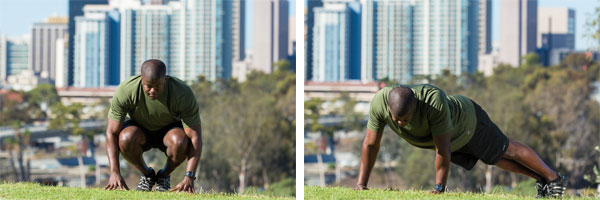
Diagonal Squat Thrust (4-count movement)
diagonal squat thrust
Starting Position: Standing
Squat and place your hands on the ground, shoulder-width apart. Thrust the feet and legs diagonally backward to the left to high plank position. Maintain an engaged core and keep the body rigid from head to heels, with feet at a 45-degree angle to the hands. Jump back in to the squat position, return to full standing (starting position) and repeat, alternating right and left, for six repetitions. To modify, thrust straight back for count 2 or step back each foot to assume plank position.
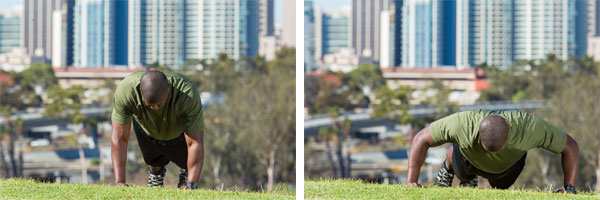
Left and Right Push-up (4-count movement)
left and right push up
Starting Position: High plank, with feet together and thumbs touching
Move your right hand to the right and lower your body low to the ground while keep your core fully engaged. Raise your body (push up) while moving the right hand back to the starting position. Repeat this move on the left side; continue to alternate right and left.
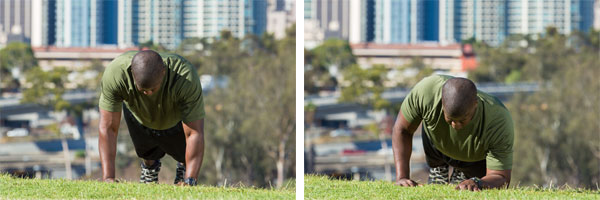
Alternating High and Low Plank (2-count movement)
alternating high and low plank
Starting Position: High plank, with wrists directly below shoulders, core engaged and body rigid
Take the right forearm down to a low plank and then bring the left forearm down to low plank. Press the right palm into the ground and return to high plank and then repeat with the left palm. Repeat high and low plank movements with minimal body shifting (some is necessary).
Low Plank Hip Tap (4-count movement)
low plank hip tap
Starting Position: Low plank with feet together
Maintain a low-plank position and twist the torso to the left, tapping the right side of the hip on floor. Return to low plank and then twist the torso to the right, tapping the left side of hip on floor under body. Return to low plank and repeat. This movement works well with cadence or at will. Try to keep your heels together and keep the upper-body shifting to a minimum.
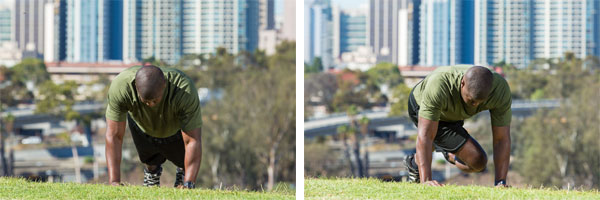
High Plank Cross-body Knee to Opposite Elbow (4-count movement)
high plank cross-body knee tap
Starting Position: High plank with feet a comfortable-distance apart
Keep the core engaged and a firm high-plank position as you bring the right knee to the left elbow, shifting the body slightly forward. Rotate the right hip toward the floor, with the foot, knee and ankle at a45-degree angle, hovering just above the floor. Return to the starting position and repeat on the opposite side. This exercise is ideally performed at cadence to ensure proper execution and purposeful movement.
Note: When these exercises are performed as a circuit or at cadence, run in place, slow march/step kick or perform side straddle step/power jacks or jumping jacks between each exercise.
Finish your workout with the following conditioning exercises, which are performed while lying supine on a mat.
1. Cross the ankles, interlace the fingers and fully extend the body, inhaling and holding for a count of three; exhale, relax and repeat four times.
2. Extend the right arm out, perpendicular to the body. Bring the right knee across body, using the left hand to hold it in place. Count to 10 and release. Repeat on the other side.
3. Bring the right arm across the chest and hold it with the left hand for eight counts. Release and repeat with the left arm.
4. Bring both knees to the chest and roll slightly side to side to release the low back.
5. Lie completely relaxed, palms up, if desired, eyes closed. Allow the body to completely relax for a full minute.

Source :  Valetta Stewart V.R. Stewart

Monday, 24 November 2014

25 Must-Try Medicine Ball Exercises


Time to get schweddy with some balls! Medicine balls, that is. Available in varying sizes and weights (some up to 150 pounds!), these weighted spheres can help improve muscular power and sports performance . The balls can be thrown and caught (don’t try that with a dumbbell!) making for explosive medicine ball movements that can improve overall athletic ability .
Plus, they’re super old school. Hippocrates used sand-filled animal skin pouches to help patients recover from injuries almost 2,000 years ago (clearly he was on to something). When choosing a weight, pick a ball that’s heavy enough to slow the motion (slower than if you weren’t using any weight at all), but not so heavy that control, accuracy, or range of motion take a hit (or the poor guy next to you).
Reps and sets will depend on intensity and fitness levels, so for most of these moves, we recommend aiming for three sets of 10-20 reps with good form. For those more focused on power and speed performance, switch it up with 3-5 sets of 3-5 reps (applying max force and max speed into every repetition ). Of utmost importance: Be aware of your surroundings. These balls can be a weapon of sorts, so pay close attention to the people (and pricey equipment) around you. Alright then, let’s go balls to the wall.

Full Body

  1. Rock and Roll Up: This one is a toughie at first to coordinate, but hits all the major muscle groups in one powerful move (byahh!). Lie down, back to the mat, with knees bent. Hold a medicine ball on the ground with arms fully extended overhead. Pull the knees into the chest, preparing to use the weight of the ball (and the strength of your core!) to help catapult you to a controlled squat position, then standing. Next, slowly lower back into a squat, and ease back to the floor, butt first before lying back down. Don’t get too comfy though: The goal is to rock and roll for 10-12 reps.

2. Lunge With Twist: Come on baby, let’s do the twist! Engage that core, standing hip width apart with shoulders relaxed. Holding a medicine ball a few inches in front of the chest, step forward into a lunge with the right leg. (Safety first! Keep the knee from sliding forward past the toes.) Get deep into that lunge, making sure the front thigh is parallel with the floor, then with extended arms, reach the medicine ball to the right, rotating the torso at the same time. Maintain the lunge and return to center. Come to standing, then lunge with the other leg (and rotate to the left this time). These can be done in place, or moving forward as walking lunges. Do the twist for 10-12 reps per side.

3. Lunge With Overhead Press: Stand with the feet together, holding a lightweight medicine ball in front of the chest in both hands. Lift the right foot off the floor, bending the knee, and hold this position for one count before stepping forward into a lunge. With the bodyweight shifting to the right leg, reach the medicine ball straight overhead (try to avoid pulling a matrix move). While still in the lunge, pull the ball back to the chest, and bring the front leg back to the starting position. Lunge for 10 reps per leg.

4. Squat Press and Throw: Heels grounded, come to a squat position (as if sitting in an invisible chair). Drive through the heels to jump, and throw the ball straight up as high as possible — then get the hell out of the way! (a quick step back should do the trick). Let the ball drop to the ground. Press it out for 10-15 reps.

5. Reverse Swing: This move could be as disastrous as throwing a bowling ball the wrong way, so read carefully. Stand with the feet hip-width apart. Hold a medicine ball directly in front of the chest, with the elbows pointing down toward the floor. Lower into a squat, keeping the back flat, and head facing forward. Reach the medicine ball back between the legs. Ready for the fun part? Explosively swing the ball up overhead to the point that it reaches behind the head and neck (just don’t throw it backward!). Keep the abs contracted as the ankles, knees, and hips extend. Bonus: Throw the ball to the ground (and watch out for your face!). Ball so hard for 10-12 reps.
 

Legs & Glutes

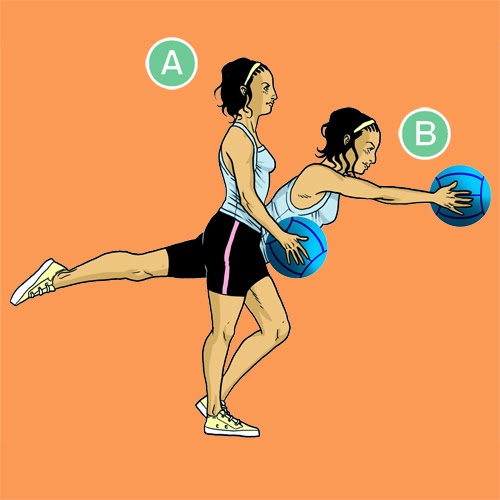
 6. Reaching Romanian Deadlift: This one takes balance, and a little breathing room to fully extend. Stand on the right leg, with a medicine ball in both hands. Bend the right knee slightly, and hinge forward at the hips, extending the left leg straight back (and for an extra challenge, extending the arms overhead). Feel like a ninja? Check! The body should now form a straight line that’s perpendicular with the standing leg. Return the extended leg to the floor, and repeat for 10-12 reps, then switch legs.

7. Step Jump: Hold a medicine ball to the heart, and never let go (Jack), while straddling the middle of a low bench or step (make sure it’s sturdy!). Drop into a squat until the tush makes contact with the bench. Stand about six inches from a low bench or platform, and jump up onto it so the feet land in a natural, wide stance.. Carefully jump back down to the start position. Jump up for 10-12 reps.

8. Circle Squat: Stand holding a medicine ball at the right hip. Circle the ball overhead toward the left, while stepping out the left leg to into a squat (just like a sumo wrestler). Circle the ball all the way to the right side of the body, while still in the squat, then step the feet back together, and circle the ball back to the right. Repeat 8-10 times through, then switch directions.

9. Single-Leg Squat: Stand with feet hip-width apart, knees slightly bent. Lift the right foot off the ground and extend it forward. Hold a medicine ball in front of the bellybutton. Lower the body into a squat position, sitting back into an imaginary chair with the knees safely positioned over the feet. Return to start position, and switch legs. That’s one rep. Get your squat on for 10-12 more.

10. Single-Leg Butt Lift: We’re warning you, this one really puts on a show. Lie on your back and place the sole of the right foot onto the medicine ball. Thrust the hips to the sky (very Jane Fonda-esque) with the left leg straight in the air, with all your weight supported by the right foot and the shoulders. Hold for one count, then slowly return to the start position with the butt on the matt, and repeat for 10-12 reps on each side.
 

Chest and Back


11. Medicine Ball Push-Up: Drop down and get ballsy. Starting in a traditional push-up position, toes tucked under, place your palms on the medicine ball, and shift your bodyweight forward until in plank position. Keeping the core tight, and the head aligned with the spine, slowly lower the chest toward the ball (woof!) until it nearly touches, keeping the elbows pinned tightly at your sides. Finish the move by pressing upward through the arms until they’re fully extended. Need an adjustment? Pop the knees on the mat and push it real good for 10-12 reps.

12. Weighted Superman: Lie face down on the mat with arms stretched out in front, holding onto a lightweight medicine ball (try starting with 4-6 lbs). Slowly raise the arms and legs up as high as possible, engaging the back muscles. Hold the position at the top for a few counts, all the while pretending you have a cape around your neck. Lower the body back down to the mat and repeat for 12-15 reps.

13. Lying Chest Toss: Since two balls are better than one, this move enlists a pair. Lie face up on a stability ball with the head and shoulder blades resting on the ball’s center, and knees bent at a 90-degree angle (the torso should be parallel to the floor). Keeping the neck in a neutral position (not straining forward or hanging back), hold a medicine ball with both hands just above the chest, with the elbows bent and pointed out to the sides. Push the ball out, in line with the chest, (like a classic chest pass) and toss it straight up toward the ceiling. Be extra careful not to toss the ball too hard. (Just remember: What goes up must come down.) Repeat for 12-15 reps.

14. Rolling Push-Up: If 9th Grade phys ed is in the past, then you know what push-ups are all about. Adding in a medicine ball quickly morphs the upper body-blaster into an even more challenging move. Get into high-plank with a medicine ball under one hand, and lower the chest toward the floor to perform a push-up. Return to high-plank and roll the ball to the other hand. Roll out 8-10 reps, or as many as possible maintaining good form.

15. Wall Pass: Find the nearest med ball-safe wall (when in doubt, always ask the gym’s staff which areas are fair game). Stand about 3-4 feet in front of it, holding a lightweight medicine ball with both hands. Get into an athletic stance, with a slight bend in the knees, and the core engaged. Bring the ball to the chest, and firmly throw it at the wall (get that aggression out!), and catch the ball on its return. Your mission: Balls to the wall for 12-15 reps — without taking off another gym goer’s head.


Shoulders and Arms


16. Ball Fly: This can get a little tricky as far as balancing goes, but we promise you’ll look like a total champ once you’ve got it down. Lie face up on a stability ball with the neck and shoulder blades resting on the ball’s center, and knees bent at a 90-degree angle (torso parallel to the floor). Now it’s time to really put on a show: With the abs engaged and hips raised, extend the arms, holding a lightweight medicine ball to the ceiling. Shift the ball to the left hand, and slowly lower the ball until the left arm is parallel with the floor (maintain a slight bend in the elbow). Bring the ball back to the center and shift the ball to the right hand (do the same thing on this side) to complete one rep. Repeat for 8-10 reps to really feel the burn. 17. Shoulder Press: This move is one of the easiest for beginners, but can be amped up with a heavier ball. Hold a medicine ball at the chest (about an inch away, right in front of the sternum). Extend the arms to the ceiling, reaching the ball overhead, and slowly lower the ball back to the start position. Easy peasy, right? Press it out for 12-15 reps.
18. Figure 8: This is totally like ribbon dancing, just probably not as graceful. Stand with feet about shoulder-width apart. Hold onto a medicine ball with both hands to one side of the head, with arms fully extended. Slowly move the medicine ball in a fluid, controlled motion, forming the figure 8. Repeat 8-10 reps through clockwise, then switch directions. This one can be deceivingly tiring, so try it with a lighter ball first.
19. Triceps Extension: Stand in a comfortable stance, or sit tall in a chair, with the core engaged. Hold a medicine ball in both hands with the arms extended overhead, inner arms grazing the ears (resist the urge to lurch the arms forward and make an elephant noise). Next, bend the elbows, lowering the ball behind the head until the arms form a 45-degree angle (or as far as feels comfortable). Squeeze the triceps to straighten the arms, bringing the ball back to the starting position. Pump out 12-15 reps.
20. Bicep Curl: Stand with feet shoulder-width apart, holding the med ball in both hands at the chest. Keeping the elbows close to the body, lower the ball toward the ground until the arms are fully extended. Then curl the ball back up to the chest. Lower the arms back to the starting position. Curl for 12-15 reps — just never at the squat rack.

Core

21. V-Up: How To: Lie flat on your back, legs extended (but try not to snooze on the mat). Reach the arms overhead—à la first thing in the morning stretch—with a medicine ball in both hands. Engage the core to lift the hands and feet simultaneously so the body forms a  “V” position. At the top of the “V,” pass the ball from the hands to the feet. Squeeze the ball between your sneaks, and slowly lower the arms and legs back down to the floor. Return to the “V,” and pass the ball back to the hands. That’s one rep. Wipe the sweat from your brow. Repeat for 8-10 more.
22. Overhead Slam: Stand with your feet shoulder-width apart, and knees slightly bent. Hold a medicine ball in both hands, and lift it overhead. Then bend at the hips (slightly hinging forward), careful not to arch the back, and slam the ball on the ground directly in front. Ask fellow gym-goers nicely if it’s OK to slam on. And don’t slam toooo hard (control is key). Retrieve the ball and keep at it for 10-12 reps.
23. Straight-Leg Sit-Ups: Ready to take the standard sit-ups up a notch? Lie flat, back to the mat, with a medicine ball in both hands. Extend the arms straight so the ball is directly above the hips. While keeping the legs together, raise them directly over the hips to the ceiling (so the body forms a giant “L”).  With control, return to the start position and bust out 12-15 reps.
24. Hay Bailer: Kneel on the right knee, (with the left foot back, toes curled under) to form a 90-degree angle. Hold a medicine ball in both hands close to the body while keeping the torso tight, and perpendicular to the floor. Bring the medicine ball toward the right hip, while keeping the rest of the body forward, then transfer it diagonally up and across the body (Think: John Travolta in Saturday Night Fever). Hold this position for one count before returning to the start position. Repeat the movement in the opposite direction with the right foot forward. (Pro tip: The more the arms are extended, the harder the move is). Bail that hay for 12-15 reps.
25. Toe Touch: Touching your toes just got even trickier. Lie on the floor, holding a medicine ball in both hands. Extend the arms overhead, with shoulders back and down to the mat. While keeping the legs together, raise them directly over the hips to the ceiling (so the body forms a giant “L”). Next, bring the ball overhead (keep the neck in a neutral position throughout), and reach it as close to the toes as possible. Crunch the upper body to the toes for 12-15 reps.

Source http://greatist.com/fitness/25-must-try-medicine-ball-exercises