Showing posts with label TRX Group Training. Show all posts

Monday, 26 October 2015

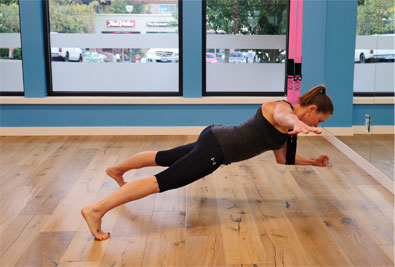
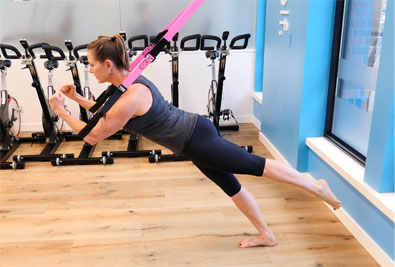
7 TRX Plank Variations for a Stronger Core

The word “core” is thrown around so often in today’s movement classes, it’s almost lost all meaning. The core doesn’t mean just your abdominals or the front of the body. It means the entire trunk, front and back, including the hips. 
The goal in this series of exercises is to help train and create core stiffness, which means the muscles of the core adequately support the spine. Dr. Stuart McGill, a leading back and spine researcher, puts it this way: “Core stiffness is essential for injury prevention. Core stiffness is essential for performance enhancement. Core stiffness is not optimized in body-building exercises. Core stiffness requires dedicated training.”
The plank is one of the best ways to train for core stiffness. Be sure your clients have mastered the basic plank, whether from their feet or knees, before moving on to the following variations featuring the TRX Suspension Trainer. 

TRX Rotational Ward


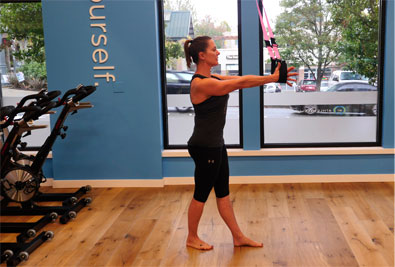
Adjust the Suspension Trainer (ST) to fully lengthened and stand with the right side of the body to the anchor. With the arms extended from the chest and the hands inside of the foot cradles, line the elbows up to the anchor point. Stand in an offset position, with the right leg in front of the left. Build the plank by corkscrewing the shoulders, feeling the lats engage. Push down into the floor for full lower-body engagement, and squeeze the legs together. With the shoulders packed, pull the ST taught, keeping tension throughout the body and the ST. Keep the eyes on the horizon, and be mindful if form begins to suffer. Remind your client that he or she has to stay intentional on the plank position. This becomes a game changer for each exercise.

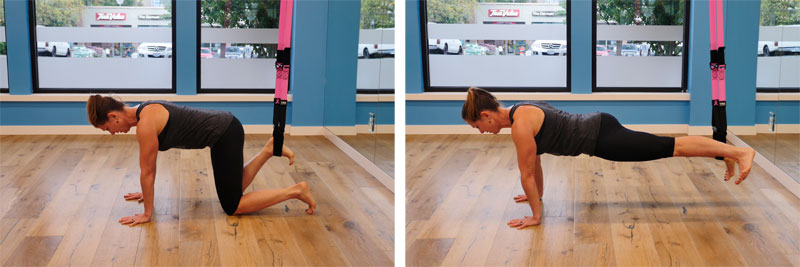
TRX Plank (hands or forearms)


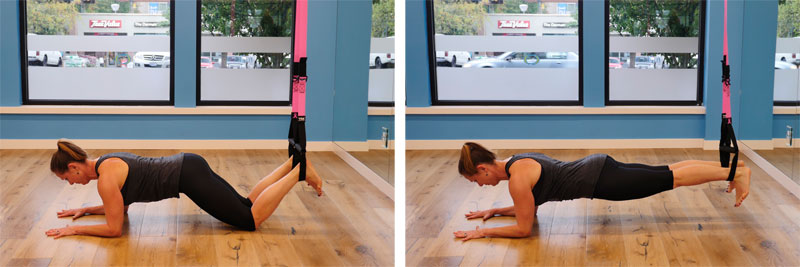
Adjust the ST to mid-calf. Face away from the anchor, place the toes in the foot cradles and assume a table-top position with the hands under the shoulders. Corkscrew the shoulders until a solid packing is felt around the shoulder girdle. Keeping the torso rigid, press the feet into the foot cradles and lift up into a plank position. Keep the feet flexed and the glutes, legs, torso and shoulders fully engaged. Hold the plank for 8 to 10 seconds. Continue as long as a perfect plank can be maintained. Rest and repeat, if desired.

TRX Side Plank (hands or forearms)


Adjust the ST to mid-calf and lie on one side with the hip in line with the anchor. The leg closest to the anchor is right in front of the back leg. Place the elbow or hand under the shoulder. Corkscrew the shoulder to create a shoulder pack. Flex the feet and squeeze them together; lift up by pressing into the foot cradles. Look straight ahead and hold the plank for 8 to 10 seconds; rest, reset and lift back up. Continue as long as a perfect plank can be maintained. Rest and repeat while lying on the other side.

Side-angle Plank (opposite arm extended)


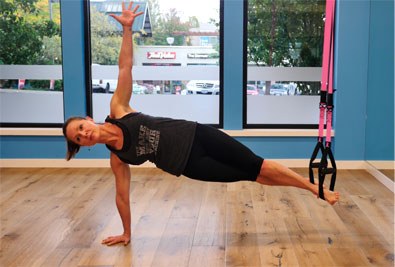
Adjust the ST to mid-calf and lie on the floor while facing the anchor point. Set the right forearm into both foot cradles. Use the left arm to help set up the plank and stabilize the position. Corkscrew the shoulders to pack and spread the legs a little wider than shoulder-width apart. Press down into the foot cradles; don’t allow the torso to rotate. Extend the left arm to shoulder height. Hold this plank while lifting and tapping the left arm to the floor. Repeat on the other side.

Forearm Plank (leg elevated)


Adjust the ST to fully lengthened and stand facing away from the anchor. Place the forearms into the foot cradles, keeping the elbows in line with the shoulders. Corkscrew the shoulders to create a pack, and keep the ribs pressing down toward the hips. Create a rigid torso and step toward the anchor to provide enough load to be challenged yet still maintain a perfect plank.

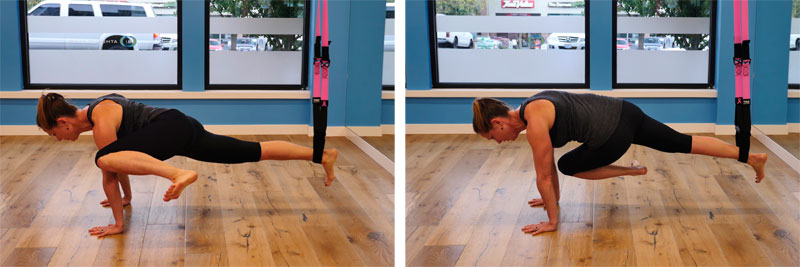
Single-Leg Plank with Alternating Elbow Tap


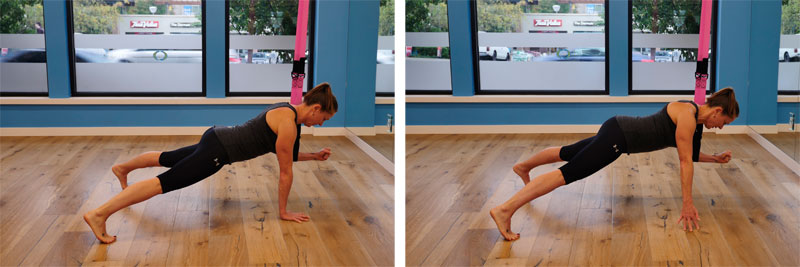
Adjust the ST to mid-calf. Face away from the anchor and lie on the floor with the hands beneath the shoulders; place the right foot in the foot cradle. Corkscrew the shoulders to pack them. From a table-top position, press down into the foot cradles and assume a plank position. Draw the right knee to the right elbow and hold for a beat. Keeping the knee high, rotate to the left elbow and hold a beat. Return to the right elbow.  Continue as long as a proper plank can be maintained and then repeat with the left knee.

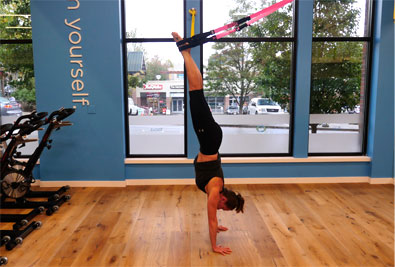
TRX Handstand


Adjust the ST to mid-calf and place the handles in single-handle mode. Stand facing away from the anchor and place the right foot in the foot cradles. Walk the hands away from the anchor until the ST is very taut. Continue walking back until the right leg is extended. Press the floor away, keep the shoulders set and lift the left leg to meet the right. While in this handstand position, think about keeping the shoulders away from the ears and tension in the core. Hold as long as a proper plank can be maintained and repeat with the other leg.

Source : ACE Elizabeth Andrews


Wednesday, 2 September 2015

Which Is Better For Muscle Mass? Full Body Workout Vs. Split Routine

Full body workouts versus split routines for goals of maximizing muscle growth. There are many possible ways for you to lay out a weekly training routine for muscle building. 
You could do full body workouts multiple times per week, do various 3, 4, and 5 day split routines, or you could simply alternate days between upper body and lower body workouts. But which approach is going to be superior for gaining muscle at the fastest rate while building a well-rounded, well proportioned physique? 
Full Body vs. Split Routines

There seems to be a bit of a push recently in favor of a full body routine, especially for beginners. Since muscle protein synthesis is only elevated in a given muscle for around three days after it's been trained, more and more people seem to be in favor of higher training frequencies as a way to maximize growth. Also, it is a fact that muscles do seem to adapt to higher training frequencies by recovering at an increasingly efficient pace over repeated sessions. Therefore, it would seem to make sense that just hammering every single muscle three days per week would be the best way to go. Now this does look good on paper, but in the real world it's really not that simple. Split routines are quite a bit better than full body workouts if your primary goal is optimized muscular hypertrophy, and to build a complete well-balanced physique. 


So before we outline the specific reasons why we think this is the case:

First off, we're not saying that a full body approach doesn't work. All we're saying is that it's probably not the very best option available. Any workout routine that allows for progressive overload over time is going to produce no worthy sized gains. A full body workout can obviously accomplish that.

Secondly, based on the goal of maximizing muscle growth for the serious trainee. Full body workouts are definitely a viable option in a variety of cases, especially if you're interested in gaining muscle, but not necessarily at a maximum level.

Full body workouts are suitable if you're just looking to improve your overall health and fitness, and you want to include a resistance training program in your plan. Additionally, it would be recommended if your goal is fat loss, and you want to employ a faster-paced circuit training style workout to maximize calorie burning, while still providing decent stimulation to your muscles. Or if hypertrophy is not your main concern, and you're more focused on developing total body strength and functionality. For example, if you are a power lifter or athlete. 
From a muscle-building perspective

So now that we've covered that, let's go over a few key reasons why a full body workout is actually inferior to a split routine from a pure muscle-building perspective.

A full body workout does not allow for complete focused development of each individual muscle group. If you truly want to optimize your total body gains, you usually need to perform at least a couple of different exercises for each muscle group in order to target the various functions of that muscle. Now a full body workout is usually not going to allow for this. There's no way that you can enter the gym, and fully cover all the necessary movements that are needed for your chest, shoulders, biceps, triceps, and your back, because they are made up of many individual muscle groups. Also your quads, hamstrings, calves, and abs all in one workout session is just not going to happen. Unless you want to be at the gym for many hours on end. Even then, it just isn't practical from a strength and energy perspective, which brings me to the next point. 
A full body routine will likely make your workout too long. It won't allow you to maintain peak mental focus and strength from the start of your session all the way to the end. So even if you were able to train your entire body in a single workout, it would likely require you to be in the gym for an unreasonable amount of time, like in excess of 2 hours. Even if that specific time frame is not an issue for you, the necessary mental focus and energy that would be required to make sure that every single muscle is training with equal intensity is just not going to be there for the overwhelming majority of trainees. Which ever muscle groups are being trained toward the latter half of your session would inevitably suffer, and so would their resulting development. 

Disadvantages of a full body workout (bodybuilding perspective)

A full body workout may prevent you from utilizing enough total training volume per muscle group. Not only will a full body routine likely prevent you from including all the necessary movements that are needed in the order to maximize your total body gains, but it will also probably prevent you from performing enough total training volume as well. Your muscles need to be overloaded in the gym by training with weights that are either at or beyond their total capacity. They also need to be put through enough overall metabolic fatigue, which is largely a function of the total number of sets that you perform. Even if you performed just four total sets for each of the major muscle groups that was previously listed, that alone would be a workout that totals around 32 sets.

The risk of over training with a full body workout

A full body workout is going to increase the chances of burn out from overtraining. Yes, the concept of over training was probably exaggerated in the past, and we now know that most hard training bodybuilders and athletes can recover much more effectively than was once thought. Nonetheless, let's assume that you are able to hit every single muscle group using all the necessary exercises and sets. Throughout multiple hour sessions several days per week, this is still going to be very taxing for most people, and in addition to this, training the same muscle group three times a week will also likely put your joints under an excessive amount of stress as well. 


Additional accessory work

Finally, a full body workout is going to make it a lot more difficult to include additional accessory work if necessary. Things like external rotations for the rotator cuff, or specific core work that you need to do or stay focused for. A basic full body workout is going to be hard enough to execute on its own, without even considering additional accessory work.

What split routine will achieve that a full body workout will not:

#1 It's going to allow for complete balanced development of all your body's major muscle groups.

#2 It will limit your workouts to a reasonable time frame, and allow you to maintain peak focus and energy throughout the entire session.

#3 It's going to allow you to utilize total volume per muscle group in order to maximize overall metabolic fatigue and overload.

#4 It's going to prevent you from burning out in over training, and allow you to easily include additional accessory work in your program if necessary.

Not to mention that a split routine is just downright more fun to execute for most people. Not only is an enjoyable training session a good thing in itself, it's also going to make it more likely that you'll stick to your program over the long run. 
So what type of split routine should you choose?

Well there's no end to the number of different ways you can figure this out. We personally prefer to split the muscles up over three different sessions. As a quick recommendation, here's one good way to go about this: a legs-push-pull structure is a good solid way to do things. Legs on day one, chest, shoulders, triceps on day two, back and biceps on day three. Just perform the workout routine 4-5 days per week, rotating through each muscle group as you go. This is a more realistic, sustainable, enjoyable, and effective approach to gaining muscle over the long run, compared to performing a full body workout multiple days per week.
Source Mike Asara

Tuesday, 11 August 2015

Circuit Training Explained

Combining several exercises in to a single, high energy, workout can lead to great results for anyone looking for a quick, intense, method of building muscle and losing weight. When you combine targeted exercises for women in short intense, limited break workouts, you are circuit training!
What is it?
In Circuit training you perform a series of exercises with a very short rest period between exercises. The point is to not allow enough time between sets for complete recovery.
Why Circuit Training?
- increased work capacity 
- increase in cardio fitness 
- increase in endurance
- mental toughness 
- positive changes in body shape and composition
Why does it work?
Circuit training falls under the metabolic training category of exercises. Metabolic training refers to the amount of work done over time. For example, Cardio training is just one type of metabolic training. In contrast, strength exercises such as maximum strength and maximum speed training are not considered metabolic types of training. Generally speaking, metabolic training and max intensity training are not compatible with each other. This is why circuit training does not make you faster or stronger.
However, it can accomplish these two things:
1. It helps release growth hormones. It is hypothesized that growth hormone release allows for rapid fat loss with limited muscle atrophy. This is why circuit training can be effective at helping you burn fat while maintaining your muscle size.
2. It also leads to an increased buildup of lactic acid. The accumulation of lactic acid is not a pleasant feeling and even makes some athletes feel nauseous. We've all seen the people in the gym, or even doing physical work, that push so hard they become physically sick.
The benefit is that your body learns to deal with and compensate for the acidosis and this leads to increased strength endurance. In simple terms, this allows you to perform at maximum exertion for longer periods of time.


 When is it most effective?
Circuit training works best:
- in the pre-season to increase work capacity 
- in the off season to maintain work capacity, 
- if you are out of shape and want to improve your overall fitness
Building a Circuit Training Routine
Circuit training combines a group of strength training exercises with limited recovery time between each exercise. In many exercise routines up to 2 minutes is allowed, in circuit training it can be as little as 30 seconds. Barely enough time to move to the next exercise. The primary goal of a circuit training workout is to build up lactic acid and trigger the release growth hormones in your body. Done properly, you should see an increase in capacity and endurance but not an increase in either strength or speed.
When you design a training circuit, choose exercises that work large muscle groups such as back or legs and that do not require much coordination or skill. This is because your form will be a challenge to maintain as you become more fatigued. If you feel nauseous, stop. The goal is not to make yourself become sick. When you have completely rested, on your next workout, increase you amount of time you rest between exercises until you can complete your circuit. Once you can complete the entire circuit you can begin to reduce the rest intervals.
Circuit Training VS Weight Lifting:
The Benefits of Circuit Training
One of the least appreciated advantages circuit training has over weightlifting is simply time management. When you less than an hour to get in a good workout, a well thought out and designed circuit or two can be done very quickly and still provide you with huge health benefits.
Additionally, since there is so little rest time between exercises your heart rate stays elevated and you continue to burn calories long after your workout is over and you have moved on to other parts of your day.
This is on top of being able to lose weight while improving your strength endurance and maintaining your overall strength and muscle size.
The Benefits of Weightlifting
Weightlifting builds strength and size. Done through high reps and sets with low weight exercises, you build your overall strength. Done through low reps and sets with higher weight exercises, you build your overall size and mass. Weightlifting also increases bone density and strength, creates greater energy and higher metabolic function, better balance and often you perform better at sports.
The exercises you put together into a training circuit can create an effective workout routine for any woman looking for results that deliver and a body that you dream of. Hard work and staying on the program is also a huge factor when trying to achieve the desired results, but a solid, well put together workout routine is paramount.

Source Flavia Del Monte | GO 

Tuesday, 4 August 2015

Circuit Training Explained

Combining several exercises in to a single, high energy, workout can lead to great results for anyone looking for a quick, intense, method of building muscle and losing weight. When you combine targeted exercises for women in short intense, limited break workouts, you are circuit training!
What is it?

In Circuit training you perform a series of exercises with a very short rest period between exercises. The point is to not allow enough time between sets for complete recovery.

Why Circuit Training?

- increased work capacity 

- increase in cardio fitness 

- increase in endurance


- mental toughness 

- positive changes in body shape and composition

Why does it work?

Circuit training falls under the metabolic training category of exercises. Metabolic training refers to the amount of work done over time. For example, Cardio training is just one type of metabolic training. In contrast, strength exercises such as maximum strength and maximum speed training are not considered metabolic types of training. Generally speaking, metabolic training and max intensity training are not compatible with each other. This is why circuit training does not make you faster or stronger.

However, it can accomplish these two things:

1. It helps release growth hormones. It is hypothesized that growth hormone release allows for rapid fat loss with limited muscle atrophy. This is why circuit training can be effective at helping you burn fat while maintaining your muscle size.

2. It also leads to an increased buildup of lactic acid. The accumulation of lactic acid is not a pleasant feeling and even makes some athletes feel nauseous. We've all seen the people in the gym, or even doing physical work, that push so hard they become physically sick.

The benefit is that your body learns to deal with and compensate for the acidosis and this leads to increased strength endurance. In simple terms, this allows you to perform at maximum exertion for longer periods of time.

When is it most effective?

Circuit training works best:

- in the pre-season to increase work capacity 

- in the off season to maintain work capacity, 

- if you are out of shape and want to improve your overall fitness

Building a Circuit Training Routine

Circuit training combines a group of strength training exercises with limited recovery time between each exercise. In many exercise routines up to 2 minutes is allowed, in circuit training it can be as little as 30 seconds. Barely enough time to move to the next exercise. The primary goal of a circuit training workout is to build up lactic acid and trigger the release growth hormones in your body. Done properly, you should see an increase in capacity and endurance but not an increase in either strength or speed.

When you design a training circuit, choose exercises that work large muscle groups such as back or legs and that do not require much coordination or skill. This is because your form will be a challenge to maintain as you become more fatigued. If you feel nauseous, stop. The goal is not to make yourself become sick. When you have completely rested, on your next workout, increase you amount of time you rest between exercises until you can complete your circuit. Once you can complete the entire circuit you can begin to reduce the rest intervals.


Circuit Training VS Weight Lifting:

The Benefits of Circuit Training

One of the least appreciated advantages circuit training has over weightlifting is simply time management. When you less than an hour to get in a good workout, a well thought out and designed circuit or two can be done very quickly and still provide you with huge health benefits.

Additionally, since there is so little rest time between exercises your heart rate stays elevated and you continue to burn calories long after your workout is over and you have moved on to other parts of your day.

This is on top of being able to lose weight while improving your strength endurance and maintaining your overall strength and muscle size.

The Benefits of Weightlifting

Weightlifting builds strength and size. Done through high reps and sets with low weight exercises, you build your overall strength. Done through low reps and sets with higher weight exercises, you build your overall size and mass. Weightlifting also increases bone density and strength, creates greater energy and higher metabolic function, better balance and often you perform better at sports.

The exercises you put together into a training circuit can create an effective workout routine for any woman looking for results that deliver and a body that you dream of. Hard work and staying on the program is also a huge factor when trying to achieve the desired results, but a solid, well put together workout routine is paramount.

Source Don Pascoe | EZINE 

Sunday, 12 July 2015

TRX Suspension Training-Questions and Answers

If you are looking for a way to get into great condition, build muscle and create impressive strength, the TRX suspension trainer is a challenging tool for fast and effective whole body workouts.
The TRX is a new form of suspension training that has a lot in common with gymnastics ring work, but allows the user to perform a much wider variety of exercises, particularly to enhance sport specific movements. The TRX was designed to place heavy demands on the muscular system for building muscle and increasing strength, while being easy to adjust to a lighter metabolic conditioning workout.
The best part is the TRX can be set up just about anywhere, from a hook in the garage, to the monkey or pull-up bars at the park, to a bedroom door.
How Do I Set up the TRX?
In the house, use the door anchor designed specifically for the TRX. the 'X' mount hardware from FitnessAnywhere, or a heavy duty eye hook screwed into a joist or stud. The TRX weighs about 2 pounds and fits into a small carrying bag, so it can be used anywhere you go and anchored to a variety stable objects, even your car door if you're on the road.
The TRX adjusts quickly and precisely to move from one exercise to another with minimal lag time. This also allows people to adjust the height for their individual needs. When setting up the TRX, be sure the mounting point is high enough to allow a full range of movement for the workout routine.
What are Suspension Exercises?
The diversity of suspension exercises is limited only by your imagination, but because of this, the movements are best put together in a comprehensive routine with a specific desired result. Some of the exercises performed on a suspension trainer are:
-Chest flyes
-Pushups at all angles
-Body Rows
-One arm pushups
-Atomic Pushup burpees
-Pistol Squats
-Bicep curls
-Tricep extensions and presses
-Leg Curls
-Dips
-Miuscle-Ups
and many, many more.

What Muscles Does the TRX Engage?
The TRX forces the core to stabilize or contract through multiple planes of motion. In addition, the entire upper body is worked either directly, indirectly, or in combination with other muscle groups. The hip complex, quads and hamstrings get plenty of work with exercises like the Sprinter's Start, Scorpion, leg curls and various lunges.
The suspension trainer excels at training not just strength and endurance, but increasing agility and mobility as well. As with traditional gymnastics work, the entire core is affected from every angle when using the TRX.
The difference is in the addition of comfortable foot straps that allow users to perform exercises like the Swinging Pendulum and pike, among others. People are often surprised at just how sore they are after their first workout with the TRX, especially throughout their midsection, but it's just that effective.
Can I Use the TRX as my only method of conditioning?
Theoretically, yes. But as with any piece of equipment, your body will eventually adapt and need a change to continue progressing. No one method does it all, and the TRX should be combined with any other tools or forms of exercise needed to get in peak condition.
Is Suspension Training for Everyone?
Suspension training can be done by anyone, including supervised children, people rehabilitating injuries or advanced athletes. As with any exercise, if in doubt, get a physical exam before beginning. Younger children and older adults with joint problems should consult with a doctor and a professional TRX trainer.
Source : by Chris Montgomery

Sunday, 21 June 2015

Fitness Boot Camp - A Great Help...

Fitness Boot Camp - A Great Help

The fitness industry is getting popular these days due to the increase in demand of health fitness. This is because people are becoming conscious about their body shapes. Now, there is an increase amount of boot camps, gyms, personal trainers and fitness centers in the market. Most people work according to the instructions of their trainers to get best results. 


Excellent results cannot be attained only by joining the gym, it requires better programs and techniques. Fitness camps are the best option to get the best value for money and best professional results.
Personal trainers:
Personal trainers cost 5 times more than these fitness camps. In this fitness area you cannot get attention like personal trainers, but motivation will be a lot more than trainers. Boot camps will motivate you more to work hard. It will provide you with more encouraging and inspiring environment. So that you can work out more, boost your metabolism and burn your fat and get better fitness shape.
All the fitness programs are not same, you need to select the best one for you. In that case you must keep following points in your mind:

Type of camp:
Different fitness areas are designed especially on the basis of gender. Women prefer to join women based fitness program and men prefer to join men based fitness program. At present, boot camps are described as group training centers. You will find a professional coaching in these centers. Do get the necessary information about the type of training provided in the boot camp.

Skills of the trainers:
Be sure that your trainers are highly skilled. They must be certified by the related authorities. There are national standards for the creation of fitness programs and appointment of the coaches.

Cost:
Another important thing to notice is the cost. Sometimes you find the camps costing less and providing best of opportunities to achieve full fitness for your body.

Nutritional advice:
This is an important area that is ignored by many fitness programs. Without a balanced diet plan you can never achieve the best results. Only training and work out is not enough. If you come across such a boot center that emphasis on the eating habits along with the other training programs then you must go for it.

In a nutshell, fitness boot camp is the most effective way of getting your body in shape. You can see the results easily after a few days. So, better choose this fitness center for your fitness.

Article Source: Yasir_M_Chohan


Thursday, 18 June 2015

TRX is shredding it in the fitness world. I come across people every day who still haven't ever heard of it, much less attempted to dangle from those terrifying yellow straps. As a Certified TRX Instructor, this pains me deep down, because TRX can be such a powerful tool for people to change their bodies. I use TRX on a regular basis with my clients who range in age from 20-85, and there is always an effective exercise that challenges each one of them. 

TRX is a very versatile tool that can be used in a wide variety of different training styles. 

During my TRX classes, I vary the training styles to keep my students interested, however, they're also able to enjoy the different benefits, such as improved strength and stability, better range of motion in their joints, and the high amounts of calories burned. In the rest of this article, I'll talk about what makes TRX challenging and why this is such a powerful benefit of this unique training style.

What Makes TRX Training Different?
TRX training utilizes a common concept - bodyweight exercise - with a very uncommon stability challenge to create a unique, full body workout with every exercise. The TRX straps are suspended from an A-frame structure, door, post, etc to allow the trainee to make each exercise harder or easier just by stepping towards or away from the anchor point. This makes it very easy to increase or decrease the intensity of each exercise. By changing the angle at which you stand relative to the floor and the anchor point, you can make a bodybuilder's veins pop out or teach a newbie the basics of resistance training. Some of you might be thinking that bodyweight exercises just aren't going to be challenging enough if you really want to put on some muscle. This may be true in a normal scenario, but with TRX training, the added stability challenge turns something as simple as a push up into a much more challenging exercise. 

By allowing your arms or legs to move freely in the straps, you make it much harder on your body. These stabilizer muscles often get forgotten and weak due to help from machines, the added stability of a barbell, or a closed chain exercise like a body weight push up. I have also found, through my own training with TRX, that my 1RM (One repetition max) for just about every exercise increases after using it for a few weeks. This is because TRX training strengthens those stabilizer muscles which makes the more structured exercises seem easier.
Another very unique aspect of TRX training is the focus on full body. If you love doing planks, then you'll love doing TRX. Because TRX is all body weight, gravity and angles, you're basically doing planks during every exercise you complete. TRX forces you to tilt your pelvis appropriately while engaging your core to safely align your spine during each exercise. With the right supervision, this can be a very powerful tool for people with back problems or who hate doing crunches or sit ups. A lot of back pain stems from the inability to use your core, which in turn makes the core very weak. After a few TRX sessions with a good trainer, the trainee can learn the basic concepts behind keeping the spine in a safe position. Once those basic principles are understood, the trainee can really start focusing on adding resistance to build muscle mass safely, which may have been impossible otherwise.
Lastly, if you're looking for exercises that will burn calories fast, then TRX is for you! So how do you burn calories fast? One of the best ways to burn calories is to use multiple muscle groups at once during your exercises. With the TRX, even a simple exercise like a Biceps Curl utilizes not only the biceps, but the shoulders, abs, glutes, forearms, and low back. TRX turns an isolation exercise into a calorie burning, muscle building machine!
If you've never tried TRX before, search the gyms in your area for TRX classes. 

SOURCE : Ryan M York | EZine 

Wednesday, 27 May 2015

TRX and Kettlebells Go Head to Head

The most useful exercise tool is the one you enjoy using the most. You choose your exercise equipment based on individual health and fitness or athletic goals and you never put all of your eggs in one basket. Still, if you only have around 200 bucks to spend, and you want a truly effective tool for whole body strength and conditioning, should you spend it on the highly praised kettlebell, or the innovative TRX suspension trainer? 
Exercise Choice
The number and type of exercises you can do with either one is enough to fill a book, and both can build muscle, strength and endurance. Let's evaluate the advantages of each. 

Adjustable Weight
A kettlebell is a fixed weight. However, with the recommended 35 lb. for men and 24lb. kettlebell for women, a lot can be accomplished. Also, while you will want a heavier kettle bell eventually, the lighter weights will always be useful. 
 The TRX is instantly, but perhaps not infinitely adjustable. To increase or decrease resistance, the user can adjust their angle, adjust the straps or try an alternative exercise.
Both pieces of equipment can create significant changes to your physique, whether you want to build muscle or burn off some fat. Both will provide enough variety to stimulate change in the body for a long time. 

Portable
If you can drive to your workout, you can take kettlebells or the TRX. However, the TRX is the winner when it comes to portability. Hence the name €Fitness Anywhere.' Besides, it is the only choice if you want to pack workout equipment on an airplane. At 2-3 pounds you won't notice the extra weight at all. Suspension training is designed to be done anywhere; a hotel room, a park fence, anywhere. 
 
Convenience
If you're workout space is small, you can still use kettlebells. As versatile free weights, they are totally effective even if you have no more than a yoga mat sized space to work with. Kettlebells are pound for pound the best pick-up and start with no warm up workout equipment.
The TRX is easy to use once you have it ready to go. Using their X-mount gives you a permanent anchor point in your workout space, while mounting it with the door anchor gives you a gym anywhere in your home. If possible, choose the permanent X-mount over the door anchor. Personally, the added stability personally gives me more confidence. 

Once it is ready, you can start an easy warm-up and stretch, then transition to harder exercises. This a TRX bonus. If your body needs a light workout, all you have to do is start at an easy angle and work into harder exercises. For a kettlebell warmup, work with a single kettlebell or use an abbreviated range of motion.
*Note: Both choices present an additional challenge. The kettlebell weight is unbalanced, and the TRX forces your body to stabilize to perform the exercises. Each has unique but effective movements.

Exercises
Let's see the difference between some common TRX and kettlebell exercises.
Kettlebell Swing:
Basically a hamstring exercise, doing swings at a steady pace for a few minutes pushes your heart rate sky high.

Hip Bridges:
An equivalent TRX movement would be 'suspended hip bridges' with leg curls. Both work the same muscles, and both demand control of your core during the exercise.

The High-Pull versus the Snatch. The TRX high pull is a great upper back and rear deltoid exercise. The snatch is a breath-catching nightmare that also works the upper back among other things. The difference is the high pull is more suited to building strength, muscle and muscular endurance.
A heavy kettlebell snatch can build strength and muscle, but a moderate weight can be snatched for several minutes, increasing cardiovascular fitness and muscular endurance.

Simple Routines
Because the two pieces of equipment are so different, it is hard to pick a winner. You can purchase heavier and heavier kettlebells, which may be better for building serious muscle and strength. 

Consider these two routines:

-Standing presses, Windmills with a pick-up (pick up another kettlebell from the ground while bending down,) followed by the Renegade Row then the Turkish Get-up.
Start with 5-8 repetitions each and do 3 rounds without resting. An intense workout. Now let's compare an intense routine using the TRX.

Start out with horizontal body rowing or pullups. Switch to suspended dips, then adjust the straps six inches off the floor and do a superset of suspended push-ups and chest flyes. If you need to, perform the flyes at a standing angle. 


This is a tough workout at first, but that is the point. You can progress with these exercises by:
a. change the angle
b. increase the repetitions.

Eventually you may have to add add external resistance, unless muscular endurance is your only objective.

Which exercise tool is better? This depends on your goals. The kettlebell may have greater opportunities to increase resistance over time. This means anyone trying to develop more strength and power would accomplish this faster with kettlebells. On the other hand, to do this you will have to keep investing in kettlebells to a point. 

The TRX suspension training system is portable, and is challenging enough in its own right. Stabilizing your own bodyweight through difficult and sometimes awkward angles can challenge a person for a long time.

So where is the best value for your money? If you want easy portability, movement specific workouts and a kit you can stuff in a backpack, buy the TRX and take it everywhere you go. It's a must-have when you travel, and most of us will be challenged by this contraption for years.

On the other hand, for the satisfying feeling of grabbing some cold iron and heaving it this way and that, you will never regret purchasing a set of kettlebells.

There is probably room in your life, and your home gym, for both. Either way, using TRX and kettlebells consistently will transform your body and get you in the best shape of your life.

Source| Martin Christopher|GO 

Thursday, 16 April 2015

TRX Suspension Trainer - Why It's Far better Then Heading to the Fitness center

  • TRX Equilibrium Lunge - Quadriceps

  • TRX Suspended Pike - Abdominals, hip flexors

  • TRX Suspended Hip Press - Hamstrings, glutes, again extensors


  • If you don't have a TRX nevertheless, get your personal TRX Suspension Trainer!

    Figures have revealed that a lot more than 50 % of U.S. citizens experience from metabolism-connected sickness because of to lack of activity and unhealthy diet regime. In this rapidly-paced, competitive globe, many of us merely do not have the time to go to gymnasium. When they attempted to work out they faced a lot of distinct difficulties. The most significant problem was that they did not have a great deal of workout machines and of study course, there constantly wasn't a fantastic deal of place to work out.

    Possibly you can picture how difficult it must be to consider to workout on board a ship or a submarine. On the other hand, lugging close to a Smith device, Complete Health club or even a Bowflex just doesn't function. As a result, they all set their heads collectively and developed an workout system that was produced from the webbing of their parachutes. This permitted them to complete bodyweight workouts, at many diverse angles. This permitted them to remain in shape and produce their core muscle tissues.

    Nevertheless, if you are not that acquainted with the TRX suspension exercise, allow me inform you that it's primarily a workout gadget that employs your body's weight as the resistance. There is no need for plates, resistance bands, or electrical power rods.

    Considering that its first development it has been constantly enhanced on.
     
     
    Today, the suspension cords have grips connected to make it easier to workout. Furthermore, they are created so that you can simply attach them to a wall, fence or even a tree. At present there are hundreds of different workout routines that you can use with the TRX teaching system. A lot of of the brand identify gyms supply TRX coaching to their members. It has grow to be that well-liked due to the fact it does develop benefits.

    Retain some of these guidelines in brain as you carry on to uncover further TRX suspension trainer reviews.

    Each single a single of us right now is turning into a lot more concerned about our wellbeing. As a outcome many of us have decided on to make adjustments to our lifestyles. Not only are we choosing to try to eat food items that are healthier and more dietary, but we're also starting up to recognize that working out on a regular basis is a necessity instead than an exception. One particular thing's not modified tho' - we nevertheless uncover it hard to suit a regular work out in to our frantic schedules. So it helps make sense that we're looking for options other than likely to the fitness center.

    That's exactly where the TRX Suspension Trainer arrives in... The TRX trainer is a straightforward principle - but awesomely executed. The idea is primarily based on suspension teaching employing your entire body excess weight. Suspension teaching includes a set of adjustable straps and pulleys that are suspended securely from an overhead stage. The TRX trainer can be employed just about everywhere, as lengthy as you have a door, or a wall/ceiling wherever you can attach it to.
     
    Source Enrique Johnston

    Saturday, 24 January 2015

    TRX® Rip Trainer™ Workout with Creator Pete Holman


     Have you tried the TRX Rip Trainer yet? ACE Personal Trainer Pete McCall chats with creator Pete Holman about this versatile training tool and demonstrates a few fun and creative exercises that challenge everything from strength and balance to hand-eye coordination and power.


    Source : American Council on Exercise


    Friday, 23 January 2015

    Core Combos Using the TRX Suspension Trainer and Ultimate Sandbags

    Intrinsic strength is required to perform quality movement, and the TRX Suspension Trainer and the DVRT Ultimate Sandbag (USB) are perfect to begin building strength from the inside out. Here are some great combinations for the core that utilize these two pieces of equipment. These exercises, some of which are quite advanced, challenge all planes of motion. Practice, train, earn the right to progress the movements and add on until the complete combo is mastered. And remember that quality, not quantity, is your goal.
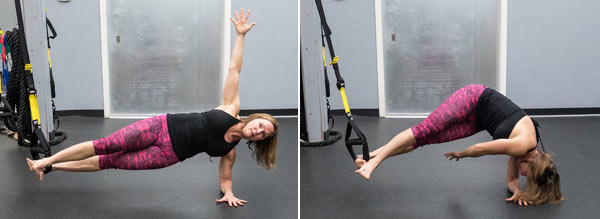
    TRX Plank Series
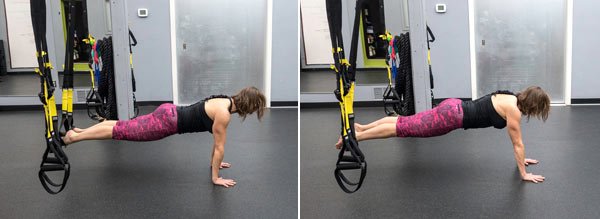
    TRX Plank
    TRX Plank
    TRX Plank
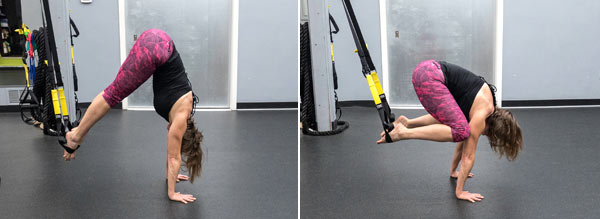
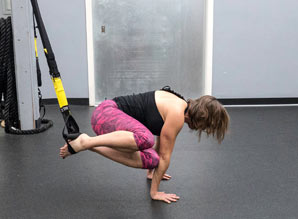
    This combo features the plank, body saw, pike, crow and oblique hold, pressing around and back to plank. Break this up into individual TRX exercises—start with two, then three and so on as you gain strength. Try to move slowly through the combo to provide a greater strength and stability challenge.
    Adjust the straps to mid-calf. Put your toes in and lay on your belly, facing away from the anchor point. With your wrists under shoulders, press up to plank (assume a forearm plank if a full plank is too challenging). Keep your shoulders engaged and don’t allow the hips or neck to sag as you press away from your hands. Begin to pull yourself back to the starting position and press your hips high and your keep your legs straight. Keep your hips pressing toward the sky as you bring the knees in to touch your elbows or triceps. Slowly bring one leg to meet the other, rotating at mid-back, and bring both knees to the elbow. Connect both knees, pressing your thighs together; with control, move your legs back to plank starting position. Repeat on the other side.
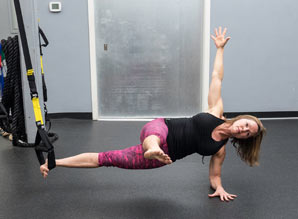
    TRX Side Plank Series
    TRX Side Plank
    TRX Side Plank
    Adjust the straps to mid-calf. Place your left foot in the strap and your right leg in front of the left in the same position as if it were in another strap. With your left elbow under the shoulder, press up into a side plank with your forearm, engaging the shoulder complex. Keep your shoulder engaged as you press against the ground to lift the hips; reach your right arm under your torso. As you reach, continue to try and get more height through hips, keeping your back extended and your neck long. Slowly move back to side plank and hold. While maintaining a strong, stable side plank, move the right leg to 90 degrees in front, keeping the leg straight. Hold and return to side plank. Repeat on the other side.
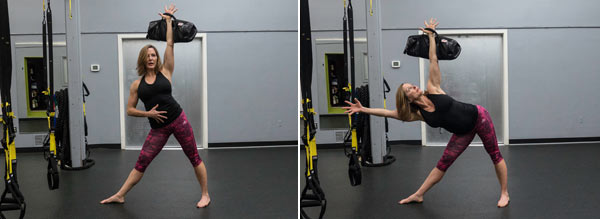
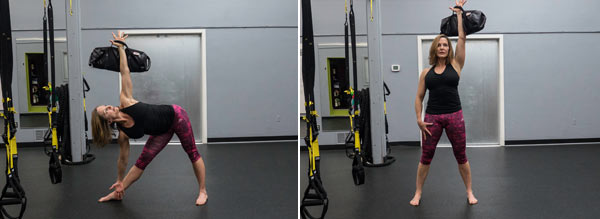
    USB Triangle Pose With Reach
    USB Triangle Pose
    USB Triangle Pose
    Stand with your legs wider than hip-distance apart and hold the USB Core Bag from the single handle or suitcase handle. Press the bag overhead with your left arm, keeping your shoulders down and engaged. Internally rotate your left foot slightly and externally rotate your right foot; face toward the side wall. With a strong arm, keep the USB overhead and your eyes on the USB as you begin to drive the left hip toward the left, reaching toward the opposite direction with right arm; keep the torso long and extended. Reach the right arm toward the floor, but only to the point where you can keep your torso extended. Hold this position for several breaths. Next, reach the right arm toward the wall and hold. Press strongly into the floor and raise to standing; adding a single-arm press at the top. Repeat on the other side.
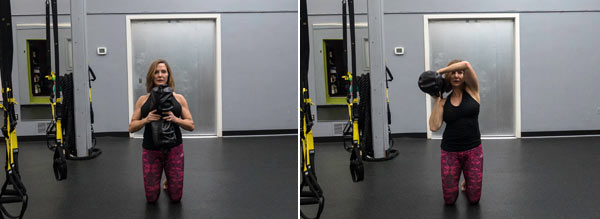
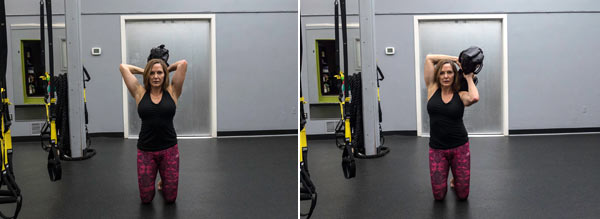
    USB Half-kneeling Halo With Press Out
    USB Half kneeling halo
    USB Half kneeling halo
    USB Half kneeling halo
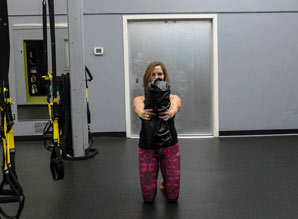
    Place a pad or mat under your knees if you are exercising on a hard surface. Flex your toes and press them into the floor; engage your hips and keep your torso tall. Hold the USB Core Bag around the center, hands in front of your sternum. Lift the right elbow and bring the USB to the left side of your head; move the USB around the head, from the left side to the back, to the right side and back to the front. Don’t allow your head or torso to shift. Complete the circle and then press the USB straight out, being careful not to shift your body weight. Repeat halo sequence with press out and repeat on the other side.

    By Elizabeth Andrews

    Sunday, 28 December 2014

    Is Suspension Training Effective?

    What is suspension training?

    If you’re tired of the same old machines, barbells and dumbbells, there are different ways to challenge your body to burn fat and build muscle.

    Remember, the best kind of exercise and diet program is the one that you are most likely to stick to. Sustainability is key to long-term lifestyle changes. You don’t want to get ripped for the summer and then go back to having a one-pack in the winter, do you?

    Why not stay shredded all year round if you can? Or even if your goal isn’t to get lean, who doesn’t want to be healthy and live longer?

    For some, lifting weights is the only way to go and that’s fine because in some ways, lifting weights is superior for muscle building. However, that’s not the only way to build muscle. In fact, there are other approaches that could be used as an all-around fat-burning and muscle-building protocol. This is where suspension training comes in.

    Suspension training takes body weight exercises to a whole new level and shows that more equipment isn’t necessarily better. Originally developed by a former Navy SEAL, suspension training is a form of resistance exercise that purports to develop strength, balance, flexibility, and joint stability simultaneously. How do they get so much workout for so little equipment?

    Suspension training does this by using a variety of multi-planar, compound movements, while having you “suspended” by a band that hangs from above. Instead of needing an entire gym, the suspension training bands are small and mobile.

    Need to workout on a vacation? You can just pop the bands into your suitcase and go. The low technology, high intensity nature of suspension training makes it a favorite of some fitness enthusiasts.

    Right now, suspension training is gaining in popularity. With fitness fanatics getting bored with the same old strength training and stability ball exercises, suspension training offers a workout that is both new and invigorating. Suspension training workout groups are popping up all over the country, and are quickly growing in size. Chances are, if you walk into any gym in America, you’ll see a pair of yellow colored bands hanging down from above.

    The term suspension training refers to a different approach to strength training that makes use of a system of bands or ropes and webbing called a suspension trainer. This allows the user to work with his/her own body weight.

    Functional Training

    Suspension Training is also a form of functional training, which is a classification of training that involves performing activities similar to those performed in daily life. By practicing these activities, we can better perform our daily activities more easily and without injuries. With suspension training, you utilize your body weight for resistance. This makes it convenient for those who travel often and want to keep fit on the go, as well as those who have limited space in their homes. If you cannot devote a large space to your gym equipment, Suspension Training requires little to no setup and can be dismantled before and after use with ease.
    As briefly mentioned above, suspension training is efficient because it engages several muscle groups at the same time. Think whole body movements for maximum calorie burn. Whole body movements are guaranteed to get your heart rate going, which will help with fat-burning and cardiovascular health. It may be difficult for some people to attain the same heart rate when doing a split-type workout routine because when you are only working one muscle group, your body isn’t working as intensely. So while that may be conducive to your muscle-building goals, it may not be as good for your fat-burning goals, unlike with Suspension Training.

    Is Suspension Training Effective – Suspension Training Exercises

    The exercises for suspension training are not necessarily all that new, it’s just the way you do them. For instance, check out the following exercises. The lunge and press are both staples of the modern gym, but with suspension training, you are adding another level of difficulty.

    Lower Body Suspension Training Exercise

    Let’s say you want to work out your lower body. Suspension training offers a lot of options, but let’s stick with a reverse single-leg lunge. While holding onto the bands at a 45-degree angle, keep your right foot solidly on the ground as you extend your left leg back, bending your right thigh parallel to the ground. Keep your left foot from touching the ground if you want to increase the difficulty. This lunge will work out your hamstrings, quads and supporting muscles in your legs. It will also work out your core, as you are required to use your core muscles to maintain stability.

    Upper-Body Suspension Training Exercise

    How about the upper-body? Try the suspended chest press. Place your hands in the straps and lower your body to a 45-degree angle. Then, just like you’re doing a pushup lower your body down and then back up. In this exercise, you will work out your chest, and once again, your core will be worked out. You can also lower the straps down enough, stick your feet in them and do elevated push-ups. The amount of core strength and stability to execute this exercise will make you think regular push-ups are for wimps.

    Single Leg Squat

    The Single Leg Squat is a great way to add resistance to your legs without increasing the overall load with weights. Those who have difficulty performing back squats because of a weak back would benefit from this exercises. The front squat, which also works out the legs, activates more core muscles and upper back muscles, but many find that they have to increase the weight in order for it to be more effective. This is troublesome for those with pre-existing disabilities or previous injuries, especially back injuries because you have to support the bar on your back during a squat. With a Single Leg Squat, you have the benefits for muscle-building in the legs without the heavy weights and barbells, and it becomes a great full body workout.

    Place your elbows parallel to your shoulders, and with tension on the bands, center your right leg on the anchor point. Mark this spot on the floor as a guide if you have trouble sticking to the same spot. Place the opposite heel on the ground to assist your right leg which is the working leg. Lower your hips down and backwards, allowing the knee of your left leg, which is the assisting leg, to bend. The majority of the weight should be in your working leg, but still some weight to transfer to the assisting leg for balance, or as needed. Drive through your heels and stand tall. Repeat the movement with your left leg.

    Common errors include: a rounded back, over arched back, knees going past the toes, knees buckling inward/outward and not pushing with the heels.

    Bulgarian Split Squats


    Bulgarian Split Squats are very similar to lunges, except your back foot is elevated. This helps with overall symmetry, and helps make sure that you are working both sides independently and equally. Sometimes bodybuilders work hard only to find that once they are shredded and have peeled all the body fat off, that they have several muscle imbalances that impact their physiques.

    Bulgarian Split Squats are like lunges, except the back leg is elevated and placed inside the handle of the training band, while the front leg is in a forward lunge position. Have a wide enough stride that will allow you to go reasonably low, but not too wide that your hip flexors start to hurt. Experiment with different stances because everybody is different, and you want to figure out which is best for you and your body type. Those with longer legs can afford a wider stride, while those with shorter legs may not have to go as low to feel the burn and the stretch in the legs.

    This is arguably one of the most popular core exercises in Suspension Training because it works out the whole core, including the lower back, among other muscle groups. This movement is almost impossible to mess up, so long as you don’t over arch your back and you keep a tight core throughout the movement for better muscle engagement.

    Start by assuming plank position. Place your feet in the handles or the foot cradles with your knees on the floor and your hands outstretched in front of your shoulders. From plank position, hinge at the hips and drive your butt up while keeping the torso straight.

    TRX straps at Mid Length

    Start in plank position—place your feet in the foot cradles, your knees on floor, and your hands under your shoulders. Lower your chest to just above the ground. Keeping your ears, shoulders, hips, knees, ankles in alignment, push back up to plank position then immediately hinge at hips. Drive your butt up while keeping your torso straight. Keep your body tight and engaged and lower back down to a plank position. Try to keep your legs straight and hinge at the hips, not at the back.

    Equipment

    Rings

    Rings are rather challenging and may require some time to learn, especially if you are a formerly sedentary individual with little to no strength. Training with rings requires a strong upper body especially, not to mention a firm grip as well. Rings are better suited for upper body exercises, though you can place your feet in the rings if you wished. However, there are other equipment that could make lower body suspension training easier.


    One of the pitfalls of using rings is the lack of versatility. Like I mentioned earlier, it’s more for upper body because lower body movements are rather limited.

    Suspension Trainers


    Suspension Trainers are like resistance bands. They are composed of handles, a stretchable band, door anchors and ankle straps if needed. TRX bands are almost synonymous with Suspension Training, but keep it mind that you are also paying for the name and the branding.

    http://www.amazon.com/gp/product/B00AFENHNI/ref=as_li_tl?ie=UTF8&camp=1789&creative=9325&creativeASIN=B00AFENHNI&linkCode=as2&tag=fitnhea00-20&linkId=ZAGLYJRNZKYLEHFH
    TRX
    TRX bands are incredibly versatile and are built well. The signature black and yellow color are trademarks of the brand, so be mindful of those things when considering which brand to purchase. It’s a little pricier than the alternatives, but owners of the TRX bands have also mentioned that it’s a little overpriced given when you get, but that the quality more than makes up for it.
    Currently, the TRX home set is priced at around $200.00.


      • Jungle Gym Suspension Training

    Jungle Gym
    The Jungle Gym suspension training set is also similar to TRX bands, but they retail for a fraction of the cost. Also, instead of the black and yellow trademark, the Jungle Gym brand is decked out in black and red. The package includes: one 16 feet of high-density suspension straps with patented two-way steel buckles.
    Currently, the Jungle Gym suspension training set is priced at around $40.00.

    Is Suspension Training for Beginners
    This rigorous exercise system might not be for beginners, however. Some sports scientists have pointed out that people without strong core stability or with weak joint integrity might be prone to injury from suspension training. This can be especially true if there is a history of joint or back injuries. The constant demands that make suspension training effective can be the limiting factor for people starting the exercise.
    However, that doesn’t mean that beginners can’t start building up to suspension training. Start by doing regular strength training with an eye towards suspension training. Need to gain strength in the core? Try some plank positions to begin developing those muscles. When you think you are ready to take on the straps, start by keeping your body at a shallower angle. This will allow you to build up the steeper angles that will put more pressure on your joints.  And of course, when starting any exercise program, make sure you check with your doctor.
    Benefits of Suspension Training
    • Increases your core strength
    When you say “core”, you are referring to the four muscle groups surrounding the organs of our lower torso. The ab muscles strengthen out lower back. Improving core strength will also have a direct impact on your posture.
    • Improves your balance and coordination
    Because you are literally suspended, you make use of more stabilizer muscles, and more muscles recruited translates to great gains in balance and coordination. Whenever we perform intense workout routines, we gain mass, strength, endurance, stability and eventually, enviable abs.
    • Back to basics with bodyweight exercises
    Bodyweight exercise routines are efficient and easy to do. They are perfect for travelling without any equipment at all. Body weight exercises are adapted to our own bodies, so it can be safer, more portable and less expensive to keep up.
    Suspension Training Program / Course
    If you’ve already got a set of suspension training straps in the post or you’re looking to buy some, you’ll probably need some guidance on the best way to burn fat. Suspension Revolution 2.0 by Dan Long might be able to help you. Suspension Revolution 2.0 is a workout program designed to help you burn fat.

    Is Suspension Training Effective?
    Advocates of suspension training point out that during any suspension training exercise, you can’t help but to engage your core to steady yourself. They compare suspension training to doing “yoga on ropes.” This makes the trainee use every muscle in their body, maximizing the time spent exercising. When you try it for the first time, you’ll know exactly what they mean. A simple 10 minutes of suspension training can leave one sore the next day. This also means that instead of using isolated muscles, suspension training uses a variety of muscles together, creating effective movement patterns.

    Rigorous research into the effectiveness of suspension training has yet to be conducted. But if testimonials count for anything, suspension training is very effective.
    Any exercise that can simultaneously exercise the core along with the direct muscle being worked has to be worth its weight.
    There are still some concerns about whether or not suspension exercises are functionally effective, i.e. whether it helps you out in everyday life. But this is can be a complaint of many exercises. For example, when do you have to run for two miles in everyday life? Unless you live in Africa, never. And regardless, if an exercise is fun and gets you excited about going to the gym, then we should consider it effective.

    Source FatLossClassroom.com / TRX.com