Showing posts with label sandbag workout. Show all posts

Thursday, 25 June 2015

Crossfit Kettlebell Sandbag: Amazing Exercise Produces Superior Results

Crossfit Kettlebell Sandbag are outstanding! These kettlebell exercises may be the answer to preserving a home gym or having a pricey club membership.
With Crossfit Kettlebell Sandbag you can establish exceptional gains over conventional exercise methods and conserve lots of area in your home.

The man who teaches Russian Kettlebell training is Pavel Tsatsouline. He is a former Spetznaz fitness instructor. For those who could not know, Spetznaz is the Russian equivalent of the CIA or special forces.
 
As every high-risk representative would want, after researching a few of Pavel's books you can certainly discover ways to have explosive instant power prepared at all times.
But, not everyone is a spy; in reality really few of us are. So what advantages does adjustable kettlebell training have for the typical lady or guy?

Crossfit Kettlebell Sandbag training can be a wonderful means to reduce weight, condition the body, and remain in shape once you get it there with the included benefits mentioned above.

And not just that, adjustable kettlebell exercises may be much better for you than weights. In one of his books, Pavel points out a few of the fitness tests that were utilized to compare kettlebell training to standard exercises.

The kettlebell trainers seemed to be in much better shape according to Pavel. And Pavel would know - You can see a picture of Pavel on his website. The guy is well muscled and toned for someone that stays clear of weight training like the torment.

Mentioning muscle and tone, look into the amazing Ab muscles that Pavel can reveal you how you can develop. Pavel, being an expert in physical training combined with his special experience and insight is completely certified to reveal you all about physical fitness.

Whether you are male or female, Pavel can show you the way to fitness. He has actually likewise gathered for our advantage, what he thinks to be outstanding recommendations in nourishment.
An additional thing I think that is intriguing about Pavel and his work is that he brings his colorful and interesting Russian personality into play. For example, simply think of the title of one of his books, Power to individuals.

I find that title funny, however if I had to discuss why I think it's funny, I'm not sure that I could. Come to think of it, I suspect liberation is in order.

Pavel desires to show us a much better method to fitness and complimentary us from our demand to invest an inordinate amount of time in the gym and spend it more carefully and effectively, so that we can have fantastic physical fitness and time to enjoy it.

As you can see by glancing at his images, Pavel not just knows ways to develop a remarkable body however he also knows how to keep himself versatile at the same time.

Possibly now you can understand why I think this man has some answers to fitness that we may not have the ability to discover anywhere else, nor all in one practical area either.

As constantly, get in touch with a main care physician before embarking on any physical fitness program. This article is for information purposes only and is not to deal with, prevent or detect any physical condition.

Source by George Holzhueter

Saturday, 11 April 2015

Are Two-a-Day Workouts Right for You?

 
 For many people, boys and young men around the country are likely suiting up for two separate football practices a day for a tradition known as “two-a-days.” There are three primary reasons for the two-practice-a-day tradition:
  • Practicing in the early morning and late afternoon is a way to beat the worst of the heat.
  • Two practices a day are required to get the athletes in game shape.
  • Athletes need the extra time and practice to learn and commit complicated plays to memory.
Two-a-day training programs are typically divided into two sessions, one focusing on technical training and the other focusing on tactical training. The first type of training session is referred to as technical training because it focuses on the technical conditioning needed for a specific sport. Technical training can be high intensity to improve overall fitness level and refine sport-specific skills. The second type of training session is referred to as tactical training because it is structured to teach the strategies and tactics that all players need to know to function successfully as a team. Tactical training is designed to be lower in intensity to allow players to learn the movements so they are eventually able to execute plays reflexively as a reaction without needing the time for conscious thought or cognitive processing.
Are two-a-days beneficial for you?
For people with specific fitness goals, could organizing your workouts into two training sessions a day provide any benefit? The answer, of course, depends on a number of variables. To determine whether two-a-day training might be right for your needs, ask yourself the following questions:
What is your existing fitness level?
What is your specific outcome or training goal?
What do you need to improve to be successful and achieve your goal?
And, most importantly, how much time can you dedicate to your workouts?
If your reason for exercising is to improve your general health or overall fitness level, then two-a-days might not be necessary. If the goal is to achieve a specific outcome (whether performance- or appearance-based), then working out twice a day might be the most effective way to achieve that goal.
Here are a few examples where organizing two-a-day workouts might be helpful for achieving a specific goal. Of course, there are a number of variables that would determine the specific training program, so keep in mind that this list is designed to simply provide a few ideas. 
The Olympic Weightlifting Lifts: The Snatch and the Clean and Jerk. Both of these exercises require a high degree of mobility and technical movement skill, as do a number of the kettlebell lifts. If you want to improve your technical skill for specific lifts, consider training for movement skill in the morning and the actual lifting, or specific strength training, in the afternoon. The morning sessions should be bodyweight only to focus on improving range of motion, mobility and dynamic flexibility, while the afternoon workout should focus on the high-intensity training required to improve strength and power.
Adding muscle mass or developing the definition required for a figure or body-building competition requires a high volume of training for both strength training to improve muscle size and low-to-moderate cardio training to burn fat. A two-a-day training schedule might feature body part-specific strength training in the morning to increase lean muscle and definition, combined with an afternoon session dedicated specifically to cardiovascular training for burning excess calories and unwanted fat.
Specific Strength- and Power-based Competitions (e.g., Powerlifting, Strongman or CrossFit). For people training for these types of competitions, two-a-day workouts could be organized into a morning session using external weights to focus on specific strength or power exercises that will be an integral component of the competition. The afternoon session could be focused on bodyweight exercises to improve core strength, mobility or explosive jumping power to support the work being done with the external resistance. 
Obstacle Course Races (e.g., Spartan Race or Tough Mudder). If your training goal is to participate in these races, you might want to split your workouts into morning runs that alternate between distance for aerobic endurance and sprinting for anaerobic strength and afternoon strength-training sessions to improve the muscular strength and coordination required for successfully overcoming the obstacles.
Marathons, Triathlons or Ultra-marathons. If your fitness goals include training for pure endurance races, it might be a good idea to split workouts into two sessions per day to increase the volume of training required for success. For endurance races, it might be necessary to focus on a specific cardiovascular endurance session in the morning for volume training and an afternoon weightlifting session to improve the strength endurance of the legs and core muscles, which can help improve running efficiency and stride rate.

Source Pete McCall MS Ace

Friday, 23 January 2015

Core Combos Using the TRX Suspension Trainer and Ultimate Sandbags

Intrinsic strength is required to perform quality movement, and the TRX Suspension Trainer and the DVRT Ultimate Sandbag (USB) are perfect to begin building strength from the inside out. Here are some great combinations for the core that utilize these two pieces of equipment. These exercises, some of which are quite advanced, challenge all planes of motion. Practice, train, earn the right to progress the movements and add on until the complete combo is mastered. And remember that quality, not quantity, is your goal.
TRX Plank Series
TRX Plank
TRX Plank
TRX Plank
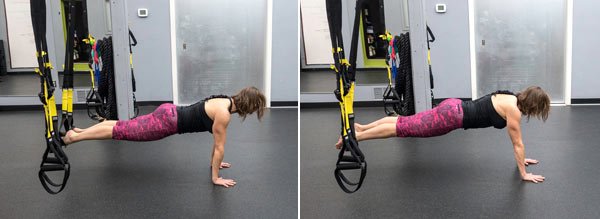
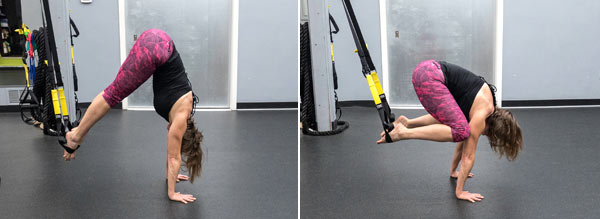
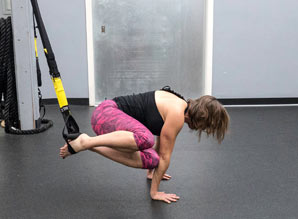
This combo features the plank, body saw, pike, crow and oblique hold, pressing around and back to plank. Break this up into individual TRX exercises—start with two, then three and so on as you gain strength. Try to move slowly through the combo to provide a greater strength and stability challenge.
Adjust the straps to mid-calf. Put your toes in and lay on your belly, facing away from the anchor point. With your wrists under shoulders, press up to plank (assume a forearm plank if a full plank is too challenging). Keep your shoulders engaged and don’t allow the hips or neck to sag as you press away from your hands. Begin to pull yourself back to the starting position and press your hips high and your keep your legs straight. Keep your hips pressing toward the sky as you bring the knees in to touch your elbows or triceps. Slowly bring one leg to meet the other, rotating at mid-back, and bring both knees to the elbow. Connect both knees, pressing your thighs together; with control, move your legs back to plank starting position. Repeat on the other side.
TRX Side Plank Series
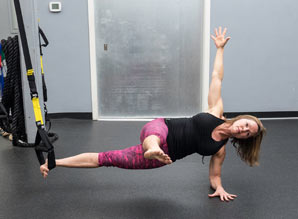
TRX Side Plank
TRX Side Plank
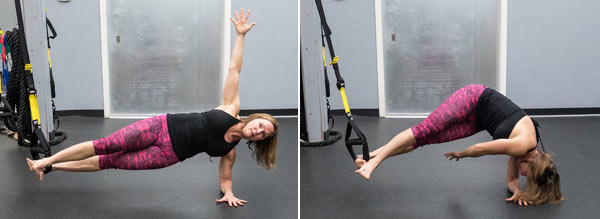
Adjust the straps to mid-calf. Place your left foot in the strap and your right leg in front of the left in the same position as if it were in another strap. With your left elbow under the shoulder, press up into a side plank with your forearm, engaging the shoulder complex. Keep your shoulder engaged as you press against the ground to lift the hips; reach your right arm under your torso. As you reach, continue to try and get more height through hips, keeping your back extended and your neck long. Slowly move back to side plank and hold. While maintaining a strong, stable side plank, move the right leg to 90 degrees in front, keeping the leg straight. Hold and return to side plank. Repeat on the other side.
USB Triangle Pose With Reach
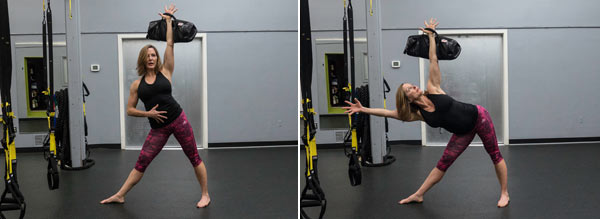
USB Triangle Pose
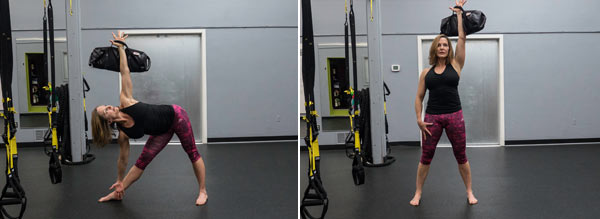
USB Triangle Pose
Stand with your legs wider than hip-distance apart and hold the USB Core Bag from the single handle or suitcase handle. Press the bag overhead with your left arm, keeping your shoulders down and engaged. Internally rotate your left foot slightly and externally rotate your right foot; face toward the side wall. With a strong arm, keep the USB overhead and your eyes on the USB as you begin to drive the left hip toward the left, reaching toward the opposite direction with right arm; keep the torso long and extended. Reach the right arm toward the floor, but only to the point where you can keep your torso extended. Hold this position for several breaths. Next, reach the right arm toward the wall and hold. Press strongly into the floor and raise to standing; adding a single-arm press at the top. Repeat on the other side.
USB Half-kneeling Halo With Press Out
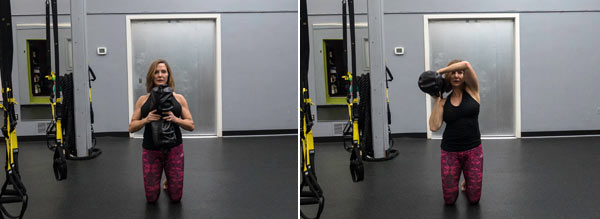
USB Half kneeling halo
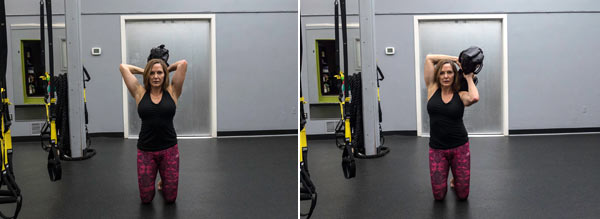
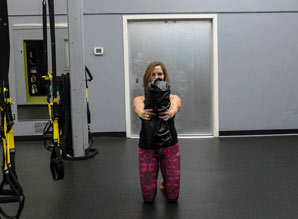
Place a pad or mat under your knees if you are exercising on a hard surface. Flex your toes and press them into the floor; engage your hips and keep your torso tall. Hold the USB Core Bag around the center, hands in front of your sternum. Lift the right elbow and bring the USB to the left side of your head; move the USB around the head, from the left side to the back, to the right side and back to the front. Don’t allow your head or torso to shift. Complete the circle and then press the USB straight out, being careful not to shift your body weight. Repeat halo sequence with press out and repeat on the other side.

By Elizabeth Andrews

Thursday, 15 January 2015

30-minute Ultimate Sandbag Workout

Struggle to find time to train? 

When life gets busy, the first thing many people drop is their workout. “I don’t have time. I’m too busy.” Many people believe that unless they have an hour to work out they might as well just skip their workout and wait until they have time. The irony.
Long-time fitness pro and educator Elizabeth Andrews blows this argument out of the water with a full-body workout using a 25-40 pound Ultimate Sandbag Power Bag


Takes less than 30 minutes. Using Ultimate Sandbags (USB) not only humbles you, they also challenge your strength, stability, balance and mobility, while stressing the neuromuscular system and working the muscles in all planes of motion. In other words, you get a lot of bang for your buck! And you know what that means: Efficiency, with a high metabolic demand. A win-win!
Lateral Lunge to Overhead Press With Single Leg Balance (10/8/6/4 ladder concept)
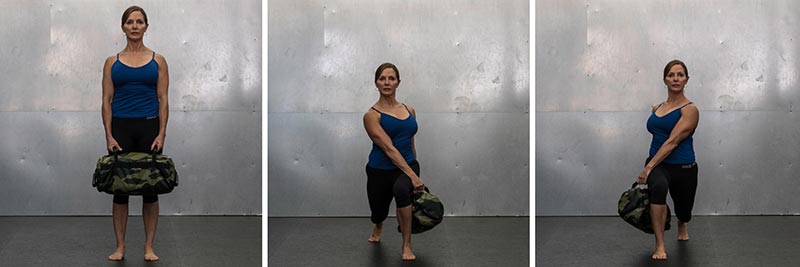
Lateral Lunge to Overhead Press With Single Leg Balance
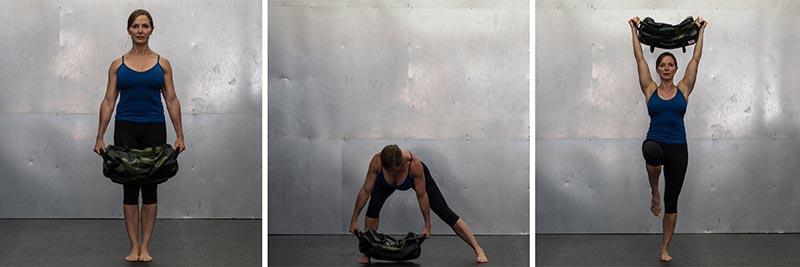
Grab the outside handles and deadlift the USB to the tall position. With both feet facing forward, step to one side and assume a lunge position, keeping the spine tall, shoulders packed and squared (pulling shoulder blades are pulled down and back, using the lats to help stabilize), and the lower tail bone down toward ground. Press off the floor to return to the starting position, cleaning the bag as you move through the pattern. From the starting position, press the bag overhead to extension, bringing one leg up at the same time; hold and balance for one beat. With complete control, lower the bag and leg at the same time. Repeat the pattern on the opposite side. In this sequence, the ladder concept of 10/8/6/4 will be applied. In this case, you’ll start with 10 on the right side, then 10 on the left side. You’ll then completely 8 on each side, then 6 on each side and so on until the ladder is complete.
High Pull (30 seconds)
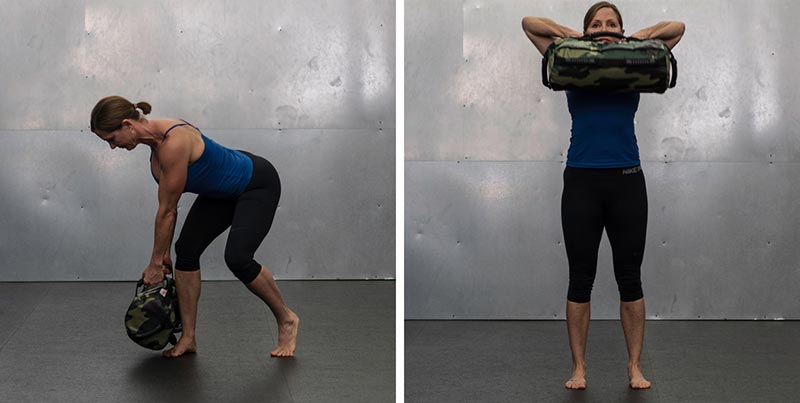
High pull
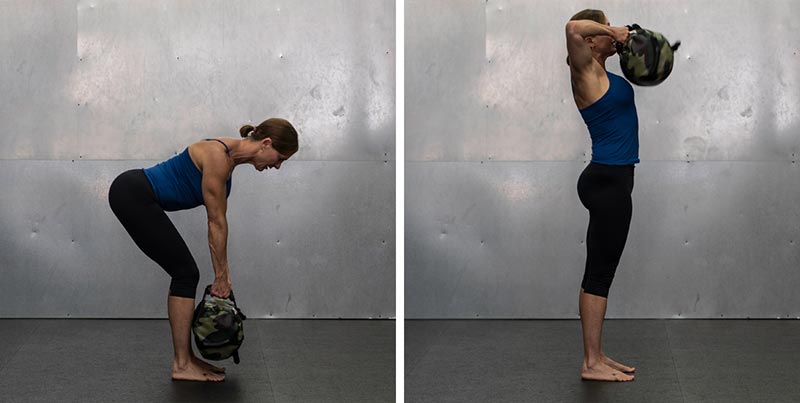
Grab the neutral handles and begin in a deadlift position, hips hinging back behind the heels and the core braced. Explode from the hips, trying to “jump” the USB to chest height, with elbows pointing to the sky. Keep the chest lifted and the core braced, being careful not to flex the back. The bag should stay close to the body throughout entire movement.
Rotational Lunge With Hold at Bottom (8-10 reps on each side)
Rotational Lunge With Hold at Bottom
Grab the neutral handles and stand with the shoulders packed and arms hang­ing freely. Look straight ahead as you step back in a direct line of hip, pressing the ball of the foot into the ground. At the same time, rotate the USB over the front side of the lead leg. Keep the arms hanging—don’t pull on the USB. Slowly lower the back leg and hover the knee right above the ground. Keep the core braced and hold for 15 seconds. Keep the spine tall, the shoul­ders packed and eyes forward. Prevent yourself from leaning forward at the hips by engaging the glutes on the rear leg, which will help increase your stability. Push off the rear leg and bring the USB back to center, maintaining control throughout the full movement. Do eight to 10 repetitions on one leg and then repeat on the opposite leg.
High Pull (30 seconds)
High pull
Repeat the movement described above.
Up/Downs Shouldering the Bag With Alternating Legs (6/4/2 ladder concept)
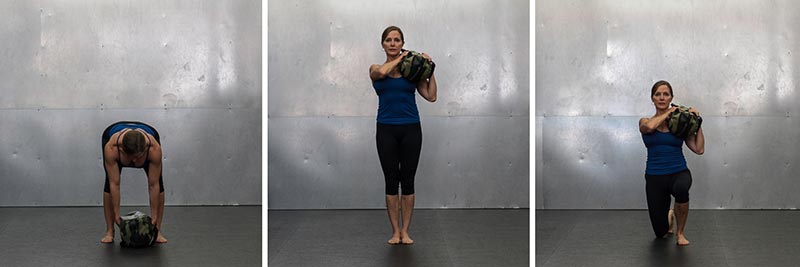
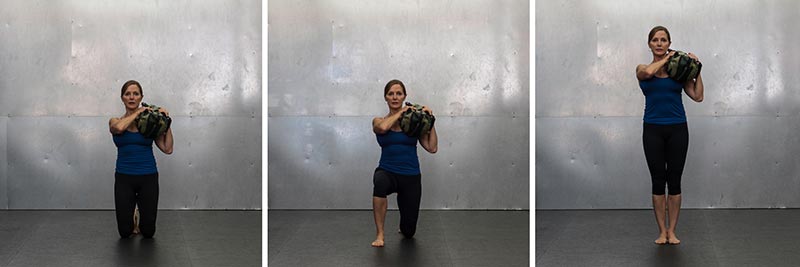
Up/Downs Shouldering the Bag With Alternating Legs
Clean the bag to the right shoulder. Step back with the same leg and drop the knee to the floor. Step back with the left leg, tucking the toes under, to a tall kneeling  position. Step up from the floor with the right leg and complete the pattern with the left leg. Repeat the pattern on the opposite side. Use the ladder concept of 6/4/2 …six on one side, six on the other side then move to four on one side, four on the other and so on until the ladder is complete.
Rotational High Pull (30 seconds)
Rotational High Pull
Grab the neutral handles and begin in the deadlift position, hips hinging back behind the heels and the core braced. Rotate the right foot internally and lower the bag to about knee height. Next, explode through the left hip, finishing through the middle as you extend, and then to the other side and back. Keep the back tall, loading the hip through the movement as you maintain a braced core.

Source By Elizabeth Andrews /Ace